
Publications
- Team Robert -Debré
- Dialyse
- Syndrome néphrotique
- Transplantation rénale
- GEM
- Lupus
- Néphrologie pédiatrique
- Covid
- ERKNet
- Cyrielle Parmentier
CONCLUSIONS: This nationwide study provides robust estimates of pediatric INS incidence in France and identifies geographic clustering and consistent seasonal patterns, suggesting a potential role for environmental and infectious factors.
- Eugene Yu-Hin Chan
CONCLUSION: Rituximab offers reasonable efficacy in young children with FRSDNS, with a trend toward a shorter relapse-free period and more potential complications. Rituximab should be reserved until established treatments are exhausted.
- Gael Cals
CONCLUSION: RTX exerts a suspensive rather than curative effect in SD/FRNS. Prolonged B-cell depletion extends relapse-free survival but is associated with more frequent hypogammaglobulinemia, without an increase in severe infections.
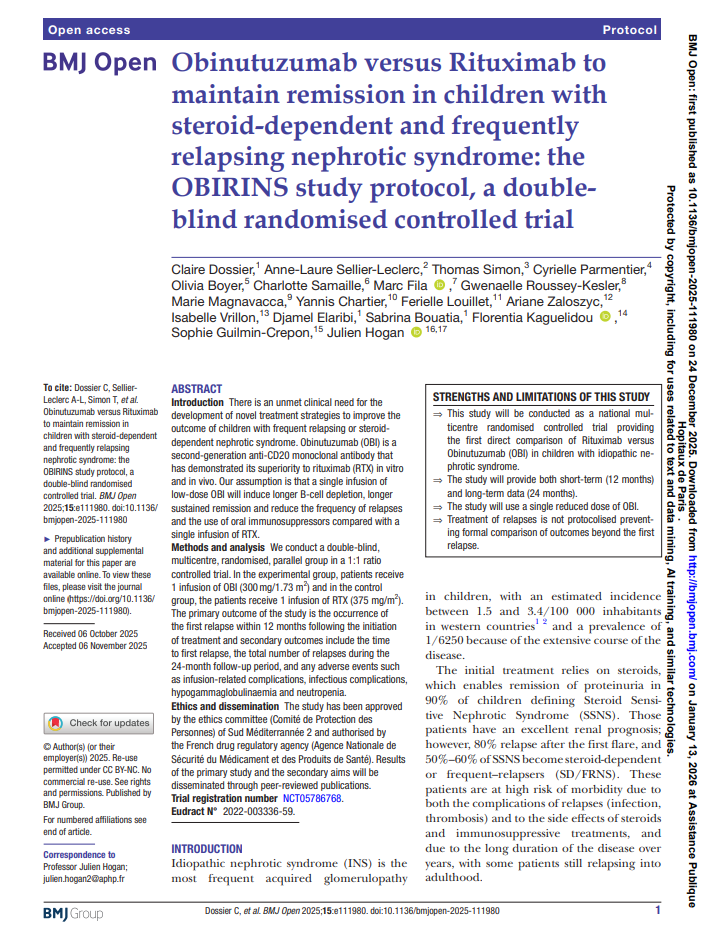
- Claire Dossier
INTRODUCTION: There is an unmet clinical need for the development of novel treatment strategies to improve the outcome of children with frequent relapsing or steroid-dependent nephrotic syndrome. Obinutuzumab (OBI) is a second-generation anti-CD20 monoclonal antibody that has demonstrated its superiority to rituximab (RTX) in vitro and in vivo. Our assumption is that a single infusion of low-dose OBI will induce longer B-cell depletion, longer sustained remission and reduce the frequency of...
- Cyrielle Parmentier
CONCLUSION: Obinutuzumab is an effective and well-tolerated option in the context of ARA, providing prolonged B-cell depletion. Further studies with ARA monitoring are needed to optimize anti-CD20 therapy.
- Claire Dossier
No abstract
- Susan M McAnallen
CONCLUSION: Our study shows unique clinical and genetic correlations of TRPC6-AP, which may enable personalized care and promising novel therapies.
- Alexandra Cambier
No abstract
- Cyrielle Parmentier
CONCLUSIONS: SP are helpful to obtain rapid remission in pediatric INS patients resistant to oral steroids. However, as most SP-sensitive patients need immunosuppressive drugs, mainly CNI and B-cell-depleting agents it could be interesting to discuss the possibility to start CNI directly after the 30-day course of prednisone instead of SP.
- Charlotte Duneton
CONCLUSIONS: Systematic association of IgIA + ECZ is not supported for all neurological STEC-HUS pediatric patients; potential rescue therapy for severe cases warrants consideration.
- Felicitas E Hengel
CONCLUSIONS: In this study, circulating antinephrin autoantibodies were common in patients with minimal change disease or idiopathic nephrotic syndrome and appeared to be markers of disease activity. Their binding at the slit diaphragm induced podocyte dysfunction and nephrotic syndrome, which highlights their pathophysiological significance. (Funded by Deutsche Forschungsgemeinschaft and others.).
- Marion Ferri
CONCLUSIONS: Eculizumab is effective and safe in inducing and maintaining remission in aHUS secondary to anti-FH antibodies and renders reduction of anti-FH titers less urgent. Anti-FH antibody titers decreased in most patients irrespective of the immunosuppressive treatment chosen, so that a strategy consisting of combining eculizumab with MMF monotherapy seems sufficient at least in non-Indian or less severe forms of anti-FH antibody-associated HUS.
- Claire Dossier
No abstract
- Alexandra Cambier
CONCLUSION: cIgAN with minimal proteinuria at time of biopsy might be linked with acute and chronic glomerular lesions.
- Claire Dossier
CONCLUSIONS: These results identified low-dose obinituzumab as a promising treatment option in children with steroid-dependent or frequently relapsing nephrotic syndrome, including those resistant to rituximab. The tolerance profile of obinutuzumab was similar to that of rituximab, but hemogram and immunoglobulin levels should be monitored.
- Jean-Daniel Delbet
CONCLUSION: A obinutuzumab and daratumumab combination seems to be a promising strategy in post-transplantation SRNS recurrence without response to standard treatment options.
- Floor Veltkamp
CONCLUSIONS: Incidence of INS before and during the Covid-19 pandemic was not different, but when schools were closed during lockdown, incidence was significantly lower. Interestingly, incidences of other respiratory viral infections were also reduced as was air pollution. Together, these results argue for a link between INS onset and viral infections and/or environmental factors. A higher resolution version of the Graphical abstract is available as Supplementary information.
- Alexandra Barry
Pediatric steroid-sensitive nephrotic syndrome (pSSNS) is the most common childhood glomerular disease. Previous genome-wide association studies (GWAS) identified a risk locus in the HLA Class II region and three additional independent risk loci. But the genetic architecture of pSSNS, and its genetically driven pathobiology, is largely unknown. Here, we conduct a multi-population GWAS meta-analysis in 38,463 participants (2440 cases). We then conduct conditional analyses and population specific...
- Bellaure Ndoudi Likoho
CONCLUSIONS: NRVT remains a challenging condition, which still requires further study because of its associated morbidity. A higher resolution version of the Graphical abstract is available as Supplementary information.
- Marina Avramescu
[Figure: see text]
- Eugene Yu-Hin Chan
CONCLUSIONS: Children receiving repeated courses of rituximab for FRSDNS experience an improving clinical response. Side effects appear acceptable, but significant complications can occur. These findings support repeated rituximab use in FRSDNS.
- Quentin Bertrand
CONCLUSIONS: This study shows that ARA are frequent in children with FR/SDNS and that close immuno- and pharmacological monitoring may help personalizing rituximab treatment in patients needing repeated injections.
- Claire Dossier
No abstract
- Claire Dossier
CONCLUSION: Global antiB cell strategy combining obinutuzumab and daratumumab induces prolonged peripheral B cell depletion and remission in children with difficult-to-treat SDNS.
- Julien Hogan
INTRODUCTION: Guidelines for the treatment of steroid-dependent nephrotic syndrome (SDNS) and frequently relapsing nephrotic syndrome (FRNS) are lacking. Given the substantial impact of SDNS/FRNS on quality of life, strategies aiming to provide long-term remission while minimising treatment side effects are needed. Several studies confirm that rituximab is effective in preventing early relapses in SDNS/FRNS; however, the long-term relapse rate remains high (~70% at 2 years). This trial will...
- Eugene Yu-Hin Chan
Rituximab is an effective treatment for steroid-dependent/ frequently-relapsing nephrotic syndrome (SDFRNS) in children. However, the optimal rituximab regimen remains unknown. To help determine this we conducted an international, multicenter retrospective study at 11 tertiary pediatric nephrology centers in Asia, Europe and North America of children 1-18 years of age with complicated SDFRNS receiving rituximab between 2005-2016 for 18 or more months follow-up. The effect of rituximab prescribed...
- Claire Dossier
CONCLUSIONS: The treatment of the first flare deserves major improvements in order to reduce the prevalence of relapsers and the subsequent long-lasting exposure to steroids and immunosuppression.
- Gaël Gasongo
CONCLUSIONS: This study confirms that NSAIDs reduce urine wasting of sodium and calcium in patients with BS. Monitoring serum renin levels may be useful to identify the lowest effective dose of NSAIDs that optimizes reduction of urine electrolyte losses.
- Julien Hogan
CONCLUSIONS: The initial dose of rituximab impacts time to B cell reconstitution and the probability of relapse. Risk of relapse is also associated with patient characteristics, suggesting that RTX regimen could be modified for each patient to balance efficacy, cost, and side effects.
- Olivier Gribouval
CONCLUSIONS: The HR genotype is frequent in FSGS patients with African ancestry in our cohort, especially in those originating from the West Indies, and confer a poor renal prognosis. It is usually not associated with other causative mutations in monogenic SRNS genes.
- Georges Deschênes
The use of steroids in idiopathic nephrotic syndrome is the major discovery of the twentieth century in the field of pediatric nephrology. At onset of the twenty-first century, steroids remain the first line of treatment at first flare. All the protocols to treat the first flare are similar by a common sequence including a first phase of daily prednisolone/prednisone at a dose of 60 mg/m²/day for at least 4 weeks followed by an alternate-day regimen for several weeks. It appears that a cumulated...
- Vasiliki Karava
CONCLUSIONS: High PWV and increased cIMT indicating arterial stiffness and hypertrophic vasculopathy may be present in children with ADPKD regardless BP status, and prior to GFR decline, suggesting that vascular disease precedes chronic kidney disease in ADPKD.
- Laurène Dehoux
CONCLUSIONS: MMF is more efficient in young patients treated early in the disease course. Nevertheless, MMF has no remnant effect while nearly all patients relapsed after withdrawal of the drug.
- Omkar S Wadekar
The simultaneous occurrence of renal artery stenosis, pseudoaneurysm, and dissection in a single native vessel is rare and poses a severe threat to renal survival. Herein, we present a case of a 50-year-old male patient on alternative medications for hypertension who presented with a three-day history of vomiting, dehydration, and 12 hours of anuria. Initially managed for dehydration and acute kidney injury, his persistent hypertension and worsening renal function prompted further investigation....
- Valeria Chirico
CONCLUSIONS: This case highlights the diagnostic pitfalls of CNDI in infancy and underscores the pivotal role of early CP assessment and molecular genetic testing in distinguishing CNDI from CDI. Prompt recognition of CNDI is essential to avoid ineffective dDAVP therapy and to initiate a targeted multidisciplinary approach. Rare AQP2 mutations further expand the genotypic spectrum of CNDI and emphasize the need for heightened clinical awareness and early referral to specialized centers.
- Ewa Benedyk-Lorens
Background/Objectives: Vaccination represents one of the most significant achievements of modern medicine and public health. However, the scope, mandatory status, and vaccination coverage vary considerably across European countries. Methods: This narrative review compares selected elements of vaccination programmes in Poland, purposively selected EU/EEA countries, and the United Kingdom. Official data from the WHO, UNICEF, ECDC, EMA, and national sources were used to delineate vaccination...
- Xiao-Pei Yang
CONCLUSIONS: In this cohort, childhood-onset AAV occurred predominantly in females, with MPA as the major subtype and the kidneys being the most frequently involved organ. Glucocorticoids formed the mainstay of treatment. Approximately half of the children achieved remission following treatment. Patients with elevated serum creatinine levels are at higher risk of progressing to ESRD. Most children achieved long-term survival.
- Zi Chan
We report a 23-year-old male with kidney failure secondary to childhood Focal Segmental Glomerulosclerosis who presented with sepsis, severe lactic acidosis, and encephalopathy. Following stabilization of the acute condition with Continuous Veno-Venous Hemofiltration, a diagnosis of Mitochondrial Encephalomyopathy, Lactic Acidosis, and Stroke-like episodes (MELAS) was confirmed by muscle biopsy and the identification of the m.3243A>G mutation. This case highlights the diagnostic difficulties of...
- Immacolata Rulli
[This corrects the article DOI: 10.3389/fped.2026.1761705.].
- Juan Antonio Ruiz-Roca
CONCLUSION: Findings on individual taxa were inconsistent across studies, likely due to heterogeneity in renal phenotype, oral niche sampled, and analytical methods. Evidence suggests that salivary biochemical alterations (notably urea and pH) and inflammatory burden may influence microbial composition, whereas the tongue microbiome may show relative ecological stability in some paediatric cohorts. Children and adolescents with CKD may present oral microbiome alterations, but current evidence is...
- Charles Massinon
Posterior reversible encephalopathy syndrome (PRES) is a clinical and radiological entity frequently observed in solid organ transplant recipients, where it is often attributed to the neurotoxicity of calcineurin inhibitors (CNIs). However, its occurrence in anuric patients who had bilateral nephrectomy and chronic kidney disease of the graft, independent of any immunosuppressive treatment, is very rare. This case highlights the crucial and isolated role of extreme fluid overload and hemodynamic...
- Alexandra Cambier
No abstract
- Alexandra Audemard-Verger
IgA vasculitis (IgAV) is an immune complex-mediated small-vessel vasculitis that typically affects the skin, gastrointestinal tract, kidneys and joints. Childhood-onset IgAV is a common disease and usually follows a self-limiting course, whereas adult-onset IgAV is considerably less frequent and is associated with a poorer prognosis. The diagnosis, assessment and management of adult-onset IgAV remain challenging owing to the absence of validated diagnostic criteria for adults and lack of...
- Kiyoshi Asakawa
CONCLUSIONS: Reduced respiratory infection exposure during the pandemic may be associated with lower new-onset NS incidence. Preventive measures against respiratory infections may help reduce NS occurrence.
- Alara Akdeniz
CONCLUSIONS: Pediatric kidney transplant recipients encounter substantial future challenges in social and professional integration as they progress through adulthood. Our cohort demonstrated moderate educational achievement and employment rates, and most were unmarried. Our findings emphasize the importance of long-term multidisciplinary support to promote successful transitions into adulthood, addressing not only medical needs but also social and occupational needs.
- Timothy Han Chuong
Chronic kidney disease-mineral and bone disorder (CKD-MBD) is a well-recognized complication of end-stage kidney disease (ESKD), encompassing abnormalities in calcium, phosphorus, parathyroid hormone (PTH), vitamin D metabolism, and bone turnover. In advanced cases, secondary or tertiary hyperparathyroidism may lead to severe skeletal disease, including osteitis fibrosa cystica and brown tumors, which can mimic hematologic malignancies. We present the case of a 47-year-old man with...
- Theerachai Thammathiwat
CONCLUSION: This case illustrates the interpretative challenges posed by VUS in complex glomerular disease and underscores the need for disciplined variant classification, careful gene-disease validation, and rigorous clinical-genetic correlation to avoid misclassification and inappropriate management decisions in SRNS.
- Jessica Dean
CONCLUSIONS: This study underscores the need for early, integrated psychological assessment within the dialysis care pathway. A trauma-informed, multidisciplinary model may improve access to support and sustain adherence over time and should be prospectively investigated.
- Edoardo La Porta
Chronic kidney disease (CKD) in childhood, although uncommon, has profound lifelong consequences. Because disease onset occurs early, even modest slowing of CKD progression may translate into decades free from dialysis, transplantation, and premature death. Progressive proteinuria is a central driver of nephron loss in pediatric CKD, making early and sustained antiproteinuric strategies particularly impactful. Despite heterogeneous etiologies, including congenital and immune-mediated kidney...
- Leah Hernandez
CONCLUSIONS: Circulating NSE in childhood reflects developmental stage rather than CKD status. Group comparisons in pediatric biomarker studies require age adjustment. Transplantation alters the NSE-age relationship beyond what kidney function explains. BDNF tracks kidney function in pediatric CKD. Age-stratified reference intervals are required before either marker can guide clinical decisions.
- Sumedh Jayanti
Hereditary thrombotic thrombocytopenic purpura (TTP) is a rare autosomal recessive disorder caused by ADAMTS13 deficiency, typically presenting in childhood or early adulthood. We describe an atypical presentation of hereditary TTP in a 55-year-old man presenting with acute kidney injury on a background of diabetic kidney disease, without prior suggestive history or identifiable triggers. Initial evaluation revealed features of thrombotic microangiopathy, including haemolysis, thrombocytopenia,...
- Satoko Abe
Oligomeganephronia (OMN) is a rare congenital renal hypoplasia characterized by markedly reduced nephron number with compensatory glomerular hypertrophy. Although typically diagnosed in childhood, adult-onset OMN is uncommon and often under-recognized. A 29-year-old man born at 28 weeks of gestation as one of triplets, with a birth weight of 740 g, was referred for evaluation of persistent proteinuria. Proteinuria had been intermittently detected for 10 years but remained uninvestigated. Three...
- Yasuyo Kashiwagi
Persistent microscopic hematuria in children is often considered benign, yet recent evidence shows that a substantial proportion of affected individuals have underlying glomerular disease, particularly collagen IV-related nephropathies. We report a case of autosomal dominant Alport syndrome (ADAS) diagnosed just before discontinuation of long-term follow-up in a young woman initially presumed to have benign familial hematuria. The proband had persistent microscopic hematuria from early...
- Ayşen Toktay
CONCLUSION: The findings from this research will provide guidance for a deeper understanding of the needs of children undergoing PD today and for initiatives planned in this context.
- Katharina Hohenfellner
Cystinosis is a rare autosomal recessive lysosomal storage disorder caused by pathogenic variants in CTNS, which encodes cystinosin, a H^(+)/cystine symporter that mediates cystine efflux from lysosomes. Defective cystinosin leads to accumulation of cystine in lysosomes and the formation of cystine crystals in most tissues. In its more severe and frequent form, infantile nephropathic cystinosis, patients present with renal Fanconi syndrome in the first 2 years of life, which progresses to...
- Oleg Kotenko
CONCLUSION: Long-term complement inhibitor therapy with the eculizumab biosimilar in patients with aHUS has demonstrated a stable effect, a favourable safety profile, and low immunogenicity.
- Agnieszka Przezak
Diabetic kidney disease is a complication of inadequately controlled diabetes of any type. It is the main reason for end-stage renal disease and the need to start dialysis, leading to a great burden for health care systems. Moreover, it strongly diminishes the quality of life and shortens life expectancy. The pathophysiology, diagnostics and treatment methods of diabetic kidney disease are not yet fully understood. This complication is underestimated and most often diagnosed in an advanced stage...
- Meaghann S Weaver
CONCLUSION: One-third of families of inpatient pediatric oncology decedents with cancer agreed to autopsy. Demographic and diagnostic factors were not universally strong predictors, underscoring the personal nature of autopsy decisions. Further research should include multisite prospective designs and direct engagement with bereaved families.
- Hiroko Fukushima
CONCLUSIONS: This single-institution disease-specific analysis revealed distinct comorbidity patterns among childhood cancer survivors treated with PBT. Although severe late effects were rare, musculoskeletal and endocrine disorders were frequent, underscoring the need for diagnosis-tailored, long-term follow-up strategies.
- Chloé Michau
CONCLUSION: This study represents the largest cohort of pediatric LN in AD population. Younger patients exhibited more frequent kidney flares, particularly within the first two years of diagnosis. Overall outcomes in pediatric LN showed a higher rate of dialysis and kidney failure than in Caucasian series.
- Sarah Kizilbash
CONCLUSIONS: Using the HOUSES Index and COI, we identified a 3-fold to fivefold higher risk of pediatric graft loss among recipients with lower SDOH. These tools provide robust non-biological predictors for transplant outcomes; however, larger studies are required to compare their relative impact.
- Immacolata Rulli
CONCLUSIONS: This case suggests a possible link between ACTL6B-related neurodevelopmental disorders and gastrointestinal dysmotility; if confirmed, it could expand the known clinical spectrum of the disease. Pyridostigmine could be considered as adjunctive therapy in PIPO, especially when a neuropathic etiology is suspected.
- Eugene Yu-Hin Chan
CONCLUSION: Rituximab offers reasonable efficacy in young children with FRSDNS, with a trend toward a shorter relapse-free period and more potential complications. Rituximab should be reserved until established treatments are exhausted.
- Dieumerci Betukumesu Kabasele
CONCLUSIONS: Early markers of kidney damage remain very common in children with homozygous sickle cell disease in the DRC. This persistence highlights the lack of effective kidney prevention strategies and the urgent need for systematic screening using simple and accessible tools in resource-limited settings.
- Rawi Hazzan
Background: Hemodialysis patients are particularly vulnerable to hepatitis B virus (HBV) due to immunosuppression and repeated vascular access. While universal childhood vaccination has reduced population-level HBV prevalence, dialysis units require tailored prevention and monitoring strategies. This study aimed to characterize HBV serologic profiles, evaluate immune responses, and assess the kinetics of antibody waning in a diverse hemodialysis population. Methods: We retrospectively analyzed...
- Kyle Ying-Kit Lin
No abstract
- Clelia Asero
CONCLUSIONS: Although DAAs lead to metabolic and hepatic improvements, long-term prognosis in T2D patients remains largely determined by baseline liver disease severity, insulin resistance, and genetic background. These findings emphasize the importance of early antiviral treatment and optimized metabolic management in this high-risk population.
- Giovanna Fernanda Vazzana
IgA nephropathy (IgAN) is the most frequently reported glomerular disease associated with inflammatory bowel disease (IBD), particularly Crohn's disease (CD), although pediatric cases remain rare. We report IgAN in a 16-year-old male with CD following intestinal surgery and during long-term infliximab therapy, with renal impairment occurring independently of bowel disease activity. The patient presented with recurrent macroscopic hematuria, proteinuria, and acute kidney injury despite sustained...
- Silvia Carrara
CONCLUSION: The burden of XLH disease in adulthood is determined by skeletal manifestations and dental disease and may be more severe in males. Additionally, cardiometabolic impairment may not be common. The disease burden impacts most of the individuals, beyond those presenting the criteria for burosumab reimbursement.
- Andrea Angioi
Steroid-resistant nephrotic syndrome (SRNS) in childhood frequently reflects monogenic podocytopathies in which immunosuppression is ineffective. Biallelic variants in MYO1E, encoding the class I myosin Myo1E, cause a distinctive form of focal segmental glomerulosclerosis (FSGS) often accompanied by "Alport-like" multilamination of the glomerular basement membrane (GBM). Early recognition has therapeutic and prognostic implications. A previously healthy 4-year-old boy presented with generalized...
- Mahipal H Khandelwal
CONCLUSION: Despite identical mutations, phenotypic differences highlight complex genotype-phenotype relations, stressing the need for research, genetic counseling, and family member screening.
- Mansi Gupta
Hemolytic uremic syndrome (HUS) is a thrombotic microangiopathy characterized by the classical triad of acute hemolytic anemia, thrombocytopenia, and kidney impairment. We report a 10-year-old boy with acute pancreatitis presenting simultaneously with atypical HUS (aHUS) with two such episodes occurring 1 year apart. The child presented with abdominal pain, vomiting, oliguria, epigastric tenderness, and had a right undescended testis. During the initial episode, anti-factor H antibodies were...
- Helena Pelanda
The gut microbiota, a vast community of symbiotic microorganisms inhabiting our gut, has been recognized as a key-lever for human health, shaping immune system resilience and being essential for immunological homeostasis throughout the life course. Gut microbiota composition may influence both initiation and/or perpetuation of intestinal inflammation, but recent research has highlighted its contribution to both rising and progression of protean non-intestinal inflammatory diseases: indeed, a...
- Yeping Jiang
CONCLUSION: Childhood HUS in this cohort is dominated by aHUS and secondary types. Early etiological differentiation, comprehensive laboratory assessment and targeted therapy improve outcomes, with findings aligning with global data but showing a more pronounced female bias due to high SLE-related cases.
- Marta Giaccari
CONCLUSION: Our results in this primarily paediatric cohort highlight the importance of metabolic control and support increasing the blood bicarbonate level for therapy to 24 mmol/L to improve growth. Compared with the overall population, patients with dRTA are at higher risk of CKD from childhood, particularly if they have underlying SLC4A1 variants.
- Banke Oketola
PURPOSE OF THE PROGRAM: Children with chronic kidney disease (CKD) experience significant physical and psychological symptoms, necessitating patient-reported outcome (PRO) measurement tools to quantify symptoms, and to improve communication between children with CKD and their health care providers. This study aimed to implement the novel PRO-Kid tool into pediatric CKD and dialysis programs in Canada.
- Thomas Ria
No abstract
- Erandi Hewawasam
Children of transplanted mothers are at increased risk of adverse birth outcomes, but childhood health outcomes are undefined. Using linked data from the Australia and New Zealand Dialysis and Transplant Registry, perinatal and hospital datasets, admissions were compared between children of transplanted mothers and mothers not exposed to kidney replacement therapy. From 2 067 661 babies, 137 children of transplanted mothers (137 birth admissions) were identified; 93 had 444 subsequent...
- Julia Maria Portmann
Hyperphosphatemic familial tumoral calcinosis (HTC) is a rare disease caused by autosomal recessive loss of function variants in the genes encoding fibroblast growth factor 23 (FGF-23), Klotho, or GalNAc-T3. This results in reduced phosphate excretion in the renal proximal tubule, leading to hyperphosphatemia. The clinical manifestations of HTC are mainly periarticular calcifications accompanied by pain and disability, inflammation, and dental problems. Inactive forms or reduced levels of FGF-23...
- Dan Li
CONCLUSION: We report a rare case of focal myocardial calcification with pathological Q waves in a maintenance dialysis patient. Chronic kidney disease (CKD)-related disturbances of calcium-phosphate metabolism can cause metastatic myocardial calcification. Severe focal calcification may produce mechanical compression and cell necrosis, disrupt electrical coupling, create electrically silent zones, and result in pathological Q waves. In CKD patients with abnormal ECG findings, myocardial...
- Shlomit Barzilai-Birenboim
High-dose methotrexate (HDMTX) is a cornerstone of contemporary treatment protocols for both pediatric and adult acute lymphoblastic leukemia (ALL); however, up to 4% of children and 15% of adults develop renal toxicity with severely delayed MTX elimination (DME). Evidence-based guidance on re-exposure after DME is lacking, and omission of further HDMTX may compromise anti-leukemic efficacy and potentially increase the risk of relapse. This study, conducted within the Ponte di Legno...
- Andrea Pasini
Proteinuria is a common laboratory finding in adolescents. It is often benign and due to transient causes or orthostatic proteinuria. However, it can also be an early sign of underlying conditions that may lead to long-term kidney damage. Early recognition and appropriate diagnostic evaluation are crucial to preventing or slowing disease progression. In this age group, proteinuria may result from newly diagnosed diseases, pre-existing conditions that become clinically evident during adolescence,...
- Sadia Jahan
CONCLUSION: Women commencing KRT within 12 months postchildbirth represents a high-risk group with complex medical needs. Maternal death during early childhood years is an underrecognized phenomenon and warrants further research.
- Mugahid Elhag Elamin
Background and objective Kidney transplantation is the preferred treatment for children with end-stage kidney disease (ESKD), offering superior survival, quality of life, and growth outcomes compared with dialysis. Achieving successful outcomes requires thorough preparation and strict adherence to standardized protocols. This study aimed to report the quality measures and standardized preparation protocol for pediatric kidney transplantation at Prince Sultan Military Medical City (PSMMC),...
- Giorgio Trivioli
CONCLUSIONS: Patients with childhood-onset AAV show good overall and graft survival after kidney transplantation and a low rate of post-transplant relapse. Further studies are warranted to confirm whether positive ANCA at the time of transplantation is associated with poorer graft outcomes.
- Élise Larché
CONCLUSION: This study suggests that in young patients with SCD without known nephropathy, the CKiDU25 equation using serum cystatin C, provides GFR estimates close to the gold standard isotopic measurement. Early tubular dysfunction is prevalent and may justify therapeutic interventions. These findings warrant confirmation in larger cohorts.
- Guido Gembillo
The increasing prevalence of pediatric obesity has raised numerous questions about its health implications, particularly regarding renal transplant outcomes. These complications often hinder medical interventions in these children. While kidney transplants are often viewed from an organocentric perspective, the overall health of the patient is critical to the success of the procedure. Current discussions make it clear that childhood obesity poses significant problems not only for graft survival,...
- Stephen W. Leslie
Autosomal recessive polycystic kidney disease (ARPKD) is a rare genetic disorder primarily affecting the kidneys and liver. Clinicians should recognize early signs such as enlarged, echogenic kidneys in utero or during infancy. ARPKD most commonly results from mutations in Polycystic Kidney and Hepatic Disease 1 (PKHD1), leading to renal cysts and congenital hepatic fibrosis in early life. About half of the patients with ARPKD develop end-stage renal failure requiring renal replacement therapy,...
- Caterina Cuppari
CONCLUSIONS: Chronic HCV infection may contribute to immune tolerance and reduced allergic expression in BT patients, potentially modulated by IL10 and TLR7 genotypes. Further studies with functional immune profiling and larger cohorts are required.
- Giorgia Ceravolo
CONCLUSIONS: The review and cases emphasise the importance of early genetic testing in paediatric renal anomalies, the necessity of multidisciplinary surveillance even in asymptomatic individuals, and the relevance of 17q12 deletion as a model of variable expressivity in genomic medicine.
- S Thaver
CONCLUSION: High index of suspicion is important in diagnosing inborn errors of metabolism. Even in resource-limited setting, a multidisciplinary team with international partnership can optimize the care for patients with rare inborn errors of metabolism. There is also a need to increase awareness, improve diagnostic capacity and establish standardized treatment protocols for rare metabolic disorders in low-resource settings like Tanzania.
- Marco Crocco
Background: Survivors of childhood brain cancer survivors (CBCS) have a higher risk of endothelial dysfunction and cardiovascular mortality. Recombinant human growth hormone (rhGH) replacement therapy may help reduce endothelial damage and the development of cardiovascular diseases (CVD). This study aimed to assess biochemical and biophysical endothelial function in CBCS with GH deficiency (GHD). Methods: CBCS who were at least two years post-treatment underwent clinical evaluation, including...
- Manuel Laslandes
CONCLUSIONS: Rituximab reduced the risk for INS relapse, and maintenance treatment between 6 and 12 months was associated with further reduction in relapses. Prospective studies are required to better specify the benefit of rituximab maintenance therapy.
- Nadide Melike Sav
CONCLUSION: Patients diagnosed with chronic kidney disease during the pediatric period demonstrate an elevated risk of cardiovascular complications from the time of diagnosis onwards. A possible correlation between reduced bone mineral density in these patients and cardiovascular events represents another factor that increases mortality and morbidity.
- Christine S Wang
CONCLUSION: For children and young adults with LN requiring CYC, use of the EuroLupus regimen increased over time and is associated with demographic and clinical factors such as race or Hispanic ethnicity, renal impairment, and absence of neuropsychiatric involvement. The differences in regimen use with severe renal impairment and neuropsychiatric lupus highlight areas for future study in CYC dosing.
- Michiel L A J Wieërs
CONCLUSIONS: These findings provide new insights into GS, highlight disease burden, and suggest areas for future research.
- Alexandra Cambier
IgA nephropathy (IgAN) is the most common primary glomerulonephritis, typically presenting early in life, often in young adults but also frequently in childhood. This chronic disease can account for up to 50% of cases progressing to kidney failure, particularly when it clinically begins at a young age. Currently validated treatments, such as renin-angiotensin blockers, SGLT-2 inhibitors, and corticosteroids, can slow disease progression, but with limited efficacy. In light of this, novel...
- Salma A Ajarmeh
CONCLUSION: Most patients were steroid sensitive, with minimal change being the most common. Focal segmental glomerulosclerosis was the predominant histopathology in the steroid-resistant cases. SRNS patients had worse outcomes, with more infections, CKD, and ESKD.
- Rei Kamitani
TSC2/PKD1 contiguous gene deletion syndrome (PKDTS) is characterized by poor renal prognosis. We encountered a female patient with a history of facial angiofibromas since childhood who developed seizures and was subsequently diagnosed with tuberous sclerosis complex. The patient later progressed to kidney failure requiring replacement therapy at 23 years of age. Imaging studies showed polycystic kidney disease (PKD) and angiomyolipoma (AML), followed by renal hemorrhage in both kidneys. Genetic...
- Caixia Bi
Background: Free thyroxine (FT4) reference intervals (RIs) provided by many laboratories do not adequately represent the differences in FT4 levels observed across age groups, limiting their usefulness in the diagnosis and management of disease, most particularly at the extremes of age. Interpretive criteria specific to neonates, young children, and older adults are rarely provided. This work was undertaken to develop comprehensive age-based RIs from birth to age 100 to provide clinicians with...
- Abigail S Kane
Advancements in pediatric cancer treatment protocols have significantly improved long-term survival. This has been accompanied by a growing recognition of morbidity and mortality associated with late effects of treatment, including kidney disease. Surviving cancer in childhood implies exposure to multiple nephrotoxic insults, some of which carry a greater risk for the development of chronic kidney disease and progression to kidney failure than others. In childhood cancer survivors who develop...
- Doaa Mosad Mosa
CONCLUSIONS: Involvement of the MSK system is a common morbidity in children with hemodialysis. Calcium × phosphate product (p = 0.026) and vitamin D level (p = 0.003) were the most significant factors associated with MSK pain in multivariate regression analysis.
- Kazumoto Iijima
Rituximab maintains remission of complicated frequently relapsing or steroid-dependent nephrotic syndrome (FRNS/SDNS) by depleting peripheral B cells, but most patients eventually experience relapses after B cell recovery. We performed a multicenter, double-blind, randomized, placebo-controlled trial to assess rituximab's efficacy and safety for childhood-onset uncomplicated FRNS/SDNS (without prior treatment with glucocorticoid-sparing immunosuppressive agents) with a follow-up study to assess...
- Hila Milo Rasouly
No abstract
- Giampiero Igli Baroncelli
No abstract
- Sophie Henriette Schmidt
Diagnosing nutcracker syndrome can be challenging, particularly when symptoms are suggestive of more common conditions. In such cases, the syndrome is often not considered as an initial differential diagnosis. We report the case of a 30-year-old woman with a history of microhematuria since childhood as well as previous episodes of macrohematuria, abdominal pain and urinary tract infections. As her mother, sister and other relatives are affected by Alport syndrome and chronic kidney disease, this...
- Chiara Casuscelli
IgA nephropathy (IgAN) is the most common glomerulonephritis worldwide, with significant implications for adults and children. The disease progresses variably, from asymptomatic hematuria to severe glomerulonephritis, and around 10-20% of children diagnosed in childhood develop stage 5 chronic kidney disease (CKD 5) within 20 years. Identifying reliable prognostic markers is crucial for early intervention and long-term management. The International IgAN Prediction Tool combines clinical,...
- Hajer Charfi
CONCLUSION: Transient isolated RTA is observed in infants and young children with mild metabolic acidosis, isolated bicarbonaturia, and moderate failure to thrive and/or growth faltering. It resolves spontaneously within a few years, usually requiring only low-dose alkalizing therapy.
- Rand Ajaj
BACKGROUND: While testicular germ cell tumors (TGCT) survival exceeds 90%, many survivors of adult TGCT are at risk for treatment toxicities. Less is known about physical morbidities in children, adolescents, and young adults (CAYA) with TGCT.
- Hila Milo Rasouly
Congenital anomalies of the kidneys and urinary tract (CAKUT) are developmental disorders that commonly cause pediatric chronic kidney disease and mortality. We examine here rare coding variants in 248 CAKUT trios and 1742 singleton CAKUT cases and compare them to 22,258 controls. Diagnostic and candidate diagnostic variants are detected in 14.1% of cases. We find a significant enrichment of rare damaging variants in constrained genes expressed during kidney development and in genes associated...
- Valeria Chirico
Background and Objectives: The nephrotic syndrome (NS) is the most common acquired childhood kidney disease. Steroids represent the cornerstone of the therapeutic strategy, representing the first-line approach, but optimal therapeutic management is debated. This study aimed to compare different steroid therapeutic management protocols. Patients and Methods: A total of 140 NS pediatric patients were enrolled retrospectively. All the kids were divided among three different groups according to the...
- Ruveyda Gulmez
Epidermolysis bullosa (EB) is a rare, heterogeneous, hereditary, chronic skin disorder with severe cutaneous and extracutaneous involvement. With the significant increase in survival of EB patients, kidney complications have become more common. Among the EB subtypes, recessive dystrophic epidermolysis bullosa (RDEB) is associated with the development of amyloidosis. Secondary amyloidosis affecting the kidneys in RDEB is fatal due to its rapid progression and difficulty in dialysis. Herein, we...
- Giampiero Igli Baroncelli
CONCLUSION: Individuals with XLH often experience unmet needs throughout life; a multidisciplinary approach involving different specialists, is recommended. The new treatment with burosumab can provide an effective and safety therapeutic option in reducing the burden of the disease in both children and adults. Therefore, awareness about the XLH disease should be increased among stakeholders. The criteria and reimbursement policies of burosumab should be revised.
- Junayd Hussain
BACKGROUND: Hypertension affects 6% of all children and adolescents, is increasing in prevalence, and is associated with adverse cardiovascular outcomes. In childhood chronic kidney disease, hypertension is associated with progression to kidney failure. However, direct evidence linking childhood hypertension with long-term adverse kidney outcomes is scarce. We aimed to determine the long-term risk of major adverse kidney events (MAKEs) among children and adolescents diagnosed with hypertension.
- Suresh Nukala
A young woman with a history of thrombocytopenia was treated for idiopathic thrombocytopenic purpura (ITP) with splenectomy, intravenous immunoglobulin, steroids and chemotherapeutic agents. The patient experienced hearing loss during childhood and, as a teenager, was diagnosed with hypertension and nephrotic-range proteinuria, which progressed to renal failure requiring dialysis. On presentation to our institution, her platelet count was 13×10⁹ /L. Peripheral blood smear showed giant platelets...
- Seyda Gul Ozcan
Karyomegalic interstitial nephritis (KIN) is a rare hereditary form of chronic interstitial nephritis that was first described over 50 years ago. It is characterized by karyomegalic tubular epithelial cells and progressive chronic kidney disease, often leading to end-stage renal disease by the fifth decade of life. Recent studies have identified FAN1 mutations as a key genetic contributor, with additional associations to environmental factors and toxic exposures, such as ochratoxin A, alkylating...
- Natasha S Freeman
CONCLUSION: The finding of this MYH9 p.R424Q variant confirmed a diagnosis of MYH9-RD in these patients. MYH9 variants affecting the head domain typically result in severe thrombocytopenia. This recently reported head domain variant caused severe renal manifestations with mild thrombocytopenia and no manifestations of SNHL or cataracts in both patients, suggesting that this variant causes a renal-predominant form of MYH9-RD.
- Mahfuz Babatunde Adigun
CONCLUSION: SM still carries a significant risk of increased mortality, the need for dialysis, and mechanical ventilation support. The first 24 h after admission, as well as the shock, are determinants of increased mortality.
- Asaf Lebel
CONCLUSIONS AND RELEVANCE: In this population-based study, CCS were at increased risk for CKD and hypertension, which are associated with mortality, suggesting that early detection and treatment of these conditions in CCS may decrease late complications and mortality.
- Silvio Maringhini
Congenital anomalies of the kidney and urinary tract (CAKUT) are a common cause of chronic kidney disease in children. Most patients will reach end-stage renal function and dialysis or transplantation in childhood or early adulthood. Patients with CAKUT deserve a careful evaluation before a kidney transplant; detailed imaging and functional studies are necessary, particularly in the presence of lower urinary tract abnormalities, and surgical procedures are advisable in selected cases. A higher...
- Clément Triaille
ANCA-associated vasculitis (AAV) is a group of rare small vessels vasculitis that preferentially affect the kidneys, lungs and upper airways. Although the detailed pathophysiology remains unclear, genetic background has been shown to play a role in sporadic forms of AAV. The discovery of these susceptibility genes (and associated biological pathways) involved in AAV have shaped the current understanding of AAV pathophysiology. In addition to common genetic polymorphisms, specific rare inborn...
- Nathalie Gayrard
Autosomal recessive polycystic kidney disease (ARPKD) is a congenital hepatorenal fibrocystic pathology and is one of the most significant childhood nephropathies leading to chronic kidney disease (CKD). While kidney damage has been well studied in this pathology, only a few studies have investigated specific cardiac damage during ARPKD. This study aimed to conduct a large analysis of heart dysfunction during the progression of CKD. ARPKD rats with the Pkhd1 gene mutation (IVS35-2A>T) were...
- Renzo Mignani
BACKGROUND: Fabry disease (FD) is a rare, X-linked lysosomal storage disorder that affects both males and females. It is caused by pathogenic variants in the gene that encodes the enzyme α-galactosidase A, GLA. The classic form of the disease begins in childhood, presenting with a range of signs and symptoms that can lead to severe complications such as stroke, as well as cardiac and renal failure. In the late-onset form, the disease appears in adulthood, often with signs of cardiac involvement.
- Marta Calatroni
CONCLUSION: While children and adults demonstrate comparable long-term kidney survival, elderly patients face significantly worse outcomes due to advanced chronicity and systemic damage. These findings highlight the need for tailored interventions in late-onset LN. Older-onset LN, in fact, was an independent predictor of CKD or death together with AKD, arterial hypertension, SLICC >0, and no remission at 1 year.
- Anood Al Rawahi
Childhood-onset systemic lupus erythematosus (cSLE) is a multi-systemic, inflammatory autoimmune disease that affects many organs including the heart. Pericardial effusion as a primary manifestation of SLE in early infancy is very rare. It has been reported as the first symptom of SLE in adult and adolescent case reports only and the youngest reported case was a three-year-old. We report a case of a 22-month-old infant who had previously been healthy but presented with pericardial effusion and a...
- Carine Domenech
Acute leukemias represent the first cause of cancer in children. Their prognosis has improved significantly due to remarkable advances in therapeutic management, despite the risk of long-term consequences, especially for patients who underwent allogenic hematopoietic stem cell transplantation (aHSCT). Through the Leukemia in Children and Adolescents (LEA) long-term follow-up cohort (clinicaltrials gov. Identifier: NCT01756599), we conducted a French national multicenter prospective study on the...
- Charlotte Gimpel
Data on the presentation of Autosomal Dominant Polycystic Kidney Disease (ADPKD) in children have been based on small/regional cohorts and practices regarding both asymptomatic screening in minors and genetic testing differ greatly between countries. To provide a global perspective, we analyzed over 2100 children and adolescents with ADPKD from 32 countries in six World Health Organization regions: 1060 children from the multi-national ADPedKD registry were compared to 269 pediatric patients...
- Beatrice Nardini
Time to remission (TTR) has been largely considered one of the predictive factors for the risk of relapse and steroid dependency in childhood steroid-sensitive nephrotic syndrome, yet conflicting opinions exist. However, the factors influencing TTR have never been studied. We performed a post-hoc analysis of the prospective pediatric cohort enrolled in a previous multicenter study (ClinicalTrials.gov Id: NCT01386957) to evaluate the possible influence of some clinical and laboratory parameters...
- Joyce C Chang
CONCLUSION: Structural inequities in area-level child opportunity may contribute to disparities in both cSLE severity and disease control. Tailoring interventions for communities with low levels of child opportunity may improve access to pediatric subspecialty care and cSLE outcomes.
- Beata S Lipska-Ziętkiewicz
CLINICAL CHARACTERISTICS: WT1 disorder is characterized by congenital/infantile or childhood onset of steroid-resistant nephrotic syndrome (SRNS), a progressive glomerulopathy that does not respond to standard steroid therapy. Additional common findings can include disorders of testicular development (with or without abnormalities of the external genitalia and/or müllerian structures) and Wilms tumor. Less common findings are congenital anomalies of the kidney and urinary tract (CAKUT),...
- Galina Nesterova
CLINICAL CHARACTERISTICS: Cystinosis comprises three allelic clinical phenotypes caused by pathogenic variants in CTNS.
- Dawn S Milliner
CLINICAL CHARACTERISTICS: Primary hyperoxaluria type 1 (PH1) is caused by deficiency of the liver peroxisomal enzyme alanine-glyoxylate aminotransferase (AGT), which catalyzes the conversion of glyoxylate to glycine. When AGT activity is reduced or absent, glyoxylate is converted to oxalate, which cannot be metabolized and must be excreted by the kidneys. Insoluble calcium oxalate crystals form due to high urinary oxalate concentration. Urinary crystals aggregate, leading to nephrolithiasis...
- Jose Abdenur
CLINICAL CHARACTERISTICS: 3-Hydroxyisobutyryl-CoA hydrolase (HIBCH) deficiency can be categorized into three subtypes based on age of presentation. Neonatal onset, the least frequent phenotype, is characterized by hypotonia, seizures, and feeding difficulties at birth. There is a high risk of death in childhood, and individuals that survive typically have developmental delay, seizures, poor weight gain, and growth deficiency and develop a movement disorder. Infantile onset is the most common...
- Kazuhiro Shimaya
Immune checkpoint inhibitor (ICI)-associated nephrotic syndrome is a rare immune-related adverse event. When it occurs during combination ICI therapy, identifying the causative agent and determining an appropriate strategy for subsequent ICI rechallenge can be clinically challenging. A 67-year-old man with unresectable sarcomatoid malignant pleural mesothelioma received combination therapy with ipilimumab and nivolumab, resulting in tumor shrinkage. Approximately four months after treatment...
- Yu Shan
ObjectiveGlucocorticoids are used to treat nephrotic syndrome; however, some patients develop resistance. T-lymphocyte subsets are involved in immune regulation and may be associated with disease progression and treatment response. The current prospective pilot cohort study explored T-cell immune phenotypes associated with steroid responsiveness in patients with nephrotic syndrome.MethodsEleven patients newly diagnosed with nephrotic syndrome between 2023 and 2024, classified as...
- Bharathidasan B
Background and objectives Varicella-zoster (VZV) virus infection can be severe in children with nephrotic syndrome. Lack of varicella vaccination through the national immunisation programme in India leaves many vulnerable to infection. We conducted this study to document the seroprevalence of Varicella antibodies in patients with nephrotic syndrome. Methods This cross-sectional study (Oct 2024-May 2025) was conducted at a tertiary-care teaching hospital in India, in children (1-18 y) with...
- Ridwanullah O Abdullateef
CONCLUSION: Due to the numerous potentials of genomic medicine in the management of diseases such as sickle cell disease, stroke, nephrotic syndrome, infectious diseases, cancer, etc., it is important that more funding is provided for research in this field. Favourable policies should also be formulated and implemented to increase genomics training opportunities, improve research participation, and promote local and international collaborations.
- Irene L Noronha
CONCLUSION: The 2022 BRKB data provide a contemporary overview of biopsy-proven kidney diseases in Brazil and highlight the predominance of glomerular disorders. Among diabetic patients undergoing biopsy, only half showed histological evidence of diabetic nephropathy, emphasizing the value of kidney biopsy in selected cases.
- Taihei Suzuki
CONCLUSION: NELL1-associated MN and PLA2R-associated MN differ not only in clinical and histological features but also in glomerular complement deposition. Reduced C3 and C4d deposition in NELL1-associated MN suggests less prominent glomerular complement activation than in PLA2R-associated MN, supporting biological heterogeneity among antigen-defined MN subtypes.
- Cal H Robinson
No abstract
- Emiliano Molina
P53-related protein kinase (PRPK; TP53RK) is an evolutionarily conserved atypical kinase whose biology reveals an unexpected integration of translational control, cytoskeletal regulation, and cell-type-specific stress responses. As a core component of the TCTC complex (Threonyl-Carbamoyl Transferase Complex), PRPK participates in the universally conserved synthesis of the tRNA modification t⁶A, an essential process for translational fidelity, proteostasis, and cellular viability. Structural and...
- Tim Ulinski
Thromboembolic complications remain among the most serious complications of childhood idiopathic nephrotic syndrome (INS). Although their incidence is considerably lower than in adults, venous thromboembolism continues to cause substantial morbidity and occasional mortality, including pulmonary embolism, cerebral venous sinus thrombosis, and extensive deep venous thrombosis. Preventive management remains controversial because most affected children may not develop thrombosis, whereas...
- Betzaida Tejada-Vera
OBJECTIVES: This report presents final 2024 data on the 10 leading causes of death in the United States by age group, race and Hispanic origin, and sex. Leading causes of infant, neonatal, and postneonatal death are also presented. This report supplements "Deaths: Final Data for 2024," the National Center for Health Statistics' annual report of final mortality statistics.
- Yousef H Hindi
Combined renal vein thrombosis (RVT) and pulmonary embolism (PE) in young adults without nephrotic syndrome, malignancy, or an identified major thrombophilia is uncommon. Severe iron deficiency anemia (IDA) has been associated with increased thrombotic risk, although a causal relationship cannot be established from an individual case. A 21-year-old male patient presented with flank and chest pain. Diagnostic workup confirmed acute left RVT and an acute embolism of the posterior basal segmental...
- Kuldeep Dalpat Rai
CONCLUSION: DDS remains a clinically and genetically heterogeneous condition requiring multidisciplinary management. Early genetic diagnosis, vigilant tumor surveillance, and timely kidney transplantation are crucial to improving outcomes in severe cases. Further research is warranted to refine genotype-phenotype correlations and management guidelines.
- Aleksandra Gałan
Antineutrophil cytoplasmic antibodies (ANCA)-negative pauci-immune necrotizing glomerulonephritis (PING) is a rare entity, representing a distinct subset of small-vessel vasculitis. The absence of ANCA does not exclude the diagnosis, and clinical suspicion should remain high in the presence of compatible systemic and renal findings. We present the case of a 22-year-old woman with recurrent, non-specific cutaneous manifestations since early childhood, who was hospitalized for an exacerbation of...
- Aqilah Hanifah Putri
Nephrotic syndrome is the leading cause of pediatric chronic kidney disease, particularly the steroid-resistant subtype (SRNS). The current diagnostic paradigm relies on prolonged steroid trials or invasive biopsies, often delaying optimal treatment. This study systematically synthesizes evidence from cohort studies on non-invasive molecular biomarkers predicting SRNS at onset. We searched PubMed, Scopus, ScienceDirect, and MEDLINE Ultimate via EBSCO for cohort studies published between January...
- Koichi Kamei
Permanent immunity to varicella zoster virus (VZV) develops following infection in most patients, with reinfections extremely rare. Here, we report a 6-year-old boy with refractory nephrotic syndrome who contracted VZV infection during B-cell depletion after rituximab treatment. Although developing febrile neutropenia, he was promptly treated with acyclovir, which was successful. The VZV immunoglobulin G antibody titer was weakly positive (3.3) by enzyme immunoassay performed 42 days after the...
- Nicole M Camacho-Fontánez
Uremic optic neuropathy (UON) is a rare but potentially reversible complication of advanced kidney failure characterized by optic disc edema and visual decline that improves with dialysis. We report the case of a 45-year-old man with no prior diagnosis of chronic kidney disease who presented with 3 months of progressive bilateral blurry vision, eye pain, and exertional fatigue. Ophthalmologic examination revealed bilateral optic disc edema with reduced visual acuity. Laboratory evaluation showed...
- Kaabak Michael
CONCLUSION: In carefully selected circumstances, back-table reduction of a deceased adult donor kidney may be a technically feasible strategy to overcome extreme donor-recipient size mismatch in pediatric kidney transplantation without compromising medium-term graft structure or function.
- Roger Alabau
CONCLUSION: GIST should be considered a potential cause of AA amyloidosis in patients presenting with nephrotic syndrome or kidney dysfunction in the setting of a solid tumor with high tumor burden and persistent systemic inflammation. Early recognition of this association may facilitate diagnosis and management of a potentially devastating complication.
- Bilquis Naeem
CONCLUSION: Common presentations were edema, oliguria and hypertension. SRNS and RPGN were common indications for kidney biopsy. FSGS and MCD were common histopathological findings. Outcome was normal kidney functions in majority and few developed chronic kidney disease.
- Marco Allinovi
Rituximab is a chimeric anti-CD20 monoclonal antibody widely used in immune-mediated and hematologic diseases, but its efficacy may be limited by the development of anti-rituximab antibodies (ADAs). This narrative review summarizes current evidence on the incidence, detection, and clinical implications of ADAs in nephropathies and other immune-mediated disorders. ADA prevalence varies markedly across diseases and is influenced by assay methodology, timing of testing, and patient immune...
- Kamyar Pournazari
Systemic lupus erythematosus (SLE) is a complex autoimmune disease that can be triggered by environmental factors. We report a novel case of a 22-year-old female that was exposed to volatile organic solvents (VOCs) while diluting oil-based paint colors prior to presenting with nephrotic syndrome and acute kidney injury, later confirmed as class IV lupus nephritis (LN). Multidisciplinary management resulted in significant clinical improvement, with a return to normal renal function and...
- Astrid Heida
CONCLUSIONS: Model-informed precision dosing-guided limited sampling strategies are feasible for estimation of current exposure using similar sampling times for mycophenolic acid and tacrolimus. Accurate long-term prediction is not possible, underscoring the need for repeated therapeutic drug monitoring.
In the article "Lipids and Lipid Metabolites in the Diagnosis, Risk Prediction, and Treatment of Chronic Kidney Disease and Acute Kidney Injury: A Narrative Review" [Kidney Blood Press Res. 2026;51:567-588. https://doi.org/10.1159/000552568] by Erfurt et al. Table 1 was incorrectly transferred during the production process. A corrected version of Table 1 is available below.Table 1.Summaries of all studies discussed, including design and outcomesReferenceDesignMethodologyMain...
- Mika Urushima
Fruquintinib (FRU) is a vascular endothelial growth factor receptor (VEGFR)-1, 2, 3 tyrosine kinase inhibitor (TKI) approved for metastatic colorectal cancer. While hypertension, fatigue, and hand-foot syndrome are common adverse events, severe proteinuria and nephrotic syndrome are rare and has not been reported in clinical trials. A woman in her 60s with recurrent rectal cancer began fruquintinib at 5 mg/d as a 4th-line treatment. She had a history of hypertension and was taking amlodipine. On...
- Ryosuke Saiki
We report a 55-year-old man who developed nephrotic syndrome 52 months after allogeneic hematopoietic stem cell transplantation for acute lymphoblastic leukemia. He had chronic graft-versus-host disease controlled with low-dose prednisolone and tacrolimus. Asymptomatic proteinuria was detected five months before referral, followed by progressive edema, massive pleural effusion, and ascites. At presentation, laboratory testing showed profound hypoalbuminemia, mildly reduced kidney function, and...
- Gülşah Doğrusadık Pirim
CONCLUSION: Children with FMF and heterozygous pathogenic MEFV exon 10 variants may exhibit a persistent, clinically meaningful phenotype with measurable cumulative damage. These findings support structured surveillance and individualized colchicine decisions integrating genotype with longitudinal clinical course.
- Sang Hun Eum
CONCLUSION: IgAN patients with NS and those with NRP-NA showed distinct patterns of proteinuria response, and the apparent difference in long-term kidney outcome did not persist after adjustment for baseline kidney function. Renin-angiotensin system inhibition was independently associated with a lower risk of kidney disease progression.
- Smruti Acharya
CONCLUSION: There was no difference in urine output or weight loss with combination therapy. Given the neutral primary outcome and the need to discontinue therapy in a subset of patients, upfront combination therapy is not recommended based on these findings. However, it should be considered hypothesis-generating for further studies in selected group of children.
- Teja Sri Konatala
CONCLUSIONS: Biochemical AI affects one in five children with INS after prolonged corticosteroid therapy and may persist beyond one year. Basal morning cortisol may serve as an initial screen, but this exploratory threshold requires validation in independent cohorts. Dynamic testing and stress-dose preparedness remain important.
- John Dotis
Pediatric nephrology is shifting from broad phenotype-based labels toward molecularly defined, genotype-guided diagnosis and management. Childhood kidney disorders are enriched for monogenic causes, yet persistent microscopic hematuria, bilateral kidney cysts, steroid-resistant nephrotic syndrome, and thrombotic microangiopathy may represent shared endpoints of biologically distinct mechanisms. Using these four scenarios, this narrative review illustrates how structured phenotyping, pedigree...
- Bektas Isik
Background/Objectives: Lower serum C-peptide, reflecting reduced beta-cell reserve, has been linked to diabetic complications, but whether these associations are independent of diabetes duration and glycaemic control is unclear. The objective of this study was to determine which microvascular and macrovascular complications of type 2 diabetes mellitus (T2DM) remain associated with fasting C-peptide after adjustment for these factors. Methods: In this single-centre, cross-sectional study with...
- Magnus Hanbin Liew
Immunotherapies, particularly immune checkpoint inhibitors, are increasingly used in cancer treatment but can cause immune-related adverse events, including rare renal complications. We report the case of a 72-year-old man with metastatic melanoma receiving combination ipilimumab and nivolumab who presented with progressive bilateral lower limb oedema. Investigations demonstrated severe hypoalbuminemia and nephrotic-range proteinuria. Autoimmune investigations were unremarkable, while kidney...
- Olivia Boyer
Idiopathic nephrotic syndrome (INS) is the most common chronic glomerular disease in children. Corticosteroids remain first-line therapy, and the initial response, differentiating steroid-sensitive (SSNS) from steroid-resistant (SRNS) forms, is the strongest prognostic factor. While most childhood-onset INS results from an incompletely defined dysregulation of the immune system, up to one-third of children with initial SRNS have a monogenic etiology. SSNS typically follows a relapsing-remitting...
- Jacob Miller
Pheochromocytoma is a rare catecholamine-secreting tumor, particularly in pediatric populations, and often presents with sustained hypertension. We report the case of a 17-year-old male with a solitary kidney who presented with asymptomatic hypertension and unexpected nephrotic-range proteinuria. Imaging and biochemical workup confirmed a right adrenal pheochromocytoma. The patient underwent a successful laparoscopic adrenalectomy, after which his blood pressure normalized and proteinuria...
- Alexis Gomez
No abstract
- Ruben Visch
A 70-year-old man presented with biopsy-proven phospholipase A2 receptor--negative membranous nephropathy (MN). Shortly thereafter, he presented with progressive sensorimotor polyneuropathy, initially consistent with an inflammatory demyelinating polyneuropathy. Laboratory testing revealed strongly positive anti-contactin-1 (CNTN1) autoantibodies, a rare antigen target recently implicated in a subset of MN patients with concurrent inflammatory demyelinating polyneuropathy, reclassifying it as an...
- Takaki Iwamoto
Focal segmental glomerulosclerosis (FSGS) is a major cause of nephrotic syndrome and is associated with a poor kidney prognosis. Complement activation, including the alternative pathway, has been implicated in FSGS. Complement factor D (CFD), a key component of the alternative complement pathway, has been implicated in adriamycin (ADR)-induced nephropathy. However, its pathogenic cellular source within the glomerulus remains unclear. Our previous multi-omics analysis revealed increased CFD...
- Ifeoluwa Stowe
Membranous nephropathy (MN) is one of the most common causes of nephrotic syndrome in the adult population. Although the majority of the cases of MN are without any inciting event, about a third are caused or associated with immune diseases, infectious diseases, and drugs and toxins. There have been very few cases of association of syphilis and MN. We describe this rare infectious cause of MN in a 41-year-old patient who presented with nephrotic syndrome. The patient was diagnosed with secondary...
- Hyun Kyung Lee
Pediatric nephrotic syndrome is a clinical condition characterized by severe proteinuria, hypoalbuminemia, hyperlipidemia, and generalized edema, most commonly affecting children aged 2 and 6 years. Although standard oral steroid therapy is effective in managing most cases, relapses are common during childhood. Nephrotic syndrome presents significant challenges due to frequent relapses and the potential side effects of long-term drug therapy. In Korea, the absence of a unified national clinical...
- Zhengyu Zhou
Minimal change disease (MCD) is the leading cause of idiopathic nephrotic syndrome in children, accounting for >85% of cases in those aged 1-12 years. Although 80%-90% of patients achieve initial remission with glucocorticoids, steroid dependence or frequent relapses occur in 55%-60% of cases, necessitating prolonged immunosuppression. Long-term steroid exposure in children is associated with severe age-specific adverse events, including growth retardation, skeletal dysplasia, cataracts, and...
- Quang Chi Ngo
Calcineurin inhibitors remain a cornerstone in the treatment of steroid-resistant nephrotic syndrome (SRNS) in pediatric patients. Hypomagnesemia, a clinically relevant yet frequently neglected complication of calcineurin inhibitors like cyclosporine, may exacerbate hypokalemia and induce neuromuscular symptoms such as tetany, challenging patient management. However, serum magnesium is not routinely monitored in many clinical settings. A 46-month-old girl with SRNS had been receiving high-dose...
- Riddhi Patel
The co-occurrence of multiple myeloma (MM), systemic immunoglobulin light chain (AL) and heavy-and-light-chain (AHL) amyloidosis, and systemic lupus erythematosus (SLE) presents a highly complex therapeutic challenge. While B-cell maturation antigen (BCMA)-directed chimeric antigen receptor (CAR) T-cell therapies have reshaped the treatment of MM, their safety and efficacy in patients with underlying autoimmune diatheses and severe organ-damaging amyloidosis remain sparsely documented. We report...
- Saima Kashif
CONCLUSIONS: SI-PSC is a notable complication in children receiving long-term corticosteroid therapy. Our findings underscore the importance of routine ophthalmologic screening. Individual susceptibility, including potential genetic factors, might play a role in cataract development and warrant further investigation.
- Xueting Li
CONCLUSION: Our findings suggest that the efficacy of obinutuzumab in PMN and MCD is not affected by the baseline level of proteinuria. Besides, obinutuzumab monotherapy has shown satisfactory therapeutic effects in both PMN and MCD.
- Mouna Riguen
CONCLUSION: Podocyte glucocorticoid receptor expression may predict the response to corticosteroid therapy in idiopathic nephrotic syndrome.
- Michael J Ross
No abstract
- Suchismita Saha
Milky white serum in infancy is rare and usually reflects a metabolic disorder; renal causes are distinctly uncommon. We report a 7-month-old male infant who presented with generalized edema and strikingly lipemic serum. Examination revealed lipemia retinalis, while investigations showed extreme hypertriglyceridemia and nephrotic range proteinuria. Initial tests also suggested hyperproteinemia and hyperphosphatemia, but repeat measurements confirmed hypoalbuminemia. Whole exome sequencing...
- Yudai Kobayashi
We experienced membrane nephropathy associated with syphilis infection. A 51-year-old woman had an increase in body weight with leg edema. Blood and urine examination showed low serum protein and heavy proteinuria. She was diagnosed with nephrotic syndrome. The light microscope showed normal glomeruli with no bubbling appearance or spike lesions. Immunofluorescence analysis on the renal biopsy sample showed granular deposition of IgG, C3, C1q, κ and λ on capillary walls. The electron microscope...
- Ranjha Khan
Sphingosine-1-phosphate lyase insufficiency syndrome (SPLIS) is a rare condition causing nephrotic syndrome, neuropathy, and other manifestations. SPLIS is caused by mutations in SGPL1, which encodes sphingosine-1-phosphate lyase (SPL), a pyridoxal 5'-phosphate (PLP)-dependent enzyme needed to degrade the bioactive sphingolipid sphingosine-1-phosphate (S1P). Supplementation with the PLP precursor pyridoxine benefits some individuals with PLP-dependent enzymopathies. We investigated whether...
- Meriam Hajji
CONCLUSIONS: MCD with mesangial IgA deposition represents an uncommon clinicopathological entity situated at the interface between MCD and IgAN. The marked discrepancy between severe nephrotic syndrome and minimal histological lesions despite mesangial IgA deposition strongly suggests a predominant podocytopathy rather than classical proliferative IgAN. Recognition of this phenotype is important to avoid diagnostic misclassification and inappropriate therapeutic strategies. Further studies...
- Guilian Zhang
CONCLUSION: Among children with NS, the proportion of DDE was highest in the permanent dentition. Permanent dentition was independently associated with DDE. Steroid-dependent NS was not significant; however, the point estimate and subgroup findings suggest a signal requiring prospective validation. Interdisciplinary collaboration between pediatric nephrology and stomatology is recommended.
- Muzna Al Hashmi
CONCLUSION: Genetic factors remain the predominant cause of CNS in this study's cohort. Despite significant disease course, advances in supportive and specialised care continue to improve outcomes.
- Vijay Jeyachandran
Karyomegalic Interstitial Nephritis (KIN) is a rare hereditary cause of chronic kidney disease (CKD), resulting from autosomal recessive mutations in the FAN1 gene. Renal biopsy typically reveals severe interstitial fibrosis, tubular injury and glomerulosclerosis. Early and accurate diagnosis can guide appropriate management. We present a middle-aged euglycaemic, normotensive female who underwent renal biopsy, which revealed tubular vacuolisation, patchy acute injury and enlarged, bizarre nuclei...
- Rui Gu
CONCLUSIONS: Together, our automated CLIA may help move anti-nephrin IgG testing from specialized research workflows toward standardized clinical application, supporting future use in disease stratification and longitudinal monitoring.
- Mohamad Abu Zaher
Immunoglobulin A (IgA)-dominant infection-related glomerulonephritis (IgA-IRGN) and primary IgA nephropathy (IgAN) can show substantial clinicopathological overlap, creating therapeutic uncertainty when crescentic glomerular inflammation occurs alongside active infection. We describe a refugee in his late teens who presented with rapidly progressive renal failure, nephrotic-range proteinuria and fluid overload requiring haemodialysis. He had chronic perianal sepsis and developed...
- Han Xiao
Membranous nephropathy is a leading cause of nephrotic syndrome, driven by autoantibodies targeting podocyte antigens. Although antibodies against PLA(2)R and THSD7A account for the majority of cases, a substantial fraction of patients remain seronegative, implying the existence of additional, unidentified autoantigens. Here, we report the identification of two novel compound heterozygous mutations in LAMA5 encoding Laminin α5, in a pediatric patient with severe nephrotic syndrome. Whole-exome...
- Amira Hussein
CONCLUSIONS: Integrative use of variable echocardiographic modalities allows detection of subclinical alterations in RV function in children with primary NS, with more affected parameters in SRNS. Therefore, regular surveillance of RV functions in primary NS should be considered.
- Fabiola Carrara
CONCLUSIONS: The performance of GFR estimation equations is acceptable only when creatinine and cystatin-C are simultaneously used as filtration markers in nephrotic patients without hypoalbuminemia. Direct GFR measurement is needed for accurate kidney function evaluation in those with hypoalbuminemia, and whenever individual clinical decision makings (including dosing of toxic medications with renal clearance) or evaluations of treatment effects on GFR changes over time are needed in clinics or...
- Alemayehu Abebe Guji
CONCLUSION: This case underscores the importance of excluding infectious etiologies, particularly TB, before initiating immunosuppressive therapy in patients with nephrotic syndrome in endemic regions. Empirical immunosuppression without histopathological confirmation risks reactivating latent TB and delaying appropriate treatment. Routine TB screening with IGRA or TST, combined with timely renal biopsy, should be prioritized in resource-limited settings to prevent misdiagnosis and improve...
- Reiji Takami
CONCLUSION: Treatment effects differed across interventions, but the overall certainty of the evidence was limited, highlighting the need for well-designed, adequately powered randomized trials with standardized methodologies.
- None Vignesh
CONCLUSIONS: Tolvaptan effectively reduces edema, increases urine output while improving serum sodium levels in pediatric nephrotic syndrome with refractory edema without any significant side effects.
- Zhijin Xu
CONCLUSION: QL1706-based therapy achieved disease control in all three patients with EMPM who had limited conventional treatment options, including a durable response in an elderly patient with PD-L1-negative disease and rapid tumor regression with QL1706 monotherapy. The contrasting clinical courses suggest that overall benefit depends not only on tumor sensitivity but also on the accompanying treatment strategy and baseline organ function.
- Shudan Lin
CONCLUSIONS: Our findings indicate that SOD gene polymorphisms are not associated with susceptibility to INS in Chinese children. Notably, SOD1 rs1041740 variants may increase the risk of steroid dependence in this pediatric population.
- Zhaowei Xue
Lipid metabolism disturbances drive Nephrotic Syndrome (NS) progression. Current NS therapies have limited efficacy against lipid disorders and often cause significant side effects. Previously, our glucose tracer profiling revealed a compensatory activation of fatty acid synthesis in NS, highlighting lipid metabolism as a critical pathophysiological factor. However, the specific molecular targets through which the multi-component Fangji Huangqi Tang (FHT) regulates this process remain undefined....
- Takaomi Shimokawa
Nephrotic syndrome, characterised by proteinuria and hypoalbuminaemia, is caused by the dysregulation of glomerular podocytes and is a significant contributor to chronic kidney disease (CKD). Sympathetic neurotransmitter noradrenaline, acting through adrenoceptor signalling, contributes to progression of various diseases, including CKD. We previously reported that treatment with yohimbine, an α2-adrenoceptor antagonist, decreased urinary protein excretion in 5/6 nephrectomy-induced CKD rat model...
- Yuto Nishiyama
Staphylococcus-associated glomerulonephritis (SAGN) is a subtype of infection-related glomerulonephritis (IRGN) that often affects older adults and can progress rapidly. The role of immunosuppressive therapy in IRGN remains controversial due to the risk of worsening infection and limited evidence from randomized controlled trials. In this report, we present the case of a 70 year-old woman who developed bacteremia, pyogenic sacroiliitis, and multiple iliopsoas abscesses caused by...
- Georgia Malakasioti
No abstract
- Ye Feng
Nephrotic syndrome (NS) is characterized by heavy proteinuria and is frequently accompanied by a hypercoagulable, hemorheologically abnormal state. Although glomerular filtration barrier (GFB) failure is central to proteinuria, the contribution of altered microhemodynamic cues to endothelial barrier injury remains incompletely defined. The endothelial glycocalyx (EG) is both a permeability barrier and a mechanosensor of fluid shear stress (FSS). We combined an adriamycin (ADR)-induced NS rat...
- Fei Yan
CONCLUSION: These data demonstrated that EGT exerts an alleviating effect on the apoptosis of HK-2 cells induced by RSL3 and Erastin by modulating ferroptosis. These findings suggest that EGT has the potential to serve as a therapeutic candidate for the treatment of kidney diseases in the future.
- Mansoor Radwi
Background/Objectives: Anticoagulation in advanced chronic kidney disease (CKD) remains challenging due to limited representation in clinical trials, resulting in uncertainty regarding optimal drug selection, dosing, and monitoring strategies. Methods: We conducted a cross-sectional, web-based survey of clinicians involved in CKD care and anticoagulation prescribing. The questionnaire explored respondent characteristics, methods of renal function estimation, anticoagulant selection across common...
- Luca Malatesta
Background: The urea-to-creatinine ratio (UCR) is used to support the differential diagnosis of acute kidney injury (AKI); however, its diagnostic utility remains debated. We explored the clinical relevance of UCR in the initial etiological assessment of AKI, also considering relevant clinical modifiers. Methods: We retrospectively analyzed 590 hospitalized patients classified as pre-renal (n = 319), parenchymal (n = 135), or post-renal (n = 136) AKI. UCR was compared across AKI subtypes and...
- Fazhan Zhong
CONCLUSION: The results suggested that recombinant human growth hormone treatment in children with NS significantly improved height, height standard deviation score, predicted adult height standard deviation score, and height velocities, compared with conventional treatment.
- Khawla Salhi
CONCLUSION: Immunonutritional status deteriorates progressively with the advancement of DKD. These findings suggest that PNI may represent a useful adjunctive marker of DKD to better identify patients at risk of protein-energy wasting and adverse outcomes.
- Palacios-Cuervo Fernando
No abstract
- Yuta Matsukuma
CONCLUSIONS: The pathological findings of NS after liver transplantation in this selected cohort are heterogeneous, therefore kidney biopsy might be valuable for evaluating the condition and guiding the selection of appropriate therapeutic strategies.
- You-Lu Zhao
CONCLUSION: Dengue infection may trigger concurrent glomerular and tubulointerstitial immune-mediated kidney injury. Molecular detection of viral RNA in renal tissue provides evidence of renal involvement.
- Rachel McDougall
Cystic fibrosis transmembrane conductance regulator (CFTR) modulators have been revolutionary for cystic fibrosis patients. Their potential influence on AA amyloidosis has not been investigated. In AA amyloidosis, patients develop amyloid deposits of serum A amyloid, in the context of a chronic inflammatory state. This case report is of a gentleman with cystic fibrosis and nephrotic range proteinuria secondary to AA amyloidosis. At 5 years following commencement of CFTR modulators, he is in...
- Masaaki Doi
Hepatic steatosis is a rare complication of pediatric idiopathic nephrotic syndrome, and its clinical course has infrequently been described. A 22-month-old boy presented with generalized edema, oliguria, and massive proteinuria and was diagnosed with idiopathic nephrotic syndrome complicated by urinary tract infection. Following infection control, prednisolone was initiated according to the International Study of Kidney Disease in Children regimen, and complete remission was achieved by day 17....
- Elena Jechel
CONCLUSIONS: Children diagnosed during the pandemic experienced longer hospitalizations, whereas most demographic and biological characteristics were comparable between periods. Infection-associated onset was less frequent during the pandemic than during the post-pandemic period, whereas the number of diagnosed cases was similar between the two study periods. Complement C4 differed between the pandemic and post-pandemic cohorts, but exploratory descriptive analyses did not identify statistically...
- JiaYi Yang
Membranous nephropathy (MN) is a common pathologic subtype of nephrotic syndrome in adults. Current clinical treatment strategies for MN are limited and are associated with high incidence rates of adverse reactions and risk of recurrence. Consequently, Traditional Chinese Medicine (TCM) has gradually emerged as an alternative option for patients. In recent years, TCM has accumulated substantial clinical experience in the management of MN. This review summarizes the latest research progress on...
- Muneharu Yamada
Immunotactoid glomerulopathy (ITG) is diagnosed by identifying organized microtubules on electron microscopy and it can therefore be missed when they are not demonstrated. A 48-year-old woman with hematuria, nephrotic-range proteinuria, and a faint IgG-κ monoclonal protein underwent an initial kidney biopsy, which showed endocapillary proliferative glomerulonephritis with membranoproliferative features and scant subendothelial deposits, but no diagnostic microtubules. With worsening renal...
- Ilay Berke
Nephrotic syndrome (NS) encompasses a heterogeneous group of glomerular diseases characterized by heavy proteinuria, hypoalbuminemia, edema, and multiple systemic complications. Despite substantial advances in diagnostic techniques and targeted therapies, the management of NS remains challenging in clinical practice. In addition to complex treatment decisions, clinicians must address diagnostic uncertainty, recognize secondary causes, and prevent potentially serious complications including...
- Sushmita Banerjee
CONCLUSIONS: In this study, spot urinary ACR had very strong association and good agreement with PCR in children with SSNS. The ACR cutoffs obtained can be useful in diagnosis and follow-up of SSNS or in evaluating retrospective study data when ACR is available rather than PCR.
- Tsai-Yi Wu
Membranous nephropathy (MN) is an autoimmune kidney disease and a major cause of nephrotic syndrome in adults. Although autoantibodies against phospholipase A2 receptor 1 (PLA2R) and complement activation are central to disease pathogenesis, the mechanisms by which anti-PLA2R antibodies activate complement at the podocyte surface remain incompletely defined. Here, we cloned 14 patient-derived anti-PLA2R monoclonal antibodies (mAbs) and found that they predominantly recognized the N-terminal...
- Mingyu Lai
CONCLUSIONS: These findings suggest that the QD-LFIA enabled rapid detection of anti-nephrin autoantibodies in children with idiopathic nephrotic syndrome. The QD-LFIA showed good agreement with IP-WB and identified additional anti-nephrin-positive samples undetected by IP-WB.
- Fares Jamal
CONCLUSIONS: Zolbetuximab therapy is associated with an early decline in serum albumin and total protein in real-world practice, frequently accompanied by edema or ascites and not explained by renal, hepatic, or progressive disease factors. These findings may reflect a treatment-related gastrointestinal protein-losing process and support close laboratory monitoring and supportive management during therapy. Further studies are warranted to clarify mechanism and clinical impact.
- Mohsina Naj
CONCLUSIONS: MMF and TAC showed comparable efficacy in maintaining remission in children with FRNS/SDNS. However, TAC was associated with less favourable kidney, cardiovascular, and growth profiles. MMF may represent a safer alternative for long-term therapy, although larger multicentre trials are needed.
- Thomas Ria
No abstract
- Fabio Mazza
We report the case of a 64-year-old man referred for evaluation of progressive renal dysfunction associated with hypertriglyceridemia and non-nephrotic proteinuria. There was no evidence of plasma cell dyscrasia, chronic inflammatory disease, or other secondary causes of amyloidosis. Renal biopsy revealed amyloid deposits with predominant glomerular involvement. Congo red staining confirmed the presence of amyloid, showing characteristic apple-green birefringence under polarized light....
- Neha Thakur Rai
Levamisole, a synthetic imidazothiazole derivative, remains a cornerstone in the management of frequently relapsing nephrotic syndrome and steroid-dependent nephrotic syndrome in resource-limited settings. While its efficacy as a steroid-sparing agent is well-established, its safety profile is complicated by rare but severe autoimmune phenomena. We present two distinct paediatric cases of levamisole-induced vasculitis from India.The first case involves a female child in middle childhood who...
- Yile Gao
Dysregulated lipid metabolism is implicated in renal injury associated with diabetic nephropathy, acute kidney injury, chronic kidney disease, nephrotic syndrome, and renal cell carcinoma. However, its causal role and mechanisms remain ambiguous. Mitochondria-associated ER membranes (MAMs) are contact sites between the endoplasmic reticulum and mitochondria that facilitate the integration of lipid trafficking, mitochondrial metabolism, calcium signaling, and redox homeostasis within cells....
- Katherine Quiñones
Chimeric antigen receptor T-cell (CAR-T) therapy is increasingly used in hematologic malignancies but can be complicated by immune-mediated toxicities, including acute kidney injury, which is typically attributed to hemodynamic factors or acute tubular injury. Glomerular diseases in this setting are exceedingly rare, with only isolated case reports in the literature. We report a 65-year-old African American man with relapsed multiple myeloma who developed AKI with nephrotic-range proteinuria...
- Wen-Jing Zhou
Mercury-associated minimal change disease (M-MCD) is a rare form of secondary minimal change disease (MCD) caused by chronic mercury exposure. Given its rarity and nonspecific clinical presentation, M-MCD is frequently underrecognized in clinical practice. We report the case of a 32-year-old woman who presented with nephrotic syndrome following 4 months of applying a skin-whitening cream. Markedly elevated urinary mercury concentrations were detected, and renal biopsy confirmed MCD with...
- Kota Shinzato
Minimal change nephrotic syndrome (MCNS) is a major cause of nephrotic syndrome in children and adults. Recent studies identified circulating anti-nephrin antibodies in 30%-50% of patients, linking them to severe proteinuria and frequent relapses. We describe a Japanese woman in her 40s with steroid-dependent nephrotic syndrome (SDNS). Anti-nephrin antibodies were identified in serum obtained at disease onset by immunoprecipitation and ELISA, and kidney biopsy showed punctate IgG colocalizing...
- Abdullah A Alsalloum
CONCLUSION: In this cohort of children with refractory SRNS, favorable responses to rituximab were observed predominantly among patients with CNI-resistant MCD and MCD with IgM deposition, whereas responses among patients with FSGS were uncommon. These findings suggest that renal histopathology may help identify patients more likely to benefit from rituximab therapy; however, the small sample size, heterogeneous histopathological distribution, and observational study design preclude definitive...
- Majid A Almeshary
CONCLUSION: The identified markers exosomal (miR-331-3p and miR-486-3p) represented a moderate level of diagnostic accuracy in differentiating between NS patients and controls, with particular efficacy of exosomal miR-331-3p in segregating SRNS cases. These findings suggest potential utility as early predictive biomarkers for glucocorticoid treatment response.
- Aayushi Chauhan
CONCLUSION: Our study reinforces that the etiologic spectrum of adult-onset nephrotic range proteinuria in India did not entirely mirror Western trends. Podocytopathies represented the largest category, emphasising the ongoing epidemiologic transition in glomerular diseases, advocating a need for continued regional surveillance and multicenter data integration.
- Annick Massart
C3 glomerulopathy and acquired partial lipodystrophy (APL) are rare disorders associated with dysregulation of the alternative complement pathway and occasionally coexist. We report a 14-year-old girl who developed nephritic-nephrotic syndrome due to C3 glomerulonephritis concomitant with APL. Despite treatment with mycophenolate mofetil and tacrolimus, kidney function deteriorated, proteinuria increased, and she developed marked faciotruncal lipoatrophy with a 10-kg weight loss. Pegcetacoplan,...
- Hijam Kherojit
Spontaneous bacterial peritonitis (SBP) is a life-threatening complication of idiopathic nephrotic syndrome (INS) in children. Evidence on the optimal duration of antibiotics in this population is limited. We investigated whether 5-day antibiotic therapy is non-inferior to 7-day therapy for SBP in children with INS. In this single-center, open-label, randomized controlled non-inferiority trial, 50 children aged 1-14 years with INS and SBP were allocated 1:1 to intravenous ceftriaxone for 5 days...
- Cong Qin
This study systematically evaluated the efficacy and safety of Kunxian Capsules(KXC), used alone or in combination with western medicine, for the treatment of glomerular diseases. A comprehensive computerized search was conducted in PubMed, Web of Science, EMbase, Cochrane Library, ClinicalTrials.gov, CNKI, Wanfang, VIP, and SinoMed databases to collect randomized controlled clinical trials(RCTs) on KXC for glomerular diseases from database inception to May 2025. The risk of bias for the...
- Vikas R Dharnidharka
CONCLUSIONS: By study end, we will know the global immune responses to EBV replication across a spectrum of clinical pediatric SOT situations. We expect to find key immune mechanisms that will predict poor or delayed EBV clearance despite clinical interventions. These findings may lead to new translational immunotherapy approaches to treat EBV DNaemia or prevent PTLD. We expect that our findings will also inform EBV oncogenesis in other immunocompromised or immunocompetent populations.
- Hakan Erdoğan
CONCLUSIONS: Given the shortage of deceased donor organs, heterozygous parents may be considered suitable donors for children with FHHNC, provided they undergo comprehensive genetic, biochemical, and radiological evaluation to exclude evidence of tubular dysfunction. However, this conclusion should be limited to carefully selected donors, and longer-term follow-up is required to establish the safety of kidney donation in heterozygous CLDN19 carriers.
- Ryuji Komine
CONCLUSIONS: Among pediatric patients with primary hyperoxaluria Type 1 who completed both liver and kidney transplantation, sequential transplantation was associated with favorable observed kidney graft outcomes. These findings describe outcomes among recipients who completed both procedures and should not be interpreted as outcomes of an initially intended sequential strategy.
- Min Li
CONCLUSION: No statistically significant association was detected between pre-transplant body composition parameters and adverse outcomes in this cohort of pediatric kidney transplant recipients. These preliminary findings suggest caution in directly extrapolating adult sarcopenia thresholds to children and highlight the need for larger, adequately powered pediatric studies to develop age-specific risk stratification tools.
- Francesco Pegoraro
Erdheim-Chester disease (ECD) is a rare histiocytic neoplasm characterized by heterogeneous clinical manifestations and limited evidence to guide targeted therapy. While MEK inhibitors (MEKi) are increasingly used, data on their real-world efficacy, durability, and safety remain incomplete. We analyzed outcomes of patients with ECD treated with MEKi monotherapy across eight countries and assessed the dynamics and predictors of response, treatment retention, and the safety profile of MEKi. We...
- Alexander Boyd Humphrey
CONCLUSIONS: SpHUS in New Zealand has increased since 2020, during a period of rising invasive pneumococcal disease, predominantly involving serotype 19A, with high acute severity and substantial long-term kidney morbidity. The burden is disproportionately borne by Māori and Pacific children, highlighting the need for ongoing surveillance and vaccine strategies responsive to local epidemiology.
- David Thomas
CONCLUSION: Bartonella and PTLD are diagnoses that need to be carefully considered and treated in vulnerable populations. Pediatric patients should be managed cautiously with both etiologies under consideration, and more research is needed for specific recommendations regarding differentiating and treating the two simultaneously when clinical presentation is questionable. Given the overlapping symptoms, a thorough workup to rule out and treat PTLD if necessary is recommended given its...
- Aarnav Gorantla
Hispanic patients in the United States experience a disproportionate burden of end-stage kidney and liver disease, yet they continue to encounter disparities across multiple stages of the transplantation pathway. This narrative review synthesizes evidence on transplant referral, evaluation, waitlisting, organ allocation, living and deceased donation, structural barriers, interventions, and posttransplant outcomes among Hispanic patients. National and regional studies demonstrate persistent...
- Shirley Pollack
CONCLUSIONS: In this contemporary cohort of PKTR, immune-related transplant factors-in particular intensified immunosuppression following living donor transplantation-were associated with post-transplant cardiovascular complications. These findings may incline the importance of vigilant cardiovascular surveillance in PKTR with high immunologic risk profiles. Larger, longitudinal studies are required to clarify the long-term cardiovascular implications of post-transplant risk markers.
- Dale Coghlan
CONCLUSIONS: Research priority-setting studies in kidney disease are becoming more common, are increasingly including patients/caregivers, and have become broader in scope over time. However, significant gaps remain, related to studies in low- and middle-income settings, the consistent inclusion end-users of research, and the completeness of reporting.
- Kaabak Michael
CONCLUSION: In carefully selected circumstances, back-table reduction of a deceased adult donor kidney may be a technically feasible strategy to overcome extreme donor-recipient size mismatch in pediatric kidney transplantation without compromising medium-term graft structure or function.
- Savio D Pandolfo
CONCLUSIONS: International PC guidelines align on core principles; however, notable divergences persist due to evidence gaps and regional practices. Evaluating both clinical content and development quality enhances understanding of guideline credibility and applicability.
- Esra Karabag Yilmaz
CONCLUSION: Chronic HD may provide a feasible bridge to KTX in selected infants and small children. No statistically significant differences in growth trajectories, transplantation, or mortality were observed between the groups. However, due to the small number of patients, this result should not be interpreted as evidence of equivalence. On the other hand, younger and smaller patients experienced greater vascular access and anemia-related treatment burdens, as well as a less favorable mineral...
- Rubina Naqvi
CONCLUSION: PRAKI is serious complication of pregnancy, it requires immediate address to the problem. Its markedly different (high) prevalence in developing world indicates impact of socioeconomic status and provision of basic health services in this part of world. Training of health care providers at basic health units with improved antenatal care, skilled birth attendance, timely addressing the problem and referrals to appropriate services must be considered seriously.
- Priyanka Chati
CONCLUSIONS: Implementation of a structured quality improvement approach was associated with reduced time to transplant activation in pediatric dialysis patients. Improved communication, education, and transplant coordination may represent modifiable factors that may enhance transplant readiness and outcomes.
- Andrea Herrera-Gayol
CONCLUSIONS: This worldwide survey suggests that there are areas for improvement at a global level in education on ODT, spanning from schoolchildren to the public and from undergraduate to postgraduate medical students. This is a "Call to Action" to close the global education gap.
- Dermot Wildes
No abstract
- Andrea Herrera-Gayol
CONCLUSIONS: The organ shortage emergency is exacerbated by parallel system-level deficiencies. This global survey identifies specific, actionable deficits that must be addressed to build equitable transplant systems worldwide.
- Marcelo Cantarovich
CONCLUSIONS: This survey reveals important knowledge and comfort gaps in DD organ acceptance. Targeted education could increase organ utilization and help address transplantation shortages.
- Vanessa Thiel
There are clear legal and ethical requirements for informed consent in pediatric kidney transplantation. While much is done pre-transplant to educate patients and families on the risks and benefits of transplantation and its associated medical therapies, it can be difficult to truly prepare them for the transformative nature of the transplant- how it will change their lives, their families' lives, and their view of themselves and their world. Using the lens of "transformative experiences" as...
- GBD 2023 Heart Failure Collaborators
CONCLUSIONS AND RELEVANCE: Heart failure is a significant global public health burden, and the impact is likely to increase as populations age. However, most HF etiologies can be prevented by interventions that reduce exposure to modifiable risk factors, such as elevated blood pressure, excessive alcohol consumption, and tobacco use. Etiology- and location-specific estimates can provide necessary information for public health officials to determine how best to prioritize interventions to reduce...
- Georgina Morón-Cazalilla
CONCLUSIONS: BKV-HC is an uncommon complication in nontransplanted children receiving chemotherapy for hematological malignancies. Clinical outcomes are generally favorable with conservative management.
In the article "Lipids and Lipid Metabolites in the Diagnosis, Risk Prediction, and Treatment of Chronic Kidney Disease and Acute Kidney Injury: A Narrative Review" [Kidney Blood Press Res. 2026;51:567-588. https://doi.org/10.1159/000552568] by Erfurt et al. Table 1 was incorrectly transferred during the production process. A corrected version of Table 1 is available below.Table 1.Summaries of all studies discussed, including design and outcomesReferenceDesignMethodologyMain...
- Leen Adel Aldossary
Sodium-glucose cotransporter-2 (SGLT2) inhibitors are a cornerstone of adult heart failure (HF) therapy and are increasingly prescribed off-label to children, yet pediatric outcomes have never been pooled. We searched PubMed/MEDLINE, Embase, Scopus, and Web of Science to 14 August 2026 for studies of any SGLT2 inhibitor in children or adolescents with HF and performed a single-arm meta-analysis of all exposed patients and a pairwise meta-analysis of the comparative studies with random-effects...
- Vittoria Soncin
CONCLUSION: Our study suggests a better response to lumasiran in children independent of the underlying genotype. In patients with pyridoxine sensitivity, we suggest continuing or initiating pyridoxine even after lumasiran initiation. After lumasiran initiation, a close follow-up and re-evaluation should be systematically performed.
- Noémie de Cacqueray
CONCLUSION: PRES is a rare but severe complication in children after transplantation, with a higher incidence and severity than previously reported. Our findings suggest a key role of endothelial dysfunction. Early recognition of risk factors and careful interpretation of MRI are crucial for timely diagnosis and management.
- Ying Li
CONCLUSIONS: The incidence of AKI following pediatric liver transplantation is high, with urine output criteria demonstrating substantial value in capturing evolving renal dysfunction, complementing the immediate risk stratification provided by serum creatinine. PELD score and total intraoperative fluid volume were independently associated with AKI, though external validation is warranted. AKI was associated with prolonged intensive care unit stay but not long-term mortality. These findings...
- John Dotis
Pediatric nephrology is shifting from broad phenotype-based labels toward molecularly defined, genotype-guided diagnosis and management. Childhood kidney disorders are enriched for monogenic causes, yet persistent microscopic hematuria, bilateral kidney cysts, steroid-resistant nephrotic syndrome, and thrombotic microangiopathy may represent shared endpoints of biologically distinct mechanisms. Using these four scenarios, this narrative review illustrates how structured phenotyping, pedigree...
- Seyma Tirpanci
Background/Objectives: Although kidney transplantation improves survival and quality of life in children with end-stage kidney disease, neurocognitive and motor impairments acquired during chronic kidney disease (CKD) may persist after transplantation. Cognitive-motor evaluations in this population remain limited. This study compared cognitive function, manual dexterity, grip strength, reaction time, and balance between pediatric kidney transplant recipients and healthy peers. Methods: This...
- Jean de Ville de Goyet
CONCLUSIONS: Kasai portoenterostomy should remain the recommended first-line treatment for most infants with BA, but its benefit is limited to only a proportion of patients. Some patients may be processed rapidly to LT because they present too late or with advanced disease: these patients have excellent outcomes as well.
- Feng Gao
Hepatorenal syndrome (HRS) is a severe kidney-dysfunction phenotype in patients with advanced cirrhosis and ascites. This review examines the historical and clinical evolution from type 1/type 2 HRS to explicit HRS-AKI, HRS-AKD, and HRS-CKD definitions. Contemporary criteria use dynamic serum creatinine and urine-output changes, assess response after adequate volume resuscitation when indicated, and recognize that structural kidney injury may coexist. The pathophysiological framework integrates...
- Olivia Boyer
Idiopathic nephrotic syndrome (INS) is the most common chronic glomerular disease in children. Corticosteroids remain first-line therapy, and the initial response, differentiating steroid-sensitive (SSNS) from steroid-resistant (SRNS) forms, is the strongest prognostic factor. While most childhood-onset INS results from an incompletely defined dysregulation of the immune system, up to one-third of children with initial SRNS have a monogenic etiology. SSNS typically follows a relapsing-remitting...
- Shifeng Zhao
No abstract
- Ísis Oliveira Arruda
CONCLUSIONS: salivary excretion of TTV was identified in children and adolescents who underwent kidney transplantation. Although no correlation was observed between TTV and SARS-CoV-2, an association was found between TTV and serum tacrolimus levels.
- Heiko Yang
CONCLUSIONS: We conclude that an ultra-low-cost NMP platform can be constructed from readily available materials. This financially sustainable and scalable model provides a road map to advance ex vivo discovery.
- William Law
CONCLUSIONS: For the indications of proteinuria and hypertension, clinical outcomes were similar between bilateral vs. unilateral nephrectomy for individuals who underwent kidney transplantation. These findings support consideration of pursuing fewer bilateral native nephrectomies in these patient populations.
- Morgan Botdorf
BACKGROUND: Controlling blood pressure (BP) is essential for slowing chronic kidney disease (CKD) progression. This study examined the associations between treatment burden, assessed by antihypertensive medication use, and health-related quality of life (HRQoL) in youth with CKD and hypertension.
- Aarish Manzar
Pediatric chronic kidney disease (CKD) is traditionally viewed as a disorder of impaired renal function, yet its effects extend far beyond the kidneys. Growing evidence indicates that CKD may disrupt brain development through interconnected biological, vascular, inflammatory, and psychosocial mechanisms, with lasting consequences for cognition, mental health, and educational attainment. In this perspective, we propose the kidney-brain axis as a neuro-renal framework for understanding these...
- Nora Nevermann
CONCLUSIONS: This is the first study offering detailed insight into LT survival beyond 30 y. The data show that 30-y survival after LT is reachable in relevant numbers, with stable graft function and the opportunity to live an active, self-directed life.
- Gabriella Cericola
CONCLUSION: Although laboratory abnormalities were uncommon, targeted assessment of proBNP and thyroid function may be clinically relevant in infants with extensive hepatic involvement. Both imaging modalities detected hepatic IH. CEUS demonstrated diagnostic findings largely consistent with MRI in hepatic hemangioma evaluation, suggesting its potential as a complementary tool without compromising disease severity assessment. CEUS advantages include real-time imaging and avoidance of sedation or...
- Alka Yadav
Primary renal mesenchymal tumors (PRMT) are uncommon, heterogeneous, and diagnostically challenging neoplasms. Comprehensive institutional data on the prevalence, clinicopathological features, immunohistochemical and molecular profiling, and outcomes of PRMTs in South Asia are limited. This retrospective study analyzed 64 surgically resected PRMTs from 1975 nephrectomies performed at our institution between January 2014 and June 2024. Tumors were categorized according to the World Health...
- Yan Li
CONCLUSION: This study provides new insights into PH pathogenesis through integrative WES and transcriptomic analysis, identifying hypothesis-generating candidate genes potentially linked to nephrolithiasis susceptibility in this small cohort that warrant further functional validation in larger, independent populations.
- Magdalena Riedl Khursigara
CONCLUSION: These recommendations, based on global consensus, aim to standardize and provide guidance for the diagnostic work-up and treatment of aHUS and secondary TMAs in children worldwide, thus ultimately improving patient outcomes. In addition, this guidance supports implementation efforts in resource-limited settings and provides direction for future research.
- Doaa Al Qaoud
CONCLUSIONS: This descriptive, single-center experience on USPD delivery, complications, and one-year outcomes. The small sample, absence of a comparator group, and heterogeneity preclude conclusions about safety, timing effects, or predictors.
- Eda Eyduran
CONCLUSIONS: IO-CKRT effectively achieves fluid and metabolic balance during LT in pediatric patients with AKI, fluid overload, and metabolic issues. Epoprostenol proves to be a safe and effective regional anticoagulation option for CKRT in bleeding patients undergoing LT, preventing site bleeding without systemic complications. This case highlights a unique and important application that warrants further investigation into its broader effectiveness and potential complications in this vulnerable...
- Su Kah Goh
Sequential dual-organ living donation, defined as donation of a kidney and a partial liver graft by the same individual in separate operations, represents a rare extension of living donor transplantation. A donor-focused analysis was performed to characterize the donor population, the operative considerations posed by a second donor operation, and early donor outcomes at a single high-volume center. A retrospective review of all dual-organ living donors at our institute was performed....
- Muzna Al Hashmi
CONCLUSION: Genetic factors remain the predominant cause of CNS in this study's cohort. Despite significant disease course, advances in supportive and specialised care continue to improve outcomes.
- İlke Taşkırdı
CONCLUSIONS: Real-world surveillance coverage and interpretable yield were incomplete, and documented management impact was limited. These data do not establish a benefit of uniform annual surveillance and provide a rationale for prospective evaluation of risk-adapted strategies.
- Wenjun Cai
This study sought to systematically evaluate the incidence rates and risk factors of acute kidney injury (AKI) following pediatric liver transplantation (PLT), providing robust evidence for early identification of high-risk pediatric patients and development of perioperative intervention strategies. PubMed, Cochrane Library, Web of Science, and Embase were searched from their inception to September 2025 for observational studies on risk factors for AKI following PLT. Literature screening, data...
- Yu-Yang Wang
Paediatric kidney transplantation substantially improves survival and quality of life in children with end-stage kidney disease. However, impaired linear growth and broader developmental challenges remain common after transplantation. This article provides an evidence-based narrative review of the mechanisms, clinical determinants, monitoring strategies, and management options for post-transplant growth and development in paediatric kidney recipients, with particular emphasis on the growth...
- Constantine J Karvellas
CONCLUSIONS: Critically ill cirrhosis/ACLF patients initiated on CRRT in the absence of liver transplantation had high in-hospital mortality. These patients were prescribed higher initial CRRT doses (median total effluent > 30 mL/kg/hr), with higher CRRT dose independently associated with increased in-hospital mortality. Of ICU survivors, 64% were transitioned to IHD at ICU discharge. Despite concerns for citrate toxicity, citrate regional anticoagulation was commonly employed in these patients.
- Christina Papachristou
While living kidney donation is considered safe and beneficial, long-term psychosocial donor outcomes remain under-explored, particularly regarding donor-recipient relationships and caregiving dimensions. This study examined quality of life (QoL) and psychological outcomes among 713 living kidney donors from two major European transplant centers, assessing QoL, anxiety, depression and somatization alongside donor-recipient relationship types, caregiver role, caregiving burden and perceived...
- Taylor R House
To ease without curing-this is the essence of palliation. It is also, fundamentally, the objective of organ transplantation. A new kidney is not a cure but a bridge-a way to ease the symptoms of kidney disease and extend life. By definition, kidney transplantation is a form of palliative care. Yet, this alignment has been lost in some aspects of pediatric kidney transplant care. We examine four aspects of transplant care that reveal ongoing disconnection between patients, families, and...
- Ineke Böckmann
Burosumab is effective in improving rickets in children with X-linked hypophosphatemia (XLH). Predictors of health-related quality of life (HRQoL) in pediatric XLH patients treated with burosumab are unknown. In this cross-sectional analysis of a prospective binational observational study, we investigated HRQoL in 64 pediatric XLH patients (36 female) on burosumab treatment, using the KIDSCREEN-52 questionnaire and qualitative interviews. Associations between HRQoL and clinical findings were...
- Mieczysław Litwin
No abstract
- Antonia Kondou
Bardet-Biedl syndrome (BBS) is a genetically heterogeneous ciliopathy associated with hyperphagic obesity and kidney disease. Evidence on setmelanotide after pediatric kidney transplantation is limited. We evaluated two children with BBS treated with setmelanotide after kidney transplantation, collecting anthropometric, hunger, metabolic, graft-function, cyclosporine and genetic data. Patient 1, a 17-year-old boy with a homozygous pathogenic SDCCAG8 exon deletion, improved over 12 months: weight...
- Elizabeth Spiwak
CONCLUSION: The urine inflammatory profile evolves over the transplant course between donors, pre-transplantrecipients and transplant recipients. Although the transplant itself is typically accepted as a pro-inflammatory event, levels of biomarks in the urine tend to decrease post-transplant. Immunosuppression regimens may influence inflammatory profiles and warrant further investigation.
- Beyza Ural Koluaçık
Ruxolitinib is a cornerstone treatment for steroid-refractory graft-versus-host disease (GVHD) following allogeneic hematopoietic stem cell transplantation (HSCT) in children, yet longitudinal data on kidney function during such therapy remain limited. We retrospectively analyzed 38 pediatric patients (0-18 years) receiving ruxolitinib for acute or chronic GVHD between January 2018 and December 2025, assessing kidney function at six timepoints from baseline to month 6. Mean serum creatinine rose...
- Juan Antonio Ruiz-Roca
CONCLUSION: Findings on individual taxa were inconsistent across studies, likely due to heterogeneity in renal phenotype, oral niche sampled, and analytical methods. Evidence suggests that salivary biochemical alterations (notably urea and pH) and inflammatory burden may influence microbial composition, whereas the tongue microbiome may show relative ecological stability in some paediatric cohorts. Children and adolescents with CKD may present oral microbiome alterations, but current evidence is...
- Linling Yu
Aortic diseases are often clinically silent until advanced stages, and risk determinants beyond traditional cardiovascular factors remain incompletely characterised. Here, we investigate associations of 42 chronic conditions and multimorbidity with incident aortic disease in UK Biobank (UKB), with external validation in China Kadoorie Biobank (CKB). In UKB, 21 chronic conditions are associated with overall aortic disease after false discovery rate correction, including coronary heart disease,...
- Dominique E Martin
CONCLUSIONS: ITOT is a geographically diverse, global phenomenon. The substantive proportion of pediatric cases, deceased donor transplants, and private-sector procedures underscores the need for strengthened national and international data collection, governance frameworks, and equitable access policies to address the ethical and clinical challenges of ITOT.
- Silvio Veraldi
Sarcopenia is increasingly recognized in pediatric chronic diseases, yet its prevalence and determinants in children with intoxication-type inborn errors of metabolism (IEM) have never been investigated. This study aimed to evaluate sarcopenia in this population and to investigate associated metabolic alterations. We conducted a retrospective single-center study including 45 pediatric patients (0-18 years) with maple syrup urine disease (MSUD, 11 pts.), organic acidurias (OA, 22 pts.), or urea...
- Elke De Bruyne
CONCLUSIONS FOR PRACTICE: Parents of CKD patients perceive their children as more vulnerable than parents of healthy children, yet they do not exhibit higher levels of overprotectiveness. Higher PCV was associated with increased parenting stress and anxiety, especially in parents of children with medical comorbidities. These findings underscore the importance of implementing psychosocial interventions targeting these parental adjustment outcomes in pediatric nephrology departments.
- Nancy M Rodig
CONCLUSION: Among pediatric and young adult kidney transplant recipients, IHC was comparable across induction agents. Younger age at transplantation and DGF were associated with significantly higher IHC.
- Li Zhang
CONCLUSION: Th17/Treg imbalance is an immunopathological feature of HSP. hUC-MSCs restore immune homeostasis by inhibiting STAT3 signaling, highlighting STAT3 as a potential therapeutic target and supporting further investigation of stem cell-based therapy.
- Helena Linge
CONCLUSION: In this selected cohort, left lateral segment transplantation was associated with excellent outcomes across weight groups. Acceptable results in small infants were achieved despite higher GRWR in a specialized setting, supporting LLS grafts as an important option to improve access to timely pediatric transplantation.
- Nivedita Pande
Children with failed kidney transplant often become highly sensitized to human leukocyte antigens (HLA), limiting access to future transplantation. We report a successful accelerated peri-transplant desensitization protocol enabling HLA-incompatible deceased donor kidney transplantation in a highly sensitized pediatric recipient. A 14-year-old boy remained on hemodialysis for 11 years after failure of his first kidney transplant and had a calculated panel reactive antibody of 99.70%. Following...
- Zaohang Yan
CONCLUSIONS: Early graft loss risk in small-donor single-kidney transplantation declines after the learning phase, with acceptable short-term outcomes and high organ utilization. This approach appears feasible in experienced centers, though long-term efficacy requires prospective validation.
- Marina Morath
CONCLUSIONS: This study provides the first age-dependent reference values for PENK. These reference values are a prerequisite for future studies evaluating the precision and clinical utility of PENK as a diagnostic biomarker across all age groups, particularly in pediatric populations.
- David Nehl
Pharmacokinetic monitoring is insufficient to estimate the intensity of immunosuppression after kidney transplantation (Tx). The randomized controlled IVIST trial demonstrated that additional steering of immunosuppressive therapy by virus-specific CD4^(+) T cells (Tvis) is safe and reduces exposure to immunosuppressants. The adenovirus-specific CD4^(+) T cells (ADV-Tvis) proved to be particularly suitable due to their stability and high prevalence. Another promising biomarker for post-Tx...
- Tennille L Vitagliano
CONCLUSIONS: Females in Australia experience substantially reduced access to the kidney transplant waitlist, with the greatest inequities affecting those facing overlapping social and/or clinical disadvantage. The absence of sex-disparity after waitlisting indicates that inequities arise earlier in the referral and evaluation pathway. Interventions to improve equity must target these upstream stages and address intersecting drivers of disadvantage.
- Nai-Wei Wang
CONCLUSIONS: Intraoperative features related to pre-unclamp volume resuscitation, MAP control, and post-unclamp hemodynamic instability are associated with slower graft function in pediatric kidney transplantation.
- Manon Estienne
CONCLUSIONS: This technique appears as a safe and physiological alternative to previously described venous anastomoses to the portal system or pelvic varices, preventing chronic venous hypertension of the graft.
- Sze Wa Wong
While successful kidney transplantation has been reported in pediatric patients with primary mitochondrial diseases, immunosuppression regimen and its effect on systemic disease were not described. We present four pediatric patients with genetically confirmed RMND1 disease in a quaternary nephrology center. They presented at a very young age and progressed rapidly to stage 5 chronic kidney disease. All underwent successful kidney transplantation. Their allograft function remained stable...
- Martin Jaros
Aging kidneys exhibit accumulation of senescent cells together with sterile low-grade inflammation. However, the spatial organization of senescence-associated immune cell accumulation in the aging kidney remains poorly defined. We systematically analyzed kidneys from young, middle-aged, and aged mice, focusing on the spatial relationship between senescent tubular cells and distinct immune cell populations. Senescent tubular cells showed significant local enrichment of immune cells, with...
- Sarah L Maxwell
Leveraging the Transplant Pregnancy Registry International, we conducted a retrospective study of children born to liver transplant (LT) recipients between 1986-2023 to evaluate long term health outcomes of offspring. Child data were collected primarily from bi-yearly maternal phone interviews. Descriptive statistics and multivariate analyses were used to evaluate risk factors for adverse child outcomes. There were 599 children with follow-up data, born to 435 LT recipients of whom 73% were...
- Luna S Klomp
CONCLUSION: This finding demonstrates that anellovirus transmission from donor to recipient occurs in pediatric kidney transplantation. This may be associated with pre-existing immunosuppression.
- Lin Hu
Steroid-resistant nephrotic syndrome (SRNS) is a major cause of kidney failure and remains a clinical challenge. Bibliometric analysis offers a quantitative approach to reveal research patterns and hotspots, yet, to our knowledge, no bibliometric analysis has focused specifically on SRNS. To summarize global research trends and future directions in SRNS. Publications related to SRNS from 1 January 1999 to 14 June 2026 were retrieved from the Web of Science Core Collection (WoSCC) database....
- Yujiro Aoki
Kidney transplantation (KT) for adenine phosphoribosyltransferase (APRT) deficiency is performed using the xanthine dehydrogenase (XDH) inhibitor allopurinol to prevent the recurrence of dihydroxyadenine (DHA) nephropathy. However, there are few reports on the use of febuxostat after pediatric KT for APRT deficiency. Herein, we report the case of a 12-year-old boy with congenital kidney and urinary tract abnormalities who underwent deceased-donor KT for end-stage kidney disease caused by APRT...
- Alicia Paessler
ABOi transplantation is a growing practice with excellent clinical outcomes. Some paediatric transplant programmes are reluctant to offer ABOi transplantation and list children on a DD waiting list. However, there are no studies directly comparing the outcomes between pediatric ABOi LD kidney transplants (LDKTx) and ABOc DD transplants (DDKTx). Data were retrieved on all pediatric kidney transplants from 1987-2020, from the United Network for Organ Sharing. Propensity score matching was used to...
- Benno Kohlmaier
Hepatitis B virus (HBV) infection remains a global health challenge, with more than 250 million people chronically infected worldwide and >2000 daily deaths from HBV-related disease. Early-life acquisition is the primary driver of chronic infection; up to 90% of infants infected perinatally progress to chronic HBV infection compared with markedly lower rates in older children and adults. Universal infant immunization, including the birth-dose, has been central to global elimination, resulting in...
- Wai H Lim
CONCLUSION: Pure TCMR with MVI, particularly in the setting of a "v" lesion, represents a high-risk phenotype associated with poorer graft survival, warranting mechanistic investigations and targeted therapeutic strategies.
- Harsham Choksi
CONCLUSIONS/INTERPRETATION: SPKTx demonstrates a superior metabolic profile post transplant to that in KTx in recipients with type 1 diabetes. However, this does not translate into differences in the risk of CAD or PVD post transplant, with PVD accounting for the greatest burden of macrovascular disease.
- Kevin W O'Connor
CONCLUSIONS: This case highlights the potential role of alemtuzumab as an alternative lymphocyte-depleting therapy for the treatment of acute rejection in pediatric kidney transplant recipients, particularly when rATG is contraindicated. Moreover, treatment with alemtuzumab may preclude the need for additional B-cell directed therapy in cases of mixed T-cell- and antibody-mediated rejection. Further studies are needed to better define its safety, efficacy, and optimal role in this population.
- Noor Sadiq Almoosawe
CONCLUSIONS: While short-term success in pediatric kidney transplantation is highly encouraging, long-term graft longevity requires targeted clinical interventions. Optimizing outcomes necessitates precise, lifelong management strategies specifically focused on mitigating chronic rejection, preventing post-operative infections, and implementing multidisciplinary support systems to enhance patient adherence to immunosuppressive therapy.
- Ananya Choudhury
BACKGROUND: Long COVID is a heterogeneous condition associated with both early immune responses to SARS-CoV-2 and antibody responses to herpesviruses. However, herpesvirus-directed antibody responses during acute SARS-CoV-2 infection and their relationship to subsequent long COVID remain poorly understood.
- Anshuman Saha
CONCLUSION: MS was found in about a third of the cohort. Graft function and LVH were similar between the groups. Post-transplant weight gain was a key determinant of MS.
- Samuel Westaway
CONCLUSIONS: This first nationwide description of outcomes following kidney transplant failure in the UK highlights strong evidence of pre-emptive re-transplantation inequalities, favouring White people, those in less deprived areas and males.
- Nicholas S Herrera
CONCLUSION: Half of U.S. identical twin kidney transplant recipients receive CNIs at discharge, with no utilization decline over 25 years. This practice is not supported by measurable reductions in rejection or improved graft survival and warrants clinical re-evaluation.
- Francisco Calderon Novoa
CONCLUSIONS: The results of this initial study suggest that 10 °C storage may offer a modest protective effect in a short-storage porcine donation after circulatory death autotransplantation model; however, no benefit was demonstrated with prolonged storage, suggesting that any potential effects may be organ- and preservation solution-specific, as well as time-dependent. Larger studies are needed to draw more definitive conclusions.
- Alejandro Padilla-Guzmán
CONCLUSIONS: This first pediatric series from Latin America suggests that combined liver-kidney transplantation is feasible and can achieve favorable long-term patient and graft survival when candidates are appropriately selected and infectious and rejection complications are managed in a protocolized manner.
- Hani Al Wahidi
Since October 7th, 2023, the healthcare system in Gaza has suffered severe damage. Patients with chronic kidney diseases, particularly those needing dialysis, are among the most affected. This study aimed to summarize the impact of the war on patients with kidney failure. Data were collected by either visiting the dialysis centers or contacting them through phone calls and text messages. We found that the total number of patients had decreased from 1022 patients in late 2022 to 750 patients in...
- Alexander Fichtner
Human leukocyte antigen (HLA) donor-specific antibodies (DSA) are among the most important determinants of late allograft loss after kidney transplantation. However, no uniform monitoring strategy has been validated in pediatric recipients. This educational review recommends that post-transplant HLA antibody monitoring in children should be tailored to the individual patient's immunological risk profile rather than applied as a fixed schedule. Pediatric recipients face a heterogeneous risk...
- Ivo Laranjinha
Sustainable nephrology should be recognized not only as an environmental priority but also as an economic and clinical imperative. Kidney care, particularly dialysis, is among the most resource-intensive areas of healthcare, generating substantial costs and environmental impacts through high consumption of water, energy, plastics, and pharmaceuticals. Increasing evidence suggests that strategies such as chronic kidney disease prevention, risk-based follow-up, conservative kidney management,...
- Sara Belga
CONCLUSION: Early CMV-specific CD4^(+)/CD8^(+) imbalances measured by AIM are associated with CS-CMVi and reflect distinct trajectories of immune reconstitution after KT. These findings support prospective evaluation of CMV-AIM assays as precision immune-monitoring tools in larger studies.
- K Ooi
No abstract
- Cahyani Gita Ambarsari
BACKGROUND: Kidney transplant rejection remains a leading cause of graft loss, and diagnosis still depends largely on invasive biopsies. Urinary extracellular vesicles (uEVs) offer a potential noninvasive alternative for detecting allograft rejection through molecular profiling of vesicle cargo.
- Sathyaprasad C Burjonrappa
CONCLUSION: Pediatric KT recipients were more likely to be male, White, and aged 12-18 years. Racial disparities persist, with ethnic minority groups-particularly Black patients-facing reduced access to KT. These findings underscore the necessity of implementing targeted interventions to promote equitable access to pediatric KT.
- Daniela Barisano
CONCLUSIONS: Influenza vaccination decreased the risk of influenza infection among pediatric SOT recipients for the 2018-2024 influenza seasons.
- Stephen W. Leslie
Autosomal recessive polycystic kidney disease (ARPKD) is a rare genetic disorder primarily affecting the kidneys and liver. Clinicians should recognize early signs such as enlarged, echogenic kidneys in utero or during infancy. ARPKD most commonly results from mutations in Polycystic Kidney and Hepatic Disease 1 (PKHD1), leading to renal cysts and congenital hepatic fibrosis in early life. About half of the patients with ARPKD develop end-stage renal failure requiring renal replacement therapy,...
- Francesco Peyronel
IgG4-related disease is a systemic, immune-mediated, fibro-inflammatory condition that can affect virtually any organ. IgG4-related kidney disease represents one of the most clinically relevant manifestations and encompasses a spectrum of renal manifestations, including IgG4-related tubulointerstitial nephritis, membranous nephropathy, and obstructive uropathy secondary to retroperitoneal fibrosis. The diagnosis remains challenging and requires integration of clinical and laboratory findings,...
- Po Cao
CONCLUSION: This study was the first time to simultaneously recommend the optimal initial dosage of tacrolimus for both adult and pediatric MN patients based on MIPD. Moreover, the dosage required for pediatric MN patients was higher than that for adult MN patients.
- Han Xiao
Membranous nephropathy is a leading cause of nephrotic syndrome, driven by autoantibodies targeting podocyte antigens. Although antibodies against PLA(2)R and THSD7A account for the majority of cases, a substantial fraction of patients remain seronegative, implying the existence of additional, unidentified autoantigens. Here, we report the identification of two novel compound heterozygous mutations in LAMA5 encoding Laminin α5, in a pediatric patient with severe nephrotic syndrome. Whole-exome...
- Abdullah A Alsalloum
CONCLUSION: In this cohort of children with refractory SRNS, favorable responses to rituximab were observed predominantly among patients with CNI-resistant MCD and MCD with IgM deposition, whereas responses among patients with FSGS were uncommon. These findings suggest that renal histopathology may help identify patients more likely to benefit from rituximab therapy; however, the small sample size, heterogeneous histopathological distribution, and observational study design preclude definitive...
- Motomichi Kosuga
Mucopolysaccharidosis type II (MPS II) results from iduronate-2-sulfatase (IDS) enzyme deficiency due to IDS gene mutations. Most patients with neuronopathic MPS II experience progressive neurological decline; however, effectiveness of standard treatment, intravenous idursulfase, is limited by blood-brain barrier transfer. Intracerebroventricular (ICV) idursulfase beta, approved in Japan in 2021, directly delivers idursulfase beta into cerebral ventricles. This post-marketing surveillance...
- Megan L Troxell
Monoclonal gammopathy, paraprotein secreted by a clonal B-lymphoproliferative or plasma cell disorder, is quite rare in children and adolescents and may be transient. Kidney injury related to monoclonal proteins, or monoclonal gammopathy of renal significance (MGRS), is correspondingly rare and may be relatively unfamiliar to pediatric nephrologists when encountering such diagnoses on kidney biopsy (e.g., amyloid, light chain tubulopathy, light chain cast nephropathy). Several recently described...
- Masato Itano
A 12-year-old girl presented with steroid-resistant nephrotic syndrome and was found on kidney biopsy to have membranous nephropathy with a full-house immunofluorescence pattern. At presentation, she had marked hypercholesterolemia, with an LDL-C level of 589 mg/dL, and a family history suggestive of familial hypercholesterolemia. Multiple immunosuppressive therapies resulted in only transient or insufficient improvement in proteinuria, while conventional lipid-lowering agents failed to control...
- Andressa Monteiro Sodré
CONCLUSION: The profile of glomerulopathies reflects not only local biopsy indications but also the heterogeneity of the population of Northeast Brazil and its particular ethnic and socioeconomic characteristics. Glomerulopathies, such as LN, accounted for the majority of cases, indicating the influence of ancestral factors in this region.
- Chien-Wen Yang
CONCLUSIONS: Increasing ACV burden was associated with lower HRQOL across multiple physical health domains for patients with GD. Our study reinforces the health care burden experienced by patients with GD and identifies risk factors for deterioration in HRQOL.
- Abhik Kansal
Primary membranous nephropathy (PMN) in pregnancy is rare and poses significant risks including pre-eclampsia, preterm delivery, low birth weight and fetal death. Anti-phospholipase A2 receptor (PLA2R) antibodies are used to confirm diagnosis.We report a case of biopsy-confirmed PLA2R-positive but seronegative PMN in a woman in her late 20s with a dichorionic-diamniotic twin pregnancy. Initial hypoalbuminaemia was attributed to intercurrent infection but was later recognised as nephrotic...
- Kathrin Doppler
Autoimmune nodopathies are a subgroup of peripheral neuropathies characterized by autoantibodies targeting nodal and paranodal proteins such as neurofascin-155 (NF155), contactin-1 (CNTN1), and Contactin-associated protein 1 (Caspr1). Unlike chronic inflammatory demyelinating polyradiculoneuropathy (CIDP), these conditions involve direct disruption of the node of Ranvier rather than demyelination, leading to their distinction from CIDP in the 2021 EAN/PNS guidelines. Paranodal autoantibodies are...
- Meghan K Gerety
CONCLUSIONS: Rituximab was associated with better kidney function preservation than calcineurin inhibitors over long follow-up. Proteinuria remission and relapse results favored rituximab but did not reach statistical significance. Long-term treatment comparative effectiveness in rare diseases can be evaluated with real-world data.
- Jing Liu
CONCLUSION: Acetate ameliorates experimental MN through coordinated immunomodulatory effects and amelioration of podocyte foot process effacement. These findings support targeting acetate pathways as a mechanistically plausible adjunct strategy with low potential toxicity for MN.
- Lili Liu
IgA nephropathy (IgAN), IgA vasculitis (IgAV), focal segmental glomerulosclerosis (FSGS), membranous nephropathy (MN), and minimal change disease (MCD) account for the majority of idiopathic glomerulo-nephropathies (GN). These disorders involve immune system dysregulation and have a complex genetic architecture. Currently, there are no adequately powered blood transcriptomic datasets coupled to genetic data from patients with GN that can delineate disease-context specific genetic effects on the...
- Umer Manzoor
CONCLUSION: We describe treatment allocation and short-term outcomes in pediatric MN using a modified risk stratification-based approach. Higher risk categories appeared to have less favorable responses, while anti-PLA2R positivity was associated with better outcomes.
- Sonia Spinelli
CONCLUSION: IgM sialylation status tracks disease activity and modulates podocyte structural, metabolic, and signaling responses, supporting immune glycan remodeling as a disease-associated modifier of podocyte vulnerability in iNS.
- Peter D Burbelo
CONCLUSIONS: Our NELL1 LIPS assay provides a noninvasive tool for diagnosing NELL1-associated MN, characterizing clinical subsets, and monitoring therapeutic response.
- Shuhei Aoyama
Membranous nephropathy (MN) is uncommon in children overall, but secondary MN is relatively common in younger children. Inflammatory bowel disease (IBD) can be complicated by kidney disease, but IBD complicated by MN is rarely reported. A 3-year-old boy diagnosed with very early onset IBD (VEO-IBD) a year earlier was incidentally found to have proteinuria via urine screening system. Laboratory tests revealed nephrotic syndrome with microscopic hematuria and signs of ongoing inflammation...
- Jonathan P Troost
CONCLUSION: Our findings highlight the importance of the systematic assessment including spatial and temporal variation of a broad range of air pollution components to determine the impact of exposure on short- and long-term outcomes in patients with primary glomerular disease (word count: 368).
- Brendon L Neuen
CONCLUSIONS AND RELEVANCE: In this exploratory analysis, treatment with finerenone slowed kidney function decline, reduced albuminuria, and lowered the risk of kidney failure or substantial loss of kidney function in patients with glomerular diseases. These findings suggest an important role for finerenone in preserving kidney function in this population.
- Qian Liu
CONCLUSIONS: Several years of FU are necessary to accurately estimate long-term eGFR slopes in patients with glomerular disease, but moderately sized gaps between eGFR measurements are acceptable.
- Lu Cao
A 10-year-old boy was admitted with facial edema and proteinuria for two months, occurring nine months after hematopoietic stem cell transplantation. He was clinically diagnosed with nephrotic syndrome and showed no remission after four weeks of standard glucocorticoid therapy, suggesting steroid-resistant disease. Renal biopsy was consistent with membranous nephropathy. Mass spectrometry identified granular co-deposition of IgG and semaphorin 3B (Sema3B) along the glomerular basement membrane,...
- Eman Nooreddeen
CONCLUSIONS: The coexistence of membranous and IgA nephropathy may have contributed to the rapid progression of the disease. Clinicians should consider IPEX syndrome in children with kidney disease accompanied by autoimmune endocrinopathies or allergic features, even if the classic gastrointestinal involvement is missing.
- Zara Saeed
Bullous systemic lupus erythematosus (BSLE) is a rare blistering manifestation of systemic lupus erythematosus (SLE), characterized by widespread tense bullae resulting from autoantibodies against type VII collagen. It is predominantly seen in women and is exceptionally rare in pediatric males. We report a case of a 14-year-old South Asian male with recurrent tense blisters over the trunk, face, extremities, palms, and mucosa, alongside systemic features including photosensitivity, arthralgia,...
- Nikesh Thadani
CONCLUSIONS: Kidney biopsy did not significantly alter immunosuppressive management in newly diagnosed patients with SRNS at our center. Larger multicenter studies are needed to confirm these findings and evaluate whether more selective biopsy criteria could spare patients from a potentially avoidable invasive procedure, improve clinical management, and reduce healthcare costs.
- Jürgen Floege
Treatments that deplete or modulate B cells are in use or being investigated for several immune-mediated glomerular diseases. Kidney Disease: Improving Global Outcomes (KDIGO) convened a Controversies Conference in Panama City, Panama, in June 2025 to review current evidence and identify key gaps in knowledge and research needs to effectively apply such therapies. Availability, effectiveness, and safety of B cell-targeted therapies vary substantially across glomerular diseases. In IgA...
- Kei Kono
Although membranous nephritis represents the classic presentation of hepatitis B virus--associated glomerulonephritis (HBV-GN) in children, adult cases can exhibit quite different features. In 1992, a 41-year-old man with recurrent nephrotic syndrome since 20 years was admitted for renal evaluation and underwent kidney biopsy. Light microscopy showed periodic acid methenamine silver staining with spike formation consistent with membranous nephropathy. However, electron microscopy demonstrated...
- Pulla Swetha Madhuri
Membranous nephropathy (MN) is an uncommon cause of nephrotic syndrome in children, accounting for fewer than 5% of cases. Primary MN mediated by antibodies against the phospholipase A2 receptor (PLA2R) is particularly rare in the paediatric population. We report the case of a 14-year-old girl with type 1 diabetes mellitus and autoimmune hypothyroidism who presented with nephrotic syndrome and was subsequently diagnosed with PLA2R-positive primary MN. She presented with periorbital oedema,...
- Decimo Silvio Chiarenza
B-cell depletion with the chimeric anti-CD20 monoclonal antibody rituximab has revolutionized the treatment of glomerular diseases. Obinutuzumab, a type II glycoengineered anti-CD20 humanized monoclonal antibody, is increasingly being employed as an alternative to rituximab in the management of difficult-to-treat cases, due to deeper and more persistent B-cell depletion. However, its safety profile, especially in pediatric and young adults with glomerular diseases, remains to be fully...
- Hogeon Lee
We aimed to systematically evaluate the strength and credibility of evidence linking exposure to five major heavy metals, including arsenic, cadmium, lead, mercury, and chromium, with health outcomes (PROSPERO, CRD420251169899). Literature searches of PubMed/Embase, CINAHL, and Google Scholar up to April 20, 2025, identified meta-analyses of observational studies assessing these associations. Effect sizes were recalculated using random-effects models and expressed as equivalent odds ratios (eOR)...
- Qiuyue Guan
BACKGROUND: Anti-contactin-1 antibody-associated autoimmune nodopathy (CNTN1-AN) is a rare disorder predominantly affecting older individuals, characterized by sensorimotor peripheral neuropathy, with over 50% of cases presenting with proteinuria and membranous nephropathy (MN). Pediatric-onset CNTN1-AN is exceptionally rare, and its clinical profile remains poorly characterized. CASE PRESENTATION AND LITERATURE REVIEW: We report a pediatric case of CNTN1-AN with MN and conduct a literature...
- Ju'an Wang
CONCLUSION: Anti-nephrin antibodies have a relatively high positive rate in podocytopathies and have a differentiating effect on SSNS and non-SSNS in children. Anti-nephrin antibodies are associated with the clinical severity and recurrence of podocytopathies.
- Vojtech Petr
CONCLUSIONS: MN is a disease of autoimmunity directed against podocyte antigens, but some patients may also produce autoantibodies that target antigens on glomerular endothelial cells. The level of these antibodies correlates with adverse clinical findings.
- Sudeep Patel
Juvenile idiopathic arthritis is common rheumatic disease in children and adolescents, but renal involvement is uncommon. Renal involvement is mostly in the form of secondary renal amyloidosis presenting as proteinuria. Membranous nephropathy is an uncommon renal manifestation of juvenile idiopathic arthritis. Here, we report a case of HLA-B27-positive oligoarticular juvenile idiopathic arthritis presenting as subnephrotic proteinuria. The patient also had positive anti-phospholipase A2 receptor...
- Yuichi Uno
Membranous-like glomerulopathy with masked Immunoglobulin G (IgG) kappa deposits (MGMID) is a recently described rare entity. MGMID is characterized by a membranous pattern of kidney injury with monoclonal IgG kappa restriction and is recognized and "unmasked" by pronase digestion on formalin-fixed paraffin-embedded tissue using immunofluorescence staining. This technique is necessary to identify peculiar forms of glomerular immune complex deposition, which is essential for diagnosing MGMID....
- Noura A A Ebrahim
Nephrotic syndrome (NS) occurring in children with cancer represents a rare yet clinically important paraneoplastic complication. Within pediatric oncology, both primary (idiopathic) and secondary forms of glomerular disease have been identified, most frequently presenting as minimal change disease (MCD), focal segmental glomerulosclerosis (FSGS), or membranous nephropathy (MN). Emerging evidence highlights the involvement of anti-nephrin autoantibodies in a significant subset of idiopathic...
- Paola Romagnani
Podocytopathies are glomerular diseases caused by initial podocyte injury or dysfunction that lead to proteinuria and often nephrotic syndrome. The term encompasses characteristic histological patterns, most commonly focal segmental glomerulosclerosis, minimal changes, membranous nephropathy, diffuse mesangial sclerosis and collapsing glomerulopathy. However, proteinuria of glomerular origin is frequently managed without biopsy; importantly, when the protein loss is mostly albumin, it is a...
- Sen Lin
CONCLUSION: FSGS exhibits a notably high prevalence in SRNS and remains the most frequently observed histopathological lesion associated with this condition.
- Elizabeth Rackovan
Membranous nephropathy (MN) is the cause of 3% of pediatric nephrotic syndrome, with increasing incidence in adolescents. It was historically divided into primary and secondary forms but is increasingly described by antigen. The direct clinical value of knowing the MN antigen often depends on the strength of association between antigen and various underlying conditions, prognostic potential, and the presence of commercially available serum antibody testing. In this case, we describe an...
- Karen Lahme
Chronic kidney disease affects 1 in 10 people worldwide, with damage to specialized blood filter cells of the kidney, called podocytes, playing a critical role. In membranous nephropathy (MN), a major cause of nephrotic syndrome, circulating autoantibodies attack proteins on podocyte foot processes (FPs), damaging the kidney's filtration barrier. Our study shows that these autoantibodies trigger the formation of antigen-autoantibody aggregates on the podocyte FP plasma membrane. These aggregates...
- Lian Li
CONCLUSION: This study developed a personalized risk prediction model for VTE in PMN patients using machine learning techniques. Additionally, a web-based tool for this predictive model was created. The model demonstrates strong predictive performance and can assist in clinical decision-making for the prevention and treatment of VTE in PMN patients.
- Carol L Shen
CONCLUSIONS: JAK/STAT pathway overactivity is present in pediatric patients with primary FSGS and predicts the severity of disease. JAK/STAT hyperactivity is likely driven by cytokine signaling and may be targeted by JAK inhibition.
- Kamal Prakash Saud
CONCLUSION: Nephrotic syndrome was leading kidney biopsy indication. IgAN was the most common histological finding, followed by lupus nephritis. Primary GN was more prevalent than secondary GN. IgAN had a distinct clinical and laboratory profile. The findings emphasize establishing national kidney biopsy registry in Nepal to standardize data and track longitudinal outcomes.
- Eva Baier
INTRODUCTION: Immunoglobulin G4 (IgG4)-related disease (IgG4-RD) is a rare and chronic fibroinflammatory condition hallmarked by tumefactive lesions that can affect nearly any organ of the body and lead to fibrotic organ destruction. Parenchymal and non-parenchymal affection of the kidney and urogenital tract are subsumed under the umbrella term IgG4-related kidney disease (IgG4-RKD), which is a severe and quite common organ manifestation in IgG4-RD. The immunopathogenesis in IgG4-RD is depicted...
- Martin Benjamin Yama Estrella
CONCLUSION: A subgroup of pregnant patients can be managed without exposing the mother-child pair to adverse effects related to immunosuppression when preeclampsia is detected in the third trimester of gestation.
- Elena W Y Hsieh
Early data have shown the potential of chimeric antigen receptor (CAR) T-cell therapies to expand the therapeutic landscape in systemic lupus erythematosus (SLE). While many CAR T-cell therapy learnings can be drawn from the experience of this modality in oncology, key questions remain regarding clinical development considerations unique to lupus. To assess and discuss these issues, the Lupus Accelerating Breakthroughs Consortium, a public-private partnership, convened a multi-partner working...
- Yuanjin Song
CONCLUSIONS: This case underscores the diverse clinical spectrum of primary Sjögren's syndrome and highlights the potential for rare glomerular involvement in children. It emphasizes the need for heightened awareness among pediatric healthcare providers regarding the systemic manifestations of primary Sjögren's syndrome to prevent delayed diagnosis.
- Xueying Yang
CONCLUSIONS: This study provides robust genetic evidence for repurposing GLP-1RAs in CKD and IgAN through anti-inflammatory (FGF23) and metabolic pathways, extending their utility beyond glucose control. While European ancestry data limit generalisability, our framework prioritises FGF23 and metabolic modulation as key targets for clinical trials in renal protection.
- Shingo Ishimori
MIRAGE syndrome is a rare multisystem disorder caused by gain-on-function SAMD9 variants. Kidney biopsies in some MIRAGE syndrome patients have shown glomerular sclerosis or interstitial nephritis. A boy with genetically confirmed MIRAGE syndrome, who showed microhematuria and nephrotic range proteinuria, underwent kidney biopsy at 18 months, revealing diffuse mesangial proliferation and partial segmental lobular accentuation associated with mesangial cell proliferation with neither crescentic...
- Bhadran Bose
CONCLUSION: Our commentary underscores the need for increased participation in clinical trials to validate regional applicability and improve long-term outcomes for people with GD in Australia and New Zealand. Clinical trials of new medications have led to more treatment options that are awaiting approval.
- Priyanka Chati
Membranous-like glomerulopathy with masked IgG-kappa deposits (MGMID) is a rare entity described primarily among young females with previously diagnosed autoimmune diseases. We present a 12-year-old female with systemic juvenile idiopathic arthritis (sJIA) with persistent non-nephrotic range proteinuria despite normal kidney function. She underwent two kidney biopsies with the second ultimately confirming her diagnosis. The initial biopsy was suggestive of mild C3 glomerulonephritis (C3GN). She...
- Vineeta V Batra
CONCLUSIONS: This system of reporting urine sediment is a sensitive and efficient method for predicting the severity of underlying kidney disease and need for performing renal biopsy.
- Ozge Hurdogan
Electron microscopy (EM) has been essential for the diagnosis of dense deposit disease (DDD) and C3 glomerulonephritis (C3GN). Recent research showed significantly higher accumulation of apolipoprotein E (ApoE) in DDD compared with C3GN and tested the use of ApoE immunohistochemistry for DDD diagnosis. We aimed to investigate the diagnostic value of ApoE in DDD and C3GN using 3 distinct ApoE clones-D719N, EP1373Y, and 1B2C9. Kidney biopsies of 26 DDD and 18 C3GN, diagnosed based on EM findings,...
- Junyi Zhou
CONCLUSION: In this study, we found several PLA2R1 and HLA-DQA1 single-nucleotide polymorphism loci associated with primary membranous nephropathy morbidity and that some PLA2R1 single-nucleotide polymorphism loci were related to the treatment response of patients with primary membranous nephropathy.
- Yelena Drexler
CONCLUSION: A substantial proportion of patients were not in remission and had persistent proteinuria despite being on IST 3 years after their first biopsy.
- Louis-Philippe Laurin
CONCLUSION: This study unveils self-reported Black race, young age (aged < 18 years) and Latinx ethnicity as potential risk factors associated with worse kidney outcomes.
- Ceyda Bayraktar Eltutan
We present a 12-year-old boy with acute onset sensorimotor neuropathy and membranous glomerulonephritis associated with contactin-1 antibodies. This prompted us to explore the clinical characteristics of this condition and assess whether its presentation differs between pediatric and adult patients. A comprehensive search was conducted across multiple online databases, including PubMed and EMBASE, using MeSH terms such as "chronic inflammatory demyelinating polyradiculopathy", "acute...
- Ester Conversano
There is rapidly increasing evidence of the role of complement in different forms of kidney disease and this has broadened the field to involve not only atypical hemolytic uremic syndrome (aHUS) and C3 glomerulopathy (C3G), but also a number of other glomerular diseases, mainly ANCA-associated renal vasculitis, immune-complex glomerulonephritis, membranous nephropathy, and IgA nephropathy (IgAN). In parallel, the field of therapeutic agents able to target the three complement pathways at...
- Edmund Y M Chung
CONCLUSIONS: Participants with MN face the burden of living with a chronic relapsing disease and associated fatigue, swelling, and substantial treatment harms with the risk of kidney failure that impact life participation and relationships. Awareness and management of these burdens and psychological support may inform care and improve outcomes among patients living with MN.
- Shikha Wadhwani
CONCLUSIONS: In the CureGN cohort, elevated risk of incident CV and TE events is associated with severity of kidney disease rather than GD subtype.
- Jonathan P Troost
Air pollution is a global problem and a major contributor to adverse health outcomes in patients of all ages. Most research has focused on the adverse effects of air pollution on cardiopulmonary events such as myocardial infarction, stroke and lung disease, with less attention given to kidney outcomes. In recent years, there is emerging evidence that air pollution contributes to the onset and progression of chronic kidney disease and, specifically, glomerular disease. This has been confirmed in...
- Leticia Peluffo
Allogeneic hematopoietic progenitor cell transplantation is a widely used procedure, and graft-versus-host disease (GVHD) is a common complication. Glomerular involvement due to GVHD is exceptional.
- Blanca Tarragón
CONCLUSIONS: PAC was used more conservatively than guidelines suggest and was mainly driven by hypoalbuminaemia severity in both adults and children. Although not included in the guidelines practice points, DOACs were used as often as coumarins in adults.
- Yuting Cao
CONCLUSIONS: Our study demonstrated that IMRCs inhibited TGF-β1-induced fibrosis in HESCs, suppressed the EMT process ex vivo, reduced the inflammatory response, and reversed endometrial damage and fibrosis in IUA rats. IMRCs exerted their effects through the paracrine pathway, with specific miRNAs in Exos downregulating the TGF-β/Smad signaling pathway to inhibit uterine endometrial fibrosis. IMRCs provide a new direction for the treatment of IUA.
- Christian Hanna
No abstract
- Zishan Lin
CONCLUSIONS: The spectrum of kidney disease has changed within the last 14 years. The relative frequency of MN and DN increased significantly, while that of HBVN decreased significantly. These findings highlight the need for ongoing public health efforts tailored to the changing spectrum of kidney diseases.
- Martina Riganati
CONCLUSIONS: Our study indicated that children affected by MN had a specific B-cell profile and that high levels of memory B-cell subsets are specific to INS pediatric patients independently of proteinuria intensity.
- Wenhao Tang
CONCLUSIONS: This genetic-level investigation uncovers causal associations between immunophenotypes and PGDs, providing valuable insights into the immunological underpinnings of PGDs. Our findings suggest potential targets for treatment strategies, thereby facilitating more personalized and effective therapeutic approaches in PGDs management.
- Qiaoling Chen
CONCLUSIONS: Circulating anti-nephrin antibody may be a potential biomarker of MCD and may play a role in the MCD diagnosis.
- Jarcy Zee
CONCLUSIONS: In the Nephrotic Syndrome Study Network cohort, combined PLA2R-Ab testing with ELISA and IIF provided optimal test characteristics in making a noninvasive diagnosis of MN before or soon after kidney biopsy, including in patients with subnephrotic proteinuria. Further studies in multiethnic populations are needed to assess whether genetic data can augment this approach.
- Edmund Y M Chung
CONCLUSIONS: Peptide vaccination induces CD8^(+) Tregs that ameliorate induction of experimental membranous nephropathy which may represent a further peripheral regulation of autoimmunity.
- Edmund Y M Chung
CONCLUSIONS: CTLA4-Ig ameliorated induction of experimental membranous nephropathy, potentially through suppression of Th17 cells in the kidney, and may represent an effective adjunct treatment in membranous nephropathy.
- Kelly Garrity
CONCLUSIONS: Approximately 25% of each age cohort reached the composite eGFR decline outcome within 5 years. As more glomerular disease clinical trials become available, we must consider opening these trials to people with childhood and adolescent onset disease since like adults they are at high risk of progressive kidney function decline.
- Eva Nüsken
Our review summarizes and evaluates the current state of knowledge on lipid metabolism in relation to the pathomechanisms of kidney disease with a focus on common pediatric kidney diseases. In addition, we discuss how nutrition in early childhood can alter kidney development and permanently shape kidney lipid and protein metabolism, which in turn affects kidney health and disease throughout life. Comprehensive integrated lipidomics and proteomics network analyses are becoming increasingly...
- Alessandra Orsillo
Primary membranous nephropathy remains a rare but challenging condition to manage in pregnancy. We present a case of an unplanned pregnancy in a 35-year-old woman with PLA(2)R-antibody positive membranous nephropathy, who had demonstrated serological response to rituximab given three months prior to pregnancy (PLA(2)R 115 IUmL reducing to 2 IU/mL, normal <13.9 IU/mL)). Throughout pregnancy, serial measurements of proteinuria and PLA(2)R-antibodies were used to understand disease activity and...
- Xinyi Xu
CONCLUSION: Genetically influenced plasma levels of PLA2R1 and NFKB1 impact MN risk, while FCGR3B and BTN3A1 levels are causally linked to IgAN risk, suggesting potential drug targets for further clinical exploration, notably BTN3A1 for IgAN.
- Eloise Salmon
CONCLUSION: To address the gap in measure availability and fluid overload content, the Prepare-NS team has launched a set of qualitative studies for concept elicitation from the population of interest to inform development of new measures. The resulting measures subsequently will undergo psychometric evaluation and validation in a survey study.
- Abhigyan Kumar
Background: A renal biopsy is essential for the identification and management of renal disorders. Although considered an invasive operation, it is necessary for a definitive diagnosis and treatment of many renal diseases. The primary goal of this study was to assess the clinicopathological aspect of renal diseases undergoing biopsy in children receiving tertiary care.Patients and Methods: Children (≤18 years) hospitalized with nephrotic syndrome were the subjects of this cross-sectional study,...
- Ruochen Che
A 3-year-old boy initially presented with purpura-like rashes and nephrotic syndrome, suspected to be IgA vasculitis nephritis (IgAVN). The suggestion of kidney biopsy was rejected. Although the patient responded well to glucocorticoids, they later developed recurrent proteinuria, refractory diarrhea, and subsequent metabolic acidosis. Kidney biopsy showed membranous nephropathy with positive semaphorin 3B expression, indicative of other kidney diseases rather than IgAVN. Although his kidney...
- Alain Michael P Abellada
Patients with nephrotic syndrome (NS) present with edema, proteinuria, hypoalbuminemia, and hyperlipidemia. In children, the most common causes are idiopathic minimal change disease and focal segmental glomerulosclerosis (FSGS). In adults, FSGS and membranous nephropathy (MN) are the most common primary causes. There are numerous secondary causes, including diabetes, amyloidosis, systemic lupus erythematosus, hematologic malignancies, and infections. In addition to confirming the diagnosis of NS...
- Joyita Bharati
Membranous nephropathy is a major etiology of nephrotic syndrome in adults and less frequently in children. Circulating antibodies to intrinsic podocyte antigens, such as M-type phospholipase A2 receptor, or to extrinsic proteins accumulate beneath the podocyte to cause damage via complement activation and/or other mechanisms. The availability of clinical testing for autoantibodies to M-type phospholipase A2 receptor has allowed noninvasive diagnosis of this form of membranous nephropathy and a...
- Stefano Volpi
DNASE1L3 is an extracellular nuclease that digests chromatin released from apoptotic cells. DNASE1L3 variants impair the enzyme function, enhance autoantibody production and type I interferon (IFN-I) responses, and cause different autosomal recessive phenotypes ranging from hypocomplementemic urticarial vasculitis syndrome to full-blown systemic lupus erythematosus (SLE). Kidney involvement in patients with DNASE1L3 variants is poorly characterized. Herein, we describe the clinical course of 3...
- Sathish Kumar Loganathan
Kimura's disease (KD) is a chronic inflammatory disorder characterized by nontender lymphadenopathy involving the head and neck region. Renal involvement in KD is rare, especially in children. We report a 12-year-old boy who had been previously treated for classical KD and had presented with anasarca and oliguria after 4 years. There were no swellings or lymphadenopathy. The kidney biopsy revealed membranous nephropathy. Remission was achieved with oral prednisolone and tacrolimus therapy. This...
- Shuo Liu
CONCLUSION: The pathological type of NS may be associated with specific malignancies in patients with PNS. Prompt identification of PNS coupled with suitable therapeutic intervention has a significant impact on the outcome for patients.
- Shan Jin
CONCLUSION: This study comprehensively elucidates the distinct attributes of renal damage related to Wilson's disease, while also speculating that renal dysfunction in Wilson's disease could be linked to immune complex deposition. Depending on the underlying pathogenesis, kidney injury associated with Wilson's disease can be classified as primary or secondary. To slow down the progression of renal impairment, it is essential to undergo a renal biopsy pathological examination as early as possible...
- Xiaolin Yan
Treatment of glomerulonephritis presents several challenges, including limited therapeutic options, high costs, and potential adverse reactions. As a recognized Chinese patent medicine, Tripterygium wilfordii poly-glycosides (TWP) have shown promising benefits in managing autoimmune diseases. To evaluate clinical effectiveness and safety of TWP in treating glomerulonephritis, we systematically searched PubMed, Cochrane Library, Web of Science, and Embase databases for controlled studies...
- Rosemary Attieh
CONCLUSION: MGMID can affect both adult and pediatric patients. Further studies are needed to fully characterize its risk factors, optimal therapy, and outcomes.
- Felicitas E Hengel
CONCLUSIONS: In this study, circulating antinephrin autoantibodies were common in patients with minimal change disease or idiopathic nephrotic syndrome and appeared to be markers of disease activity. Their binding at the slit diaphragm induced podocyte dysfunction and nephrotic syndrome, which highlights their pathophysiological significance. (Funded by Deutsche Forschungsgemeinschaft and others.).
- Evan M Zeitler
CONCLUSIONS: Among adult patients in CureGN, class 2-3 obesity is associated with cardiovascular but not kidney outcomes when adjusted for potential confounding factors.
- Kezhi Zhou
CONCLUSIONS: Cyclophosphamide can induce immunological remission earlier than rituximab at the span of 6 months. The PLA2R-CTLD1-IgG4 has a better predict value than total PLA2R-IgG for remission of proteinuria at the 6th month.
- Syed M Nissar
Nephrotic syndrome (NS) is one of the common presentations of kidney diseases both in children and adults. NS patients, particularly those with membranous nephropathy, have increased risk of thromboembolic events. Heparin and vitamin K antagonists (VKAs) continue to be commonly used as prophylactic and therapeutic agents, given the experience of use of these agents in NS and nonrenal indications of anticoagulation. The use of direct oral anticoagulants (DOACs) in NS is reported in some case...
- Nicole K Andeen
Recent progress in glomerular immune complex and complement-mediated diseases have refined diagnostic categories and informed mechanistic understanding of disease development in pediatric patients. Herein, we discuss selected advances in 3 categories. First, membranous nephropathy antigens are increasingly utilized to characterize disease in pediatric patients and include phospholipase A2 receptor (PLA2R), Semaphorin 3B (Sema3B), neural epidermal growth factor-like 1 (NELL1), and protocadherin...
- Georgie Mathew
No abstract
- Geremy Clair
Here, we used digital spatial profiling (DSP) to describe the glomerular transcriptomic signatures that may characterize the complex molecular mechanisms underlying progressive kidney disease in Alport syndrome, focal segmental glomerulosclerosis, and membranous nephropathy. Our results revealed significant transcriptional heterogeneity among diseased glomeruli, and this analysis showed that histologically similar glomeruli manifested different transcriptional profiles. Using glomerular...
- Xiaobin Liu
CONCLUSION: Low concentrations of anti-CysR-IgG4, anti-CTLD1-IgG4, and anti-CTLD6-7-8-IgG4 at initial diagnosis predict rapid remission after treatment. The use of specific IgG4 against PLA2R and its different epitopes combined with eGFR and urinary protein provides a better assessment of the prognostic outcome of IMN.
- Diliyaer Dilixiati
CONCLUSION: The results of this study suggest a potential link between PCa and a higher risk of ED.
- Zubin J Modi
Primary glomerular diseases are rare entities. This has hampered efforts to better understand the underlying pathobiology and to develop novel safe and effective therapies. NEPTUNE is a rare disease network that is focused on patients of all ages with minimal change disease, focal segmental glomerulosclerosis, and membranous nephropathy. It is a longitudinal cohort study that collects detailed demographic, clinical, histopathologic, genomic, transcriptomic, and metabolomic data. The goal is to...
- Qi Zhang
The deposition of antipodocyte autoantibodies in the glomerular subepithelial space induces primary membranous nephropathy (MN), the leading cause of nephrotic syndrome worldwide. Taking advantage of the glomerulus-on-a-chip system, we modeled human primary MN induced by anti-PLA2R antibodies. Here we show that exposure of primary human podocytes expressing PLA2R to MN serum results in IgG deposition and complement activation on their surface, leading to loss of the chip permselectivity to...
- Soumya Patil
CONCLUSION: Nephrotic syndrome is a chronic disease that demands extensive treatment plans and strict monitoring. Medication errors are common among parents or caregivers of pediatric patients. This case is a take-home message emphasizing the significance of patient-centered communication in preventing medication errors. A clinical pharmacist can aid in conveying simple and unambiguous information to parents or caregivers.
- R V Deepthi
CONCLUSIONS: IHC PLA(2)R staining of glomerular tissue is a useful diagnostic marker of IMN. Though PLA(2)R prevalence is lower in children, its role in guiding treatment needs further exploration.
- Saira Sheikh
CAR T-cell therapy has demonstrated the capacity to induce deep, drug-free remissions in patients with severe, refractory systemic lupus erythematosus (SLE), including those with lupus nephritis (LN). These observations challenge long-standing assumptions about the reversibility of autoimmune disease and raise a critical question: whether CAR T-cell therapy should remain a therapy of last resort or if trials could investigate use earlier in the disease course, when its disease-modifying...
- Francesco Caso
INTRODUCTION: Parvovirus B19 is a clinically important viral mimic of systemic inflammatory rheumatic diseases, frequently presenting as an abrupt-onset inflammatory polyarthritis in adults. While typically self-limiting, B19V infection can induce transient autoantibodies, cytopenias, and phenotypes resembling rheumatoid arthritis or systemic lupus erythematosus. In specific contexts, it may also lead to persistent or atypical musculoskeletal manifestations.
- Boonyaporn Hengwichai
ObjectiveInfection is a major factor in morbidity and mortality among pediatric systemic lupus erythematosus (SLE) patients, particularly opportunistic infections (OI), which can result in severe clinical outcomes. There is a scarcity of data regarding OI in children with SLE in resource-limited areas. This study aimed to determine the incidence of OI in childhood SLE, describe their characteristics, and identify associated risk factors.MethodsThis study is a retrospective and prospective study...
- Alexandra Theisen
CONCLUSION: This scoping review highlights the scarcity of articles on cNPSLE and identifies significant knowledge gaps. The 1999 ACR NPSLE case definitions, while providing a framework for classifying NPSLE, are not formally validated in children, resulting in heterogeneity in existing cNPSLE research and diagnostic criteria. Per the GRADE methodology, most studies were retrospective, single center, with low quality of evidence. The range in prevalence and frequency of cNPSLE manifestations...
- Mingliang Zheng
CONCLUSIONS: Fatigue is common in cSLE and is independently associated with mobility, sleep quality, depression, and anxiety. These findings support a multidimensional view of fatigue in cSLE and highlight the importance of considering physical functioning, sleep quality, and psychological symptoms alongside disease-related factors in comprehensive pediatric rheumatology care.
- Yuxing Shi
CONCLUSION: Major challenges persist, including scarce pediatric-specific trials, delayed translation of genetic findings, heterogeneous treatment responses, and unknown long-term safety. Addressing these gaps through multicenter cohorts, pediatric-specific randomized controlled trials, and biomarker-driven algorithms will transform cSLE management from adult-data extrapolation to molecular subtyping and tailored therapy.
- Anastasia-Vasiliki Madenidou
CONCLUSIONS: AI-assisted WES analysis substantially reduced the number of variants requiring manual review without missing the two monogenic cases. These findings support the integration of AI-assisted pipelines into genomic workflows for SLE and other SARDs which has the potential to improve efficiency and scalability of WES.
- Yang Pu
CONCLUSION: Sunlight exposure was associated with disease-specific risks of SLE, RA, and gout.
- Christina Gerstner
CONCLUSION: Women with SLE and their newborn children had increased expression of a range of proinflammatory biomarkers irrespective of their anti-SSA/SSB or anti-dsDNA autoantibody status. Irrespective of the increased expression of several IFN-regulated proteins in anti-SSA/SSB-positive and anti-dsDNA-positive mother-child pairs, the presence of these autoantibodies alone did not significantly influence the level of IFN activation in neither the mothers nor the newborns exposed to these...
- Rosana Gomes de Torres Rossi
CONCLUSION: The present findings suggest alterations in the endogenous antioxidant defense system in patients with IEI, characterized by reduced erythrocyte GPx activity and lower plasma selenium concentrations. The inverse association between selenium and usCRP concentrations suggests a potential link between selenium status and systemic inflammation. However, these findings should be interpreted cautiously, as inflammation may influence circulating selenium concentrations, and the...
- Evelyn Van de Perre
While typically associated with benign infectious mononucleosis, Epstein-Barr virus (EBV) is now recognized as a pivotal driver of complex immunopathological disorders. By shuttling between lytic replication and strategic latency programs, EBV reprograms B-cell biology to evade immune surveillance and disrupt homeostasis. Central to this pathogenesis is the viral protein EBNA1, which triggers autoimmunity through molecular mimicry with host antigens, including GlialCAM in multiple sclerosis...
- Wanfeng Xu
Childhood-onset systemic lupus erythematosus (cSLE) occurs during a period of significant developmental changes in the immune system, when tolerance checkpoints and regulatory networks continue to mature. Compared with adult-onset SLE (aSLE), cSLE more frequently presents with strong type I interferon activity, BAFF-induced B-cell hyperactivation, and increased activity of T follicular helper cells that promote persistent generation of autoantibodies. These changes induce an...
- Ilaria Galliano
CONCLUSIONS: EBV DNA was detected more frequently in patients with SLE than in healthy controls, but this finding was not accompanied by detectable expression of the selected EBV transcripts under the analytical conditions used or by a consistent host transcriptional signature associated with EBV DNA positivity. These findings emphasize the importance of distinguishing EBV DNA detection from detectable viral transcript expression in SLE.
- Hikaru Takahashi
Background/Objectives: Maternal systemic lupus erythematosus (SLE) is associated with preterm birth, but whether maternal disease activity influences early neonatal hematologic profiles beyond developmental immaturity remains unclear. We compared hematologic parameters between SLE-exposed preterm infants and maturity-matched controls and explored findings according to maternal SLE flare during pregnancy. Methods: This single-center retrospective matched-cohort study included 13 SLE-exposed...
- Guilherme Ramires de Jesús
In recent decades, pregnancy in patients with systemic lupus erythematosus (SLE) has ceased to be a contraindication and has become more common due to improved understanding of the disease and improved healthcare assistance. However, there are still many gaps in the reproductive health of women with lupus, ranging from limited guidance on contraception and the best time to conceive, to conflicting information about medication use during pregnancy and concerns regarding short- and long-term...
- Andy Dongkwun Lee
No abstract
- Salima Meherali
CONCLUSION: SRH remains insufficiently addressed among young adults with chronic conditions, requiring inclusive research, equitable policies and integrated clinical approaches.
- Xiaohua Tan
CONCLUSION: LPI-associated lupus-like immune dysregulation is rare and clinically heterogeneous. Accurate diagnosis requires an integrated assessment of genetic, metabolic, and immunologic data. Immunomodulatory therapy may be effective, but vigilance is essential due to infection risk and disease flares. Early recognition, management, and long-term follow-up are critical to improving prognosis.
- Shuya Kaneko
Macrophage activation syndrome (MAS) is a life-threatening hyperinflammatory complication of systemic lupus erythematosus (SLE), but its immunopathology remains poorly understood. We investigated cytokine-associated inflammatory heterogeneity in SLE-associated MAS (SLE-MAS). Serum levels of interferon (IFN)-α, C-X-C motif chemokine ligand 9 (CXCL9), interleukin (IL)-6, IL-18 and soluble TNF receptor type II (sTNF-RII) were measured in nine patients with SLE-MAS and compared with patients with...
- Samah Mbarek
CONCLUSION: Primary pediatric APS may initially present with devastating bilateral vaso-occlusive retinopathy. Early recognition through systematic antiphospholipid antibody testing and prompt multidisciplinary management are essential for preserving vision.
- Abdur Rehman
Bilateral basal ganglia involvement is an uncommon but treatable manifestation of neuropsychiatric systemic lupus erythematosus (NPSLE) that is rarely described in pediatric patients and is frequently omitted from the standard differential diagnosis for bilateral basal ganglia lesions in childhood. We report an adolescent girl with a recent diagnosis of systemic lupus erythematosus who presented with acute neuropsychiatric deterioration, including altered mental status and seizures. Brain...
- Jia-Rui Xu
CONCLUSIONS: In Beijing, data from 2015-2022 indicate a rising incidence of pediatric SLE, an increasing burden of organ damage among hospitalized patients, and marked shifts in treatment patterns.
- Yoon Lee
CONCLUSIONS: Modest associations were observed between prenatal exposure to acid-suppressive medications and pediatric autoimmune diseases; however, the low absolute excess risks and null findings from the sibling comparison analysis, which provides stronger control for unmeasured shared familial factors, indicate limited clinical concern. Nevertheless, exposure during the first trimester may warrant careful clinical consideration.
- Wenqiang Sun
The early-life gut microbiome may influence susceptibility to antibody-mediated neonatal autoimmunity, but the underlying mechanisms remain poorly understood. We investigated whether gut microbial functional capacity and metabolites influence autoantibody-dependent immune activation in 90 neonates, including healthy controls, anti-Ro/La-exposed neonates without neonatal lupus erythematosus (No-NLE), and neonates with NLE (n = 30 per group). Shotgun metagenomic profiling demonstrated progressive...
- Damien Glon
TBK1 kinase is a central regulator of type I IFN production. Upon activation of the IFN-β induction pathway, TBK1-adaptor proteins (NAP1, SINTBAD, TANK) form liquid condensates. We show that NAP1 condensates concentrate TBK1. Using NAP1^(KO) cell lines, we demonstrate that NAP1 exerts a dual effect on TBK1 activity. Initially, NAP1 binds TBK1 and increases its activity, promoting IFN pathway activation. Subsequently, TBK1-mediated phosphorylation of NAP1 induces the formation of condensates....
- Debjani Bandhopadhyay
CONCLUSIONS: The CSIS can be readily applied to gauge inflammation severity in the clinical setting. Changes in inflammation scores over time can also reflect disease progression or remission, allowing for timely interventions and better outcomes.
- Chen Shen
CONCLUSIONS: This study unveils the profound immunological and transcriptomic dysregulation underlying SLE severity. The identified five-gene SLEsev score serves as a potential biomarker for disease stratification, while the hyperactive intercellular signalling networks highlight specific molecular targets for modulating immune responses in severe SLE.
- Chris Simpson
CONCLUSIONS: Children with IC and autoimmune conditions, particularly HCT and SLE, develop HZ more frequently and are more likely to experience HZ complications than other children. Varicella vaccination appears to reduce these risks.
- Hülya Ercan Emreol
CONCLUSION: DNASE1L3 deficiency was associated with a broad clinical spectrum of immune-mediated disease rather than a single clinicopathological entity. The occurrence of identical pathogenic variants across distinct phenotypic and severity states argues against a simple genotype-phenotype model and suggests that additional modifiers influence disease expression.
- Samuel J Virolainen
Genome-wide association studies have identified genetic polymorphisms at 11p15 associated with systemic lupus erythematosus (lupus). Statistical fine mapping prioritizes a highly prevalent coding haplotype within IRF7. Analysis of ancient DNA confirms that this haplotype has persisted at high frequencies in the global population for millennia. The IRF7 risk haplotype is sufficient to increase nuclear localization of IRF7 and transcriptional activity downstream of pattern recognition receptor...
- Tianyuan Han
Tubulointerstitial nephritis (TIN) is an important cause of renal tubular dysfunction in children but may be misdiagnosed as urinary tract infection (UTI) because of non-specific urinary manifestations. Autoimmune-associated TIN is particularly challenging when overlapping autoimmune features are present. Here, we report a pediatric case of TIN with an autoimmune-associated phenotype initially presenting as recurrent culture-negative urinary symptoms suggestive of UTI. A 5-year-old boy presented...
- Jason Xu
Early-phase studies of deep B cell depletion with anti-CD19 chimeric antigen receptor (CAR) T have produced prolonged, drug-free remission in refractory autoimmune disease. However, CAR T cell therapy requires lymphodepleting chemotherapy, autologous cell manufacturing and specialized infrastructure, limiting reach to a fraction of patients who might benefit. Bispecific T cell engagers (TCEs) offer a potent, off-the-shelf approach to deep B cell depletion; however, controlled clinical evaluation...
- I Sanjeev
Hemophagocytic lymphohistiocytosis (HLH) is a rare hyperinflammatory condition seen in children with various etiology. Sepsis and rheumatological etiolgy are being common. This was a retrospective study conducted at a tertiary care hospital during the study period January 2020 to July 2024. Children aged ≤ 14 years, who were diagnosed as HLH/MAS during the period enrolled in the study consecutively. HLH was classified based on the HLH-2004 criteria, except in cases involving underlying...
- Noémie de Cacqueray
CONCLUSIONS: Compared to previous studies, these findings confirm variability in CL(RRT) with a potential contribution of circuit adsorption. Further clinical and in vitro studies are needed to better characterize caspofungin pharmacokinetics during CRRT and identify situations in which dose adjustment may be required.
- Reem Abdwani
CONCLUSIONS: In the largest DNASE1L3 deficiency cohort, reduction in clinical disease activity does not prevent progressive organ damage. These findings suggest that apparent disease quiescence may mask ongoing subclinical injury, underscoring the need for sustained long-term surveillance and optimised transitional care strategies. However, the findings should be interpreted with caution in light of the small sample size in this ultra-rare disease.
- Nivethigha Elango
Childhood-onset rheumatic diseases including Juvenile Idiopathic Arthritis (JIA), Juvenile Systemic Lupus Erythematosus (jSLE), and Juvenile Dermatomyositis (JDM) could impact growth, but this is not well described within the UK population, particularly over the long term. This study aims to compare the growth patterns of patients with JIA, jSLE, and JDM to those of their peers. This population-based cohort study used primary care data from the Clinical Practice Research Datalink (CPRD) with...
- Jinfang Chen
Autoimmune skin diseases, including psoriasis, cutaneous forms of systemic lupus erythematosus, and scleroderma, involve complicated interactions between genetic and environmental factors. Modern developments have pointed out the importance of regulatory epigenetic processes associated with DNA methylation, histone lactylation, and different types of non-coding RNA molecules like miRNA, lncRNAs, and circRNAs. Epigenetic factors serve as a "pacemaker" for immune cell activation, keratinocytes'...
- Dionysia Mandilara
ObjectivesTo explore pregnancy-related concerns among women with systemic lupus erythematosus (SLE) and impact of the disease on desired family size.MethodCross-sectional, single-center study, including women with SLE diagnosed before menopause. Data were collected via questionnaires and medical records. Participants were classified into three groups: (i) those who never conceived (Group 1); (ii) those who had conceived before SLE diagnosis (Group 2), and (iii) those who had conceived at least...
- Ran You
Podocyte injury drives proteinuria in lupus nephritis (LN). Targeting therapy against podocyte injury in LN is in demand. The E3 ubiquitin ligase WWP2 has context-dependent roles in renal tubulointerstitial injury and repair; however, since immune disorder-induced podocyte injury has distinct pathological foundations than tubulointerstitial pathology, WWP2's function in podocytes and LN remains unknown. Here we found that WWP2 protein levels significantly increased in the glomeruli of LN kidneys...
- Erika S W Jones
Hypertensive disorders of pregnancy (HDP) remain a leading cause of maternal and perinatal morbidity and mortality worldwide, especially in low- and middle-income countries. Moreover, HDP are directly linked to an increased risk of long-term cardiometabolic and kidney disease in mothers and offspring. Since prevention, diagnosis, and treatment of HDP remain suboptimal globally, enhanced understanding and implementation of current guidelines on HDP present a substantial opportunity to...
- Li-Yun Xu
CONCLUSIONS: cSLE is characterized by distinct peripheral B-cell immunophenotypes across different clinical states, marked by expansion of ABCs and plasma-cell populations. Persistent LLPC enrichment during clinical quiescence suggests incomplete immunological restoration and may contribute to disease heterogeneity and relapse susceptibility.
- Nicholas McClellan
CONCLUSIONS: A branched capillaroscopic pattern was observed more frequently in JDM and OM, particularly TIF1y+ JDM patients within our cohort. Microhaemorrhage density was the most changeable capillaroscopic feature and associated with markers of increased disease activity.
- Jingbao Rao
CONCLUSION: This proof-of-concept study demonstrates the feasibility of using PBMC Raman spectroscopy with ensemble learning to discriminate SLE from non-SLE populations (including healthy controls and other autoimmune diseases). The observed spectral differences provide descriptive molecular fingerprints that may guide future hypothesis-driven investigations.
- Xiaona Zhu
CONCLUSIONS: Ruxolitinib-based therapy was associated with sustained disease control and a significant glucocorticoid-sparing effect in pediatric RD-MAS. These findings support that ruxolitinib may serve as a promising steroid-sparing strategy with favorable efficacy and safety for pediatric RD-MAS, although larger prospective studies are warranted.
- Jian Tang
CONCLUSIONS: This cross-platform analysis reveals both shared and platform-specific concerns among people with SLE, highlighting distinct informational and emotional needs across cultural and platform contexts. Recurring treatment-related misconceptions and the substantial volume of negative-sentiment discussions warrant targeted public health communication and psychological support. The findings may help clinicians, public health authorities, and patient support organizations identify unmet...
- Qinni Yang
Human epididymal protein 4 (HE4), also known as protein four-disulfide core domain 2, is a secretory protein that is highly expressed in epithelial ovarian cancer. HE4 has higher specificity and sensitivity than traditional biomarkers in ovarian cancer, making it an effective marker for monitoring the progression of ovarian cancer. Given the similarities between the pathological processes in cancer and autoimmune diseases (ADs), namely overactivation of immune cells and involvement of...
- Taussia Boadi
CONCLUSION: Differences in network density, constraint, and diversity highlight structural and relational patterns that may influence how health behaviors develop. They also reveal network configurations that position individuals to act as bridges, introducing new information and behaviors into communities where medical mistrust and systemic inequities undermine health messaging.
- Chenxi Wei
CONCLUSIONS: Serum 25-(OH)D levels are affected by seasonal changes and closely correlated with disease activity in children with SLE. Patients with new childhood-onset SLE manifest abnormal peripheral lymphocyte subsets and insufficient 25-(OH)D.
- Mohamed Husein Aldokhi
CONCLUSION: Laboratory changes associated with increased disease activity, including lower C3 levels, lower hemoglobin, and higher BUN and Cr were reported in cSLE patients with HTN. Given the high prevalence of HTN among cSLE patients, early diagnosis and treatment of HTN and renal involvement are crucial in the long-term outcomes of these patients.
- Renaissance Majee
Juvenile systemic lupus erythematosus (jSLE) is a rare disorder that presents with greater severity compared to adult systemic lupus erythematosus. It typically manifests in adolescent females with constitutional symptoms, multisystem involvement, and a malar rash. In this case, a 9-year-old African American pre-pubertal girl presented with a progressive facial and scalp rash, weight loss, night sweats without fever, and abdominal pain following recent penicillin exposure. On laboratory results...
- Mona Atef Alatar
CONCLUSIONS: High disease activity in pSLE is strongly associated with major organ involvement across multiple systems. These findings support the use of disease activity indices for risk stratification and highlight the need for multidisciplinary monitoring and region-specific management strategies.
- Sab Siddiq
Background/Objectives: Patients with childhood-onset rheumatic diseases may be at additional risk of developing other health conditions. This systematic review aimed to (i) identify and describe the comorbidities associated with three significant childhood-onset rheumatic diseases-Juvenile Idiopathic Arthritis (JIA), Juvenile-onset Systemic Lupus Erythematosus (jSLE), and Juvenile Dermatomyositis (JDM); (ii) describe comorbidity prevalence and incidence reported as apparent in childhood or...
- Chelsea Reynolds
Background/Objectives: Childhood-onset systemic lupus erythematosus (cSLE) is a chronic, multisystem autoimmune disease that is associated with more severe organ involvement, more intensive drug therapy, and increased long-term organ damage compared with adult-onset disease. The objectives of this study were to evaluate the performance of widely used small area-level multidimensional indicators of neighborhood disadvantage in a mixed urban-rural cSLE cohort against disease outcomes. Methods:...
- Yuhuan Song
[This corrects the article DOI: 10.3389/fimmu.2026.1850485.].
- David H Chae
Leukocyte telomere length (LTL) is a biomarker of replicative history of cells and has been posited to be an indicator of biological aging. LTL may yield insight into immunomodulatory disorders, including systemic lupus erythematosus (SLE), an immune-mediated inflammatory disease that disproportionately affects Black/African American women. This study examined the association between LTL and mortality among 422 Black/African American women in the Black Women's Experiences Living with Lupus...
- Young-Soo Chang
CONCLUSION: Tonsillectomy and/or adenoidectomy during childhood was associated with an increased risk of developing autoimmune diseases later in life. These findings suggest a possible association between tonsillar and adenoid immune function and later autoimmune disease risk.
- Alejandro Arco-Hierves
Chronic interferon (IFN) activation is a hallmark of autoimmune diseases such as systemic lupus erythematosus and Sjögren's disease (SjD), where epithelial cells are key contributors. Although viral and retroelement triggers have been proposed as triggers, direct evidence in patient tissues is limited, and endogenous mechanisms of epithelial IFN dysregulation remain unclear. Mitochondrial double-stranded RNA (mt-dsRNA) is a potent type I IFN (IFN-I) inducer, but its regulation in epithelial...
- Yves Renaudineau
CONCLUSIONS: Observations suggest that the private truncating TLR7 p.Glu834* variant associates with SLE-like clinical pictures through coupling with TLR8. Findings expand the list of SLE-associated disease mechanisms and support genetic risk stratification and consideration of TLR and/or IFN-targeted treatments.
- Abarna Thangaraj
Rheumatological disorders encompass a broad and complex spectrum of conditions, often driven by dysregulated immune responses and autoantibody formation. Increasing evidence highlights the significant overlap between rheumatological diseases and inborn errors of immunity (IEIs). The 2024 update of the International Union of Immunological Societies phenotypic classification describes 559 IEI, including 67 novel monogenic defects and 2 new phenocopies. This review examines the clinical spectrum of...
- Nicholas W Sugiarto
Lupus nephritis (LN), a severe manifestation of systemic lupus erythematosus (SLE), is a heterogeneous disease driven by diverse immune and tissue cell types. We obtained 538,194 single-cell and 142,881 single-nuclear profiles from kidney biopsies of 155 patients with LN and 30 preimplantation transplant biopsy controls, along with 327,326 single-cell blood profiles. We characterized key stromal and immune cell types and cell states; moreover, we distinguished cell states that were tissue...
- Jun Jiang
CONCLUSION: A multivariate logistic regression model incorporating serum TC, Ca, and IgG levels demonstrates strong discriminatory utility for prevalent LN in children with SLE.
- Shuo-Yan Gau
CONCLUSIONS: IBS was associated with a higher risk of diverse systemic rheumatic diseases. Further studies are warranted to clarify the mechanisms underlying these observed associations.
- Mounia El Alaoui El Hanafi
CONCLUSIONS: This first genetically confirmed Moroccan case series expands the clinical and molecular spectrum of Wiskott-Aldrich syndrome in North Africa. Our findings highlight the marked clinical and genetic heterogeneity of WAS and underscore the importance of early molecular diagnosis to guide appropriate management, genetic counseling, and timely referral for curative therapy in resource-limited settings.
- Alyamama Kousa
RATIONALE: DNASE1L3 deficiency is a rare autosomal-recessive monogenic form of systemic lupus erythematosus, characterized by defective clearance of extracellular DNA, leading to immune-complex formation, autoantibody production, and systemic inflammation. While early-onset lupus nephritis and hypocomplementemic urticarial vasculitis are hallmark features, the full clinical spectrum remains incompletely understood, particularly in pediatric populations.
- Anning Chen
CONCLUSION: This case suggests that acute co-infection with EBV and CMV may play a role in the pathogenesis of SLE, possibly via molecular mimicry and B-cell activation. Therefore, routine screening for EBV and CMV in adolescent SLE patients may be warranted to advance etiological research and inform personalized treatment strategies.
- Seham M Alqahtani
Monogenic Pediatric systemic lupus erythematosus (SLE) secondary to complement deficiencies, including C1Q deficiency caused by C1QA mutations, is a rare and severe type of SLE that can be characterized by early onset and refractory disease. Inhibiting the interferon pathway has proved to be an effective treatment option, although there is little evidence in monogenic pediatric SLE. We describe a 10-year-old female with genetically-verified C1Q deficiency who had persistent and severe...
- Ya-Chun Huang
CONCLUSION: In this nationwide, population-based study from an Asian population, maternal SARDs were associated with higher risks of childhood MDs. Our findings suggest early monitoring of MDs among offspring of mothers with SARDs as part of clinical practice.
- Emine Özçelik
ObjectiveHematological involvement is a common manifestation of juvenile-onset systemic lupus erythematosus (jSLE). While nephrological and neurological involvement often guide treatment decisions in the early disease course, hematological findings may also impact morbidity and mortality. The aim of this study is to evaluate the clinical characteristics and treatment approaches of jSLE patients with hematological involvement.MethodThis retrospective, single-center cohort study was conducted on...
- Burak Kundakci
CONCLUSION: This data-driven and expert/patient consensus-based process has proposed 39 candidate items, some with subitems, and definitions for a revised SDI. Weighting of items and subitems is underway to develop a clinical scoring system.
- Burak Kundakci
CONCLUSION: This data-driven and expert/patient consensus-based process has proposed 39 candidate items, some with subitems, and definitions for a revised SDI. Weighting of items and subitems is underway to develop a clinical scoring system.
- Xuerui Tong
CONCLUSION: Both t-MPA-AUC and f-MPA-AUC effectively predict MMF efficacy in paediatric LN. However, f-MPA-AUC demonstrates superior predictive value for safety outcomes, specifically haematological ADRs. This supports f-MPA as a potentially better TDM metric for optimising MMF therapy safety in this population.
- Huizhong Long
CONCLUSION: CD8^(+) HLA-DRB1^(+) T cells represent a dysfunctional effector memory and proliferative population expanded in SLE. Type I IFN drives this paradoxical state by promoting exhaustion and impairing degranulation.
- Fiona Landells
Drug-induced lupus erythematosus (DIL) is an uncommon condition that mimics systemic lupus erythematosus (SLE) and accounts for approximately 10%-12% of SLE cases. Numerous drugs have been implicated, most commonly hydralazine, procainamide, isoniazid, and certain antiepileptics. Levetiracetam has rarely been associated with SLE. We describe the first known possible pediatric case of suspected levetiracetam-induced lupus erythematosus. A previously healthy 6-year-old girl developed...
- Yuhuan Song
CONCLUSION: U.S. SLE-related mortality declined overall from 1999 to 2023, but the absolute burden remained substantial and unequally distributed across demographic and geographic strata. Persistent excess mortality among women, older adults, Black individuals, and residents of high-burden areas highlights the need for more equitable translation of advances in lupus care into real-world survival gains.
- Caifeng Li
CONCLUSION: SC belimumab demonstrated expected steady-state exposure and tolerability in Chinese paediatric patients with SLE, supporting its use in this patient population.
- Li-Chin Liao
CONCLUSIONS: Maternal ADs are independent risk factors for offspring structural CHD. These findings underscore the importance of multidisciplinary counseling and specialized fetal echocardiographic screening for pregnant women with ADs to ensure early detection and management of potential cardiac defects in their offspring.
- Ahmad Bakhsh
CONCLUSION: Reduced communication frequency between families with LPOE with care teams may drive language-related disparities, particularly during periods of system stress. Enhanced outreach to families with barriers to health care engagement may facilitate more equitable care delivery.
- Rodolfo Enrique Rangel Ayón
BACKGROUND AND OBJECTIVE: Paediatric-onset systemic lupus erythematosus presents a diagnostic and therapeutic challenge, particularly when the initial presentation is neurological or neuropsychiatric. The objective of this study is to describe the clinical characteristics, neuroimaging findings, therapeutic approach, and outcomes of a cohort of paediatric patients presenting with neurolupus as the first manifestation of the disease.
- Rachel Koelmeyer
CONCLUSIONS: Adults with cSLE entered adult follow-up with higher baseline damage and continued to experience a higher longitudinal disease activity burden than patients with aSLE. These findings highlight the importance of early recognition, consistent longitudinal monitoring and timely escalation of therapy during earlier years of disease to reduce long-term disease burden.
- Zi-Wen Feng
Dysregulated activation of the stimulator of interferon genes (STING) pathway underlies various inflammatory and autoimmune pathologies. Since STING oligomerization is fundamental to its biological function, targeted modulation of this polymerization process presents a promising therapeutic approach. However, achieving precise control over STING polymerization has remained a significant challenge. In this study, we report that benzofuran derivatives serve as molecular glues to potently inhibit...
- Shuolan Jing
CONCLUSIONS: Four indicators, serositis, anti-dsDNA positivity, low IgG, and low albumin, were independent risk factors predictive of high-risk LN in patients with childhood-onset SLE. The model has been validated internally and performs well.
- Yuko Tsujioka
Treatment strategies for pediatric rheumatic diseases have changed substantially over the past two decades, driven by the development of biologics and cytokine-targeted molecular therapy. Therapeutic approaches that modulate both innate and adaptive immune responses have improved prognosis in these immune-mediated disorders, and early diagnosis with timely intervention is associated with better outcomes. However, affected children often present with non-specific symptoms, and reliable biomarkers...
- Obadah Tolaymat
CONCLUSION: Substantial evidence supports associations between multiple autoimmune disorders and rhinosinusitis through shared Th1/Th17 pathways and mucosal immune dysregulation. Future research should focus on prospective phenotyping, biomarker integration, and targeted screening strategies.
- Manoj M Wagle
Single-cell transcriptomics technology offers unprecedented insights into molecular heterogeneity. However, capturing sample-level representations that reflect both systemic and cellular states remains challenging, especially when disease annotations are mostly available as coarse sample-level labels. Here, we introduce Phenoverse, an interpretable deep learning framework that learns sample-level disease state representations through cell type-aware residual encoding, prototype learning, and...
- Kristine Oleinika
Systemic lupus erythematosus develops when autoreactive B cells escape tolerance and enter differentiation pathways that sustain pathogenic autoantibody responses. A defining feature of lupus is the evolving autoantibody repertoire, in which initially focused autoreactivity broadens over time through recruitment of additional self-reactive B cell clones as well as continued mutation and selection of B cells engaged in the response. Here, we review insights from the 564Igi lupus model, in which a...
- Dai Kishida
ObjectivesAlthough pregnancy and childbirth are critical for patients with systemic lupus erythematosus (SLE), patients who continue to parent their children during treatment have received little attention. In this study, we aimed to investigate the impact of parenting on the quality of life (QoL) of patients with SLE.MethodsThis cross-sectional study used data from the Lupus Registry of Nationwide Institutions. The participants were females with SLE. The exposure was parenting, categorized...
- Theresa Ms Burkard
CONCLUSIONS: In our descriptive meta-analyses of crude IRRs among databases from various countries and settings, we did not observe increased rates of incident POTS, ME/CFS, RA, IBD, SLE and T1DM in COVID-19 versus test-negative or reinfection versus COVID-19 during the first 9 months of the post-acute phase of COVID-19 or reinfection (>90 days postinfection until month 12). Since causal interpretation cannot be made from this study, further causal research is warranted.
- Oded Shamriz
Complement component 2 deficiency (C2D) is the most common inherited complement deficiency and is associated with severe bacterial infections and autoimmunity. We describe a 14-year-old Ashkenazi Jewish boy presenting with bullous cutaneous lupus erythematosus and lupus nephritis, whose diagnosis of C2D was prompted by a family history of fatal pneumococcal meningitis in a sibling. Genetic analysis identified homozygosity for the recurrent C2 c.841_849 + 19del variant, and complement studies...
- Teodora P Staeva
INTRODUCTION: SLE remains a disease of high unmet medical need. Protean manifestations and the lack of clear understanding of aetiology, pathogenesis and disease subgroups make it difficult to develop and employ targeted therapeutic approaches. Community-wide access to a longitudinal, highly curated patient dataset with linked biospecimens and cellular/molecular data is critical to enable advances and is now provided by Lupus Nexus (LNx). In this study, we describe the development of this unique...
- Mohamed S Al Riyami
Childhood-onset lupus nephritis (cLN) should no longer be framed as a smaller version of adult lupus nephritis. It is a high-stakes pediatric kidney disease in which immune injury, treatment toxicity, growth, puberty, fertility, adherence, and transition to adult care intersect over decades. Approximately 10-20% of systemic lupus erythematosus begins in childhood, and 40-60% of affected children develop lupus nephritis. Regional cohorts report even higher renal involvement in some populations,...
- Kelvin Hm Kwok
CONCLUSION: The study provides a comprehensive overview of outcomes in pregnancies complicated by autoimmune diseases in three Nordic countries. These pregnancies show notable proportions of adverse maternal and neonatal outcomes, underscoring the importance of tailored clinical management and specialized perinatal care to address the unique challenges faced by the mothers and their children.
- Mauro Francesco Pio Maiorano
ABSTRACT: This study aimed to assess whether co-treatment with gonadotropin-releasing hormone agonists during cyclophosphamide therapy protects ovarian function and preserves fertility in women with systemic lupus erythematosus. We performed a systematic review and meta-analysis of comparative cohort studies including premenopausal women with systemic lupus erythematosus treated with intravenous cyclophosphamide with or without gonadotropin-releasing hormone agonists. The primary outcome was...
- Kirill Kirgizov
Autologous hematopoietic stem cell transplantation (aHSCT) has evolved as a treatment for severe autoimmune diseases (ADs). Advances in transplant procedures and supportive care have led to improvements in long-term survival but there is limited data on 'late effects'. The aim of this retrospective EBMT registry study is to assess the incidence of 'late effects' after aHSCT for ADs. All EBMT centres were invited and data were received for 579 patients (median age 37 years, range 2.7-73.8), who...
- Yanwei Bi
Dysregulated immune responses and extensive inflammatory damage to several organs are hallmarks of systemic lupus erythematosus (SLE), a highly heterogeneous systemic autoimmune disease that significantly impairs patients' quality of life and prognosis. Persistent antigenic stimulation causes T cell exhaustion (Tex), a unique functional state that is carefully controlled by exogenous, temporal, and spatial factors. Tex plays a special bidirectional regulatory role in SLE: on the one hand, it...
- Satoko Minakawa
Background and Clinical Significance: Varicella, caused by the varicella-zoster virus (VZV), is typically a childhood disease; however, adult cases carry substantially higher morbidity and mortality. Immunocompromised individuals are particularly vulnerable to severe outcomes. Many adults in Japan lack documented varicella vaccination, representing a missed opportunity for preventing primary VZV infection. None of the patients had documented prior varicella vaccination. Case Presentation: We...
- Bengisu Menentoğlu
CONCLUSION: This case illustrates the evolving nature of post-transplant immune dysregulation and suggests that declining donor chimerism may contribute to the reactivation of autoreactive lymphocytes, leading to atypical autoimmune manifestations. In pediatric patients presenting with unusual post-transplant symptoms, careful clinical assessment and immune monitoring may aid in timely diagnosis. Individualized immunosuppressive therapy can facilitate symptom control and support favorable...
- Marit Stockfelt
CONCLUSION: In a prospective cohort of well-controlled SLE patients with low disease activity delivering mostly at term, SGA and small placentas remain common. The increased prevalence of placental malperfusion lesions together with an altered balance of pro- and anti-angiogenic proteins suggests that the role of vascular and angiogenesis-related factors should be further explored in relation to SGA in SLE pregnancy.
- Matheus Santos França
Disseminated tuberculosis in children may present with systemic and immunologic features that overlap with autoimmune diseases, complicating diagnosis and treatment. We report the first pediatric case of microbiologically confirmed disseminated tuberculosis involving multiple sites associated with Poncet's disease, mimicking childhood-onset systemic lupus erythematosus (cSLE). A previously healthy five-year-old boy presented with a four-month history of persistent fever, weight loss, and...
- Wenqian Wang
Systemic lupus erythematosus (SLE) is a complex autoimmune disease in which neutrophils, especially the pro-inflammatory low-density neutrophil (LDN) subset, play a central pathogenic role. Yet, the molecular mechanisms that link neutrophil ferroptosis, degranulation, and interferon amplification remain incompletely understood. Through integrative bioinformatics and validation in clinical samples, we identified acyl-CoA synthetase long-chain family member 1 (ACSL1) as a pivotal regulator in SLE....
- Dana Baigrie
Vasculitis refers to inflammation of the blood vessels, leading to tissue destruction and possible organ damage. Vasculitis is classified as small vessel, medium vessel or large vessel vasculitis and may be either idiopathic or associated with an underlying pathology/disease. Small vessel vasculitis can be seen secondary to systemic vasculitides such as anti-neutrophil cytoplasmic antibody (ANCA)-associated vasculitis (which includes microscopic polyangiitis, granulomatosis with polyangiitis, or...
- Hakan Erdoğan
CONCLUSIONS: Given the shortage of deceased donor organs, heterozygous parents may be considered suitable donors for children with FHHNC, provided they undergo comprehensive genetic, biochemical, and radiological evaluation to exclude evidence of tubular dysfunction. However, this conclusion should be limited to carefully selected donors, and longer-term follow-up is required to establish the safety of kidney donation in heterozygous CLDN19 carriers.
- Valeria Chirico
CONCLUSIONS: This case highlights the diagnostic pitfalls of CNDI in infancy and underscores the pivotal role of early CP assessment and molecular genetic testing in distinguishing CNDI from CDI. Prompt recognition of CNDI is essential to avoid ineffective dDAVP therapy and to initiate a targeted multidisciplinary approach. Rare AQP2 mutations further expand the genotypic spectrum of CNDI and emphasize the need for heightened clinical awareness and early referral to specialized centers.
- Francesco Peyronel
IgG4-related disease is a systemic, immune-mediated, fibro-inflammatory condition that can affect virtually any organ. IgG4-related kidney disease represents one of the most clinically relevant manifestations and encompasses a spectrum of renal manifestations, including IgG4-related tubulointerstitial nephritis, membranous nephropathy, and obstructive uropathy secondary to retroperitoneal fibrosis. The diagnosis remains challenging and requires integration of clinical and laboratory findings,...
- Yujin Choi
CONCLUSIONS: Our findings define males and children aged 10-14 years as priority groups for early ADHD detection and intervention. Moreover, we provide critical evidence to guide targeted ADHD prevention and management strategies across Asia.
- Adrien Cottu
BACKGROUND: Eosinophilic granulomatosis with polyangiitis (EGPA) is an ANCA-associated vasculitis characterized by eosinophilic asthma and ENT involvement. Both mepolizumab and benralizumab have demonstrated efficacy in EGPA and are now considered front-line options. In patients who do not respond to mepolizumab, benralizumab may be a valuable alternative owing to its enhanced depletion of eosinophils. We assessed the efficacy for and safety of switching from mepolizumab to benralizumab in EGPA.
- Saira Sheikh
CAR T-cell therapy has demonstrated the capacity to induce deep, drug-free remissions in patients with severe, refractory systemic lupus erythematosus (SLE), including those with lupus nephritis (LN). These observations challenge long-standing assumptions about the reversibility of autoimmune disease and raise a critical question: whether CAR T-cell therapy should remain a therapy of last resort or if trials could investigate use earlier in the disease course, when its disease-modifying...
- Sumalee Thachai
No abstract
- Cal H Robinson
No abstract
- Cancan Cheng
No abstract
- Isabel Duque-Schweizer
CONCLUSION: In Colombia, the prevalence of chronic kidney disease in the pediatric population is higher than that reported globally. However, the high proportion of cases with unknown etiology is notable; among identified etiologies, congenital anomalies of the kidney and urinary tract and glomerulopathies were the most frequent. These findings highlight the need to improve epidemiological records and establish diagnostic guidelines to determine the etiology of chronic kidney disease.
- Balwinder Singh
Objective: To examine whether glucagon-like peptide-1 receptor agonist (GLP-1 RA) use is associated with reduced risk of kidney replacement therapy (KRT) and health care utilization (HCU) compared with active comparators in adults with bipolar disorder (BD) and chronic kidney disease (CKD; stage ≤3).
- Jaehyun Kong
CONCLUSIONS AND RELEVANCE: In this binational cohort study of mother-child pairs in South Korea and Japan, the modest population-level association between maternal influenza infection during pregnancy and the risk of any neuropsychiatric disorder in offspring was attenuated and not statistically significant in sibling-comparison analyses in either cohort. These findings suggest that familial factors may account for the association observed in the population-level analysis.
- Semih Canpolat
CONCLUSION: Many ambulance transports of infants involved non-urgent conditions, yet hospitalization rates remained high, especially among neonates. Improving parental education, scheduled follow-up for high-risk infants, and primary care access could reduce unnecessary visits.
- Tong Yiming
IgA nephropathy (IgAN) is the most prevalent primary glomerular disease in adolescents, with 20% progressing to end-stage kidney disease within 20 years[1]. Targeted-release formulation (TRF) budesonide (Nefecon-IgAN-specific TRF-budesonide) is FDA-approved for adult IgAN but lacks evidence in adolescents[2]. We describe three adolescents with biopsy-proven IgAN treated with 16 mg/d Nefecon for 9-12 months (one patient with extension). All showed marked reductions in proteinuria and hematuria...
- Yu Zhang
Due to the ability to catalyze the formation of covalent cross-links between proteins, microbial transglutaminase (MTGase) has been widely applied in the fields of food industry, biomedicine and biotechnology. However, the industrial-scale purification of MTGase is often limited by the complexity and low efficiency of traditional chromatographic techniques. Herein, we introduce an economical and handy method utilizing a recyclable thermoseparating ethylene oxide-propylene oxide (EOPO) random...
- Quynh Trang Nguyen
Anti-glomerular basement membrane (anti-GBM) glomerulonephritis is a rare cause of rapidly progressive glomerulonephritis in children. The disease is characterized by the formation of antibodies against the glomerular basement membrane, leading to diffuse glomerular injury and rapid deterioration of renal function if not diagnosed and treated promptly. We report the case of a 14 year-old girl who was admitted with acute-onset edema and hypertension. Initial investigations revealed hematuria,...
- Francesco Pegoraro
Erdheim-Chester disease (ECD) is a rare histiocytic neoplasm characterized by heterogeneous clinical manifestations and limited evidence to guide targeted therapy. While MEK inhibitors (MEKi) are increasingly used, data on their real-world efficacy, durability, and safety remain incomplete. We analyzed outcomes of patients with ECD treated with MEKi monotherapy across eight countries and assessed the dynamics and predictors of response, treatment retention, and the safety profile of MEKi. We...
- Boonyaporn Hengwichai
ObjectiveInfection is a major factor in morbidity and mortality among pediatric systemic lupus erythematosus (SLE) patients, particularly opportunistic infections (OI), which can result in severe clinical outcomes. There is a scarcity of data regarding OI in children with SLE in resource-limited areas. This study aimed to determine the incidence of OI in childhood SLE, describe their characteristics, and identify associated risk factors.MethodsThis study is a retrospective and prospective study...
- Chun Il Park
Most genome-wide association studies (GWASs) of obsessive-compulsive disorder (OCD) have been conducted in European populations, limiting the understanding of OCD genetics across populations. Here, we investigated the cross-ancestry and cross-disorder transferability of European-derived polygenic risk scores (PRSs) for OCD in the first East Asian OCD cohort. We performed a GWAS in 532 Korean OCD cases and 4376 controls, followed by PRS analyses using European GWASs for OCD and 10 psychiatric...
- Tim Ulinski
Thromboembolic complications remain among the most serious complications of childhood idiopathic nephrotic syndrome (INS). Although their incidence is considerably lower than in adults, venous thromboembolism continues to cause substantial morbidity and occasional mortality, including pulmonary embolism, cerebral venous sinus thrombosis, and extensive deep venous thrombosis. Preventive management remains controversial because most affected children may not develop thrombosis, whereas...
- Wang Chun Kwok
Introduction. While rhinovirus was thought to cause mild infections such as the common cold, severe infections such as community-acquired pneumonia and asthma exacerbations can also occur. Children with chronic medical conditions have been shown to have increased risks of severe infections.Hypothesis/Gap statement. There is a difference in the risks of serious in-hospital outcomes among adults hospitalized for rhinovirus or influenza virus infection. Multiple morbidities in adult patients are...
- Yuksel Urun
BACKGROUND: Renal Cell Carcinoma (RCC) represents a growing global health burden, with rising incidence and mortality worldwide. Despite major therapeutic advances, access to novel systemic treatments remains uneven across countries and regions.
- Seyyed Ramin Madani
CONCLUSION: Infants with AD were most allergic to egg and cow's milk. Medicine, diet, and avoiding food allergies may help infants with AD, especially avoiding eggs and cow's milk in dietary before 6 months.
- Moath K Alfentoukh
CONCLUSIONS: The observed high prevalence of undiagnosed UDT in Riyadh young adults exceeds typical adult estimates, indicating missed opportunities for early detection. Low awareness and sociocultural stigma are the main barriers; urgent actions include targeted education, routine genital screening in child and adolescent health encounters, standardized referral pathways, and individualized oncological surveillance or management for newly diagnosed adults.
- Ewelina Jarosz-Wójcik
CONCLUSIONS: Neurological (ischemic stroke, ophthalmological anomalies) and systemic (circulatory failure) complications may represent important determinants of outcome in pediatric HUS. Mortality also appears to be associated with systemic inflammatory activation and coagulopathy.
- Alexander Boyd Humphrey
CONCLUSIONS: SpHUS in New Zealand has increased since 2020, during a period of rising invasive pneumococcal disease, predominantly involving serotype 19A, with high acute severity and substantial long-term kidney morbidity. The burden is disproportionately borne by Māori and Pacific children, highlighting the need for ongoing surveillance and vaccine strategies responsive to local epidemiology.
- Butool Hisam
CONCLUSION: UTAs are highly prevalent in patients with persistent cloaca and are associated with anatomic complexity. Patients with solitary kidney frequently have additional ipsilateral anomalies, identifying a subgroup at risk for adverse renal outcomes.
- Sofia B Ahmed
No abstract
- Resmi Raju
CONCLUSION: The loss of Wnt and BMP signaling inhibition by SOSTDC1 causes aberrant mixed osteogenic and odontogenic differentiation of mesenchymal cells, contributing first to the labial outgrowth and then to the formation of the lingual supernumerary tooth. We hypothesize that this aberrant differentiation underlies the pathology, yet its direct functional role in the supernumerary tooth formation remains to be established.
- Pinar Zeybek
CONCLUSION: This study reaffirms that recombinant human growth hormone (rhGH) therapy is an effective treatment for growth failure in pediatric patients with chronic kidney disease (CKD) and those born small for gestational age (SGA). The decoupling of total circulating insulin-like growth factor-1 (IGF-1) from growth outcomes in patients with CKD highlights the role of growth hormone (GH) resistance-driven primarily by reduced bioavailability of free IGF-1 rather than absolute total IGF-1...
- Angelika Grudzińska
Castration-resistant prostate cancer relies on intratumoral androgen synthesis mediated by cytochrome P450 17A1 (CYP17A1). Treatment with the only clinically used CYP17A1 inhibitor, abiraterone, is limited by resistance and side effects, underscoring the urgent need for new CYP17A1 inhibitors with greater selectivity and improved safety profiles. In response to this challenge, we designed, synthesized, and biologically evaluated 30 novel piperidine derivatives. All compounds were initially...
- Aadi Pandya
No abstract
- Aarnav Gorantla
Hispanic patients in the United States experience a disproportionate burden of end-stage kidney and liver disease, yet they continue to encounter disparities across multiple stages of the transplantation pathway. This narrative review synthesizes evidence on transplant referral, evaluation, waitlisting, organ allocation, living and deceased donation, structural barriers, interventions, and posttransplant outcomes among Hispanic patients. National and regional studies demonstrate persistent...
- Koichi Kamei
Permanent immunity to varicella zoster virus (VZV) develops following infection in most patients, with reinfections extremely rare. Here, we report a 6-year-old boy with refractory nephrotic syndrome who contracted VZV infection during B-cell depletion after rituximab treatment. Although developing febrile neutropenia, he was promptly treated with acyclovir, which was successful. The VZV immunoglobulin G antibody titer was weakly positive (3.3) by enzyme immunoassay performed 42 days after the...
- Siti Fatimah Abu Hussain
Renal tubular dysgenesis (RTD) is a rare autosomal recessive disorder of renal development caused by disruption of the foetal renin-angiotensin system, most commonly due to pathogenic variants in the angiotensin-converting enzyme (ACE) gene. The condition is classically associated with antenatal oligohydramnios or anhydramnios, refractory neonatal hypotension, and anuric kidney failure, with extremely high perinatal mortality. We report a preterm neonate with genetically confirmed RTD-ACE who...
- Valentine Villada
Deficiency of CFHR proteins and autoantibody-positive HUS (DEAP-HUS) is a rare autoimmune subtype of atypical HUS that is distinct from typical Shiga toxin-producing Escherichia coli (STEC)-associated HUS. We report the case of a 30-month-old child initially presenting with STEC-associated HUS whose severe clinical course prompted complement investigation despite confirmed STEC positivity. Markedly elevated anti-factor H antibody titers and a homozygous CFHR1-CFHR3 deletion led to...
- Shirley Pollack
CONCLUSIONS: In this contemporary cohort of PKTR, immune-related transplant factors-in particular intensified immunosuppression following living donor transplantation-were associated with post-transplant cardiovascular complications. These findings may incline the importance of vigilant cardiovascular surveillance in PKTR with high immunologic risk profiles. Larger, longitudinal studies are required to clarify the long-term cardiovascular implications of post-transplant risk markers.
- Paola Gargiulo
CONCLUSIONS: Implementation of cardioprotective glucose-lowering therapies remains suboptimal in Italian outpatient cardiology practice, underscoring the need for a multidisciplinary approach integrating recommendations from CV, T2DM, and kidney guidelines to optimize implementation of therapy in patients with T2DM.
- Sarah Syed
CONCLUSIONS: One in three physicians had a mental health visit during their residency. However, visit rates were lower than those of matched non-physicians, despite persistent concerns about physician mental health. Female physicians were more likely than male physicians to seek care, mirroring the general population.
- Philipp Kaps
CONCLUSION: CDK2/9 inhibition shows promise as a therapeutic strategy for GBM. Fadraciclib exhibits multifaceted anti-tumor activity and spares nonmalignant cells of the central nervous system, supporting its further development in therapies that target transcriptional and immune pathways, as well as quiescent tumor cell populations.
- Denise C Hasson
No abstract
- Nandaki Keshavan
Primary pyruvate dehydrogenase complex deficiency (PDCD) comprises a group of monogenic disorders caused by pathogenic variants in genes encoding subunits of, or regulatory components affecting, the pyruvate dehydrogenase complex. The clinical phenotype spans a broad continuum, ranging from early onset congenital lactic acidosis to infantile or childhood onset global developmental delay with epilepsy, through to more attenuated adult-onset neurological presentations. Reports from patients and...
- Sameer Thadani
CONCLUSIONS: Earlier CRRT initiation after AKI onset was associated with more RRT-free days, while AKI, defined by FO >15%, was associated with dialysis dependence. Our findings suggest that delaying CRRT in critically ill pediatric patients may lead to worse outcomes.
- Shaifali Sandal
CONCLUSION: Our review consolidates findings across multiple studies and highlights the profound vulnerability of ESKD patients to hazards. Evidence gaps are highlighted to guide future research and policy efforts.
- Subhankar Sarkar
No abstract
- Takuo Kubota
Hypochondroplasia is a skeletal dysplasia characterized by disproportional short stature with rhizomelic limb shortening, caused by pathogenic variants of FGFR3, most frequently the p.Asn540Lys variant. However, affected individuals harbor a wide variety of pathogenic variants, accounting for the broad phenotypic spectrum of the disorder. Despite being closely related to achondroplasia, hypochondroplasia is a milder condition that was previously believed to be recognizable only in childhood, but...
- Duuamene Nyimanu
CONCLUSIONS: Apelin receptor activation by exogenous apelin inhibited cAMP synthesis and cyst growth and improved kidney function in an orthologous mouse model of ADPKD. We propose that the apelin receptor may be a potential therapeutic target in ADPKD.
- Ana C Onuchic-Whitford
Allele-specific expression (ASE), the preferential expression of one gene copy, is a key mechanism of genomic regulation. However, its role in human kidney disease remains poorly understood. In this study, we generated a high-quality, genome-wide ASE map using paired whole-genome sequencing and RNA sequencing from microdissected glomerular and tubulointerstitial compartments of patients with proteinuric kidney disease. We showed that the majority of common ASE events were deterministic and...
- Esra Karabag Yilmaz
CONCLUSION: Chronic HD may provide a feasible bridge to KTX in selected infants and small children. No statistically significant differences in growth trajectories, transplantation, or mortality were observed between the groups. However, due to the small number of patients, this result should not be interpreted as evidence of equivalence. On the other hand, younger and smaller patients experienced greater vascular access and anemia-related treatment burdens, as well as a less favorable mineral...
- Masahiro Matsui
Reduced renal function has been associated with lower skeletal muscle mass and bone stiffness; however, the mechanisms linking renal function to skeletal muscle and bone health remain unclear. Fibroblast growth factor-21, whose circulating levels increase with impaired renal function, may be involved in these associations. This study examined whether renal function indices showed indirect associations with an appendicular lean mass index and bone stiffness through serum fibroblast growth...
- Joy Owens
No abstract
- Dai Xiaomei
A 7.6-year-old boy with hTTP had fever-induced hemorrhagic rash, MAHA, cerebral infarction, and renal impairment. After plasma therapy, symptoms were partially relieved; 9-year follow-up showed regular plasma transfusion was needed, with CKD Stage 3. Early genetic diagnosis is crucial; plasma therapy prevents recurrence, and gene therapy offers new hope for hTTP.
- Bilquis Naeem
CONCLUSION: Common presentations were edema, oliguria and hypertension. SRNS and RPGN were common indications for kidney biopsy. FSGS and MCD were common histopathological findings. Outcome was normal kidney functions in majority and few developed chronic kidney disease.
- Katherine R Tuttle
The GLP-1 receptor agonist semaglutide preserves kidney function in people with type 2 diabetes and chronic kidney disease, but the underlying mechanisms are unclear. Here we report a 52-week randomized trial of subcutaneous semaglutide 1 mg once weekly versus placebo (n = 106 (n = 25 women, n = 81 men)) in participants with type 2 diabetes and chronic kidney disease. To identify kidney-specific mechanisms of action for semaglutide, we performed integrated multiparametric magnetic resonance...
- Xuemei Jiang
CONCLUSION: In children with severe abdominal HSP, adding telitacicept to glucocorticoid significantly shortens the time to abdominal pain relief and reduces the short-term relapse rate, with a favorable safety profile. This study provides preliminary clinical evidence for telitacicept as an adjunctive therapy to glucocorticoids, which warrants further validation in prospective randomized controlled trials.
- Ida Bagus Gde Tirta Yoga Yatindra
Primary prostate rhabdomyosarcoma is a rare, aggressive malignancy predominantly affecting children and adolescents. We report a 14-year-old male presenting with progressive gross hematuria and lower abdominal pain. Imaging revealed a large heterogeneous prostatic mass extending to the bladder base with pelvic lymphadenopathy. Prostate biopsy demonstrated spindle-shaped tumor cells in a myxoid background, consistent with rhabdomyosarcoma. The patient received chemotherapy and supportive...
- Yi Xin
CONCLUSION: Domain-grounded LLM approaches can support scalable extraction of genome-informed clinical recommendations from EHR data. Larger studies are needed to assess generalizability in real-world workflows.
- Rubina Naqvi
CONCLUSION: PRAKI is serious complication of pregnancy, it requires immediate address to the problem. Its markedly different (high) prevalence in developing world indicates impact of socioeconomic status and provision of basic health services in this part of world. Training of health care providers at basic health units with improved antenatal care, skilled birth attendance, timely addressing the problem and referrals to appropriate services must be considered seriously.
- Priyanka Chati
CONCLUSIONS: Implementation of a structured quality improvement approach was associated with reduced time to transplant activation in pediatric dialysis patients. Improved communication, education, and transplant coordination may represent modifiable factors that may enhance transplant readiness and outcomes.
- Yibo Zhuang
This study demonstrates that gamma-aminobutyric acid (GABA) ameliorates diabetic kidney disease (DKD) by modulating macrophage-driven inflammation and podocyte injury through the JAML/FPR2 signaling axis. In streptozotocin (STZ)-induced DKD mice, GABA administration significantly improved renal function by reducing serum creatinine, urea nitrogen, 24-hour urine protein, attenuated glomerular hypertrophy/mesangial expansion, and suppressed pro-inflammatory cytokine production (TNF-α, IL-1β, iNOS)...
- Sandra Amaral
CONCLUSIONS: In this cohort, although fewer Black donor candidates were accepted for donation versus White and Hispanic candidates, accepted candidates had extremely low risk of developing ESKD within 15 years, regardless of ancestry. Variability across providers and transplant centers was observed, but absolute differences in their threshold of acceptance (or non-acceptance) were small. Our findings suggest that disparities in living donor access by donor ancestry are not explained by...
- Hanlong Wang
CONCLUSION: NGR1 directly binds CKLF1, thereby suppressing the CCR5/ER stress/NLRP3 cascade and attenuating neuronal pyroptosis. These findings establish a mechanistic framework supporting the therapeutic potential of NGR1 in ischemic stroke.
- Dhammika Leshan Wannigama
No abstract
- Liang Zhao
CONCLUSION: CKD enhances cerebrovascular contractile responses to vasoconstrictors, and this effect is mediated by activation of the FGF2 pathway. Targeting the FGF2 pathway may provide treatment of cerebrovascular dysfunction in CKD.
- H Rhodes Hambrick
CONCLUSION: Freely available LLMs produce highly variable and often discordant antibiotic dosing recommendations for patients with AKI and receiving CKRT. Although valuable for hypothesis generation and literature retrieval, LLM outputs should not be used in isolation for drug dosing in critically ill patients with kidney dysfunction.
- Lu Zhang
CONCLUSION: Reduced MPA exposure was associated with MMF doses < 20 mg·kg⁻¹·day⁻¹, hypoproteinemia, preserved or mildly impaired renal function, and HNF1A rs56097722 C/C or CYP2C8 rs1058932 G/G genotypes. CES2 rs11075646 C/C tended to correlate with a shorter MPA T₁/₂. The validated LSS models are recommended for estimating MPA-AUC(0-12 h) in pediatric LN, which are expected to simplify the therapeutic drug monitoring process.
- Quan Sun
CONCLUSIONS: Our results demonstrate the added value of a CHD PRS to the PREVENT risk prediction models in individuals with chronic kidney disease. The combined PRS+PREVENT model has the potential to improve clinical decisions on disease prevention and treatment strategies.
- Marcelo Cantarovich
CONCLUSIONS: This survey reveals important knowledge and comfort gaps in DD organ acceptance. Targeted education could increase organ utilization and help address transplantation shortages.
- Andrea Herrera-Gayol
CONCLUSIONS: This worldwide survey suggests that there are areas for improvement at a global level in education on ODT, spanning from schoolchildren to the public and from undergraduate to postgraduate medical students. This is a "Call to Action" to close the global education gap.
- Loredana Bucciarelli
Type 2 diabetes (T2D) is associated with a substantial burden of cardiovascular and renal complications. Although current evidence supports early implementation of organ-protective strategies, therapeutic inertia and uncertainty regarding guideline implementation may delay treatment intensification. The goal of this review is to discuss the rationale for early cardiorenal protection in T2D and to explore real-world perspectives on the use of SGLT2 inhibitors and GLP-1 receptor agonists through...
- Andrea Herrera-Gayol
CONCLUSIONS: The organ shortage emergency is exacerbated by parallel system-level deficiencies. This global survey identifies specific, actionable deficits that must be addressed to build equitable transplant systems worldwide.
- Astrid Heida
CONCLUSIONS: Model-informed precision dosing-guided limited sampling strategies are feasible for estimation of current exposure using similar sampling times for mycophenolic acid and tacrolimus. Accurate long-term prediction is not possible, underscoring the need for repeated therapeutic drug monitoring.
- GBD 2023 Heart Failure Collaborators
CONCLUSIONS AND RELEVANCE: Heart failure is a significant global public health burden, and the impact is likely to increase as populations age. However, most HF etiologies can be prevented by interventions that reduce exposure to modifiable risk factors, such as elevated blood pressure, excessive alcohol consumption, and tobacco use. Etiology- and location-specific estimates can provide necessary information for public health officials to determine how best to prioritize interventions to reduce...
- Ahmed Bakr Eldesouky Hassan
CONCLUSIONS: Tamsulosin treatment following SWL for renal stones in children showed trends for increasing SFR and decreasing complications in comparison with control group. However, statistically significant differences were not achieved.
- Jun Mori
In Japan, GH treatment (GHT) is used for short stature associated with small for gestational age (SGA), Noonan syndrome (NS), Turner syndrome (TS), achondroplasia (ACH), and hypochondroplasia (HCH). However, real-world data on these diagnoses and GHT use for these conditions in Japan remain limited. In this retrospective cohort study, we used the JMDC claims database (2005-2021) to extract data of children with SGA-related short stature or diagnosed with short stature diseases, namely NS, TS,...
- Kohei Saito
Type 2 diabetes (T2D) is a highly heterogeneous metabolic trait, with a higher prevalence in East Asians. Despite extensive genetic studies focusing mainly on Europeans, how genetic risk for T2D is distributed across biological pathways in East Asians in comparison with Europeans remains incompletely understood. Here, we show results from what is, to our knowledge, the largest genome-wide association study in East Asians, including 596,778 individuals, with a direct comparison to a European...
- Dermot Wildes
No abstract
- Reut Hod Dvorai
No abstract
- Kelly E Mercer
INTRODUCTION: While microRNA (miR) expression profiling has identified potential biomarkers in patients with COVID-19, the regulatory mechanisms by which miRs modulate disease severity remain poorly characterized. We performed integrated miR-proteome analysis to elucidate mechanistic relationships between miR regulation and COVID-19 severity.
- Yu Zhang
Acute kidney injury (AKI) is a prevalent clinical syndrome associated with high mortality and lacking effective therapies, largely due to incomplete understanding of its pathogenic mechanisms. Proximal tubular epithelial cells (PTECs), with their high metabolic demand, represent the primary targets of injury in AKI. We identified β-ureidopropionase 1 (Upb1), a key enzyme in pyrimidine catabolism, as being specifically enriched in PTECs but markedly downregulated upon AKI. Genetic silencing of...
- Hao Li
CONCLUSION: Elevated inflammatory markers including WBC, neutrophils, platelets, NLR, PLR, and D-dimer, as well as decreased albumin, are associated with multi-system involvement in children with IgAV, with the most pronounced differences observed between multi-system and skin-only groups. Onset age >10 years is associated with increased renal involvement risk. These routine laboratory indicators, interpreted in conjunction with age and disease duration, may aid in early risk stratification.
- Xin Wang
Urinary tract infections (UTIs) are among the most common bacterial infections and pose a significant global health challenge in children. UTIs can cause a range of conditions from cystitis and pyelonephritis to bacteraemia. Current methods for diagnosing UTI lack adequate sensitivity and specificity and are time-consuming, driving demand for improved approaches. Although most UTIs resolve with antibiotic therapy, some children develop recurrent UTIs due to multidrug-resistant organisms and...
- Jonathan Marquez
CONCLUSIONS: Rapid exome or genome sequencing for pediatric inpatients with kidney disease yielded a diagnosis in 47% of cases, with high rates of actional clinical impact during the initial hospital admission.
- Jie Hu
Polygenic risk scores are widely used for predicting genetic risk across complex diseases and traits, and several pre-trained models have been developed. Few approaches leverage these pre-trained polygenic risk scores to further refine predictive performance. Here, we present Adaptive Boosting of pre-trained Polygenic Risk Socres, a fine-tuning framework that refines pre-trained polygenic risk score models through adaptive variable selection and model boosting to identify additional predictive...
- Gülşah Doğrusadık Pirim
CONCLUSION: Children with FMF and heterozygous pathogenic MEFV exon 10 variants may exhibit a persistent, clinically meaningful phenotype with measurable cumulative damage. These findings support structured surveillance and individualized colchicine decisions integrating genotype with longitudinal clinical course.
- Brian K Alverson
Urinary tract infection (UTI) is one of the most common bacterial infections in infants and young children, with a prevalence of 7% in infants with fever. This clinical practice guideline (CPG) provides an update of the literature and clinical recommendations of the 2011 American Academy of Pediatrics (AAP) CPG on diagnosing and managing UTI in infants and children. It is designed to provide guidance for pediatricians and other pediatric clinicians on the diagnosis and management of UTIs in...
- Muayad Azzam
CONCLUSION: This systematic review illustrates the unreliability of RBUS as a stand-alone test in detecting VUR in a variety of scenarios. These results informed the development of an updated AAP CPG on the management of pediatric UTI. Specific areas of uncertainty identified through this review may be addressed with future research.
- Catherine S Forster
Accurate diagnosis is essential to appropriate care. Although urinary tract infection (UTI) is one of the most common bacterial infections in children, there is no gold standard for its diagnosis. During the American Academy of Pediatrics' revision of its Clinical Practice Guideline for the Diagnosis and Treatment of Urinary Tract Infection in Children from Eight Days to Five Years of Age, the Guideline panel established a revised UTI definition through an iterative discussion process. This...
- Noémie de Cacqueray
CONCLUSION: PRES is a rare but severe complication in children after transplantation, with a higher incidence and severity than previously reported. Our findings suggest a key role of endothelial dysfunction. Early recognition of risk factors and careful interpretation of MRI are crucial for timely diagnosis and management.
- Vittoria Soncin
CONCLUSION: Our study suggests a better response to lumasiran in children independent of the underlying genotype. In patients with pyridoxine sensitivity, we suggest continuing or initiating pyridoxine even after lumasiran initiation. After lumasiran initiation, a close follow-up and re-evaluation should be systematically performed.
- Ling Yu
CONCLUSIONS: Taken together, hCMEC and hAoEC have similar single characteristics. NPR-C activation downregulates the function of an EnNaC/ENaC-like channel while nystatin enhances expression of the alpha subunit of the channel. Transient knockdown of MLP-1 in both hCMEC and hAoEC caused rearrangement of the actin cytoskeleton, which is known to regulate channel function.
- Yanhan Shen
BackgroundWe evaluated longitudinal kidney function in children with perinatally acquired HIV (CWH) compared with HIV-negative controls.MethodsWe analyzed data from an observational study in Johannesburg, South Africa (2013-2018), including 220 CWH on non-tenofovir regimens and 220 controls. Baseline and follow-up visits with blood, urine, and dual-energy X-ray absorptiometry (DXA) were conducted a median of 3.7 years apart. Kidney function was assessed using serum creatinine-based (revised...
- Leena AlShenaiber
CONCLUSION: These results informed the development of the updated AAP CPG on the management of pediatric UTI, including recommendations on the duration of antibiotic therapy, route of antibiotic administration, use of prophylaxis in children with VUR and BBD, and timing of medical evaluation when UTI is suspected. Specific areas of uncertainty identified through this review may be addressed with future research.
- Hyeonbin Jo
Psoriasis is a heritable, common chronic autoimmune disorder characterized by cycles of remission and flare-ups. Here, we jointly analyze genomic and single-cell transcriptomic data to elucidate the genetic and molecular architecture of psoriasis. We perform a large-scale genome-wide meta-analysis of individuals of European ancestry (n = 1,131,685) and identify 125 independent susceptibility loci associated with psoriasis, including 17 previously unreported loci. Integrating these findings with...
- Sitarah Mathias
BACKGROUND: There is limited data on neonatal acute kidney injury (AKI) from resource-constrained settings. In this study, we describe time to AKI diagnosis and its predictors among neonates born outside the treating hospital (outborn) in India, accounting for competing events like death and discharge against medical advice (DAMA).
- Rong Hu
Preemptive pharmacogenetics (PGx) testing, which leverages genetic variation to predict drug response and toxicity, represents a pivotal advancement in precision medicine. By predicting drug-gene interactions and guiding precision dosing, it demonstrates significant potential to enhance drug safety and efficacy. However, its integration into routine clinical practice still faces a substantial translational gap. This review examines preemptive PGx testing implementation through an implementation...
- Feng Gao
Hepatorenal syndrome (HRS) is a severe kidney-dysfunction phenotype in patients with advanced cirrhosis and ascites. This review examines the historical and clinical evolution from type 1/type 2 HRS to explicit HRS-AKI, HRS-AKD, and HRS-CKD definitions. Contemporary criteria use dynamic serum creatinine and urine-output changes, assess response after adequate volume resuscitation when indicated, and recognize that structural kidney injury may coexist. The pathophysiological framework integrates...
- Olivia Boyer
Idiopathic nephrotic syndrome (INS) is the most common chronic glomerular disease in children. Corticosteroids remain first-line therapy, and the initial response, differentiating steroid-sensitive (SSNS) from steroid-resistant (SRNS) forms, is the strongest prognostic factor. While most childhood-onset INS results from an incompletely defined dysregulation of the immune system, up to one-third of children with initial SRNS have a monogenic etiology. SSNS typically follows a relapsing-remitting...
- Satoru Kudose
No abstract
- Shifeng Zhao
No abstract
- Yujin Choi
CONCLUSIONS: Our findings define males and children aged 10-14 years as priority groups for early ADHD detection and intervention. Moreover, we provide critical evidence to guide targeted ADHD prevention and management strategies across Asia.
- Adrien Cottu
BACKGROUND: Eosinophilic granulomatosis with polyangiitis (EGPA) is an ANCA-associated vasculitis characterized by eosinophilic asthma and ENT involvement. Both mepolizumab and benralizumab have demonstrated efficacy in EGPA and are now considered front-line options. In patients who do not respond to mepolizumab, benralizumab may be a valuable alternative owing to its enhanced depletion of eosinophils. We assessed the efficacy for and safety of switching from mepolizumab to benralizumab in EGPA.
- Kelly E Mercer
INTRODUCTION: While microRNA (miR) expression profiling has identified potential biomarkers in patients with COVID-19, the regulatory mechanisms by which miRs modulate disease severity remain poorly characterized. We performed integrated miR-proteome analysis to elucidate mechanistic relationships between miR regulation and COVID-19 severity.
- Teofana-Otilia Bizerea-Moga
Childhood obesity is consistently associated with earlier pubertal timing, particularly in girls, whereas its relationship with true central precocious puberty (CPP), defined by premature activation of the hypothalamic-pituitary-gonadal (HPG) axis, is less clearly established. An increased frequency of CPP diagnoses and referrals was reported during the COVID-19 pandemic, alongside changes in body weight, lifestyle, sleep, and psychosocial exposures. Human studies link excess adiposity to...
- Laura G Coelho
In the post-pandemic era, identifying children who are most susceptible to severe illness and COVID-19-related mortality is essential for guiding public health policies. This study examined the risk factors for COVID-19-related severe illness and mortality from 2023 to mid-2025. We conducted a population-based cohort study using nationwide Brazilian data from patients aged <18 years with laboratory-confirmed SARS-CoV-2 infection between January 2023 and June 2025. The primary outcomes were...
- Jana Khawandi
CONCLUSION: This review provides insight into the utilization of PFTs and 6MWT and the frequency of test abnormalities in patients with PCC. Despite existing evidence, there is a need for future studies to assess the diagnostic test accuracy of these tests in PCC.
- Gonzalo Bravo-Soto
INTRODUCTION: The COVID-19 pandemic highlighted the crucial role of evidence-based practice guidelines (EBPGs) in healthcare systems. Reliable and timely guidelines are essential in health emergencies. This study aims to identify and comprehensively understand the determinants that influence the development and implementation of EBPGs during health emergencies from the perspective of guideline developers and implementers. In this article, we describe the study protocol.
- Alessandro Grattoni
Nanomedicine has progressed far beyond its early role as an experimental drug-carrier toolbox and today stands as a clinically validated enabling technology. Liposomal formulations and albumin-bound nanoparticles have transformed cancer therapy, while lipid nanoparticle (LNP) platforms accelerated the rapid development and global deployment of SARS-CoV-2 mRNA vaccines-demonstrating how nanoscale engineering can reshape therapeutic response, manufacturing speed, and public health impact. With...
- Maria Michailou
CONCLUSIONS: Vaccination coverage of CKD patients is suboptimal for vaccines particularly important for their condition and their family members are insufficiently informed about potential contribution to their protection by cocooning strategy.
- Lilia Oreto
CONCLUSIONS: MIS-C with cardiovascular involvement has a substantial incidence of acute myocardial dysfunction, particularly in patients with higher levels of TroponinT and BNP and in those who developed MAS. Cardiovascular abnormalities are usually transient. However, in 10% of cases, mild abnormalities are still detected by cardiovascular imaging in the long-term, without any correlation with the severity of the acute phase.
- Hélène Dollfus
Patients with rare diseases are particularly vulnerable during emergencies due to dependence on specialised care pathways, medicines, and expertise. European Reference Networks (ERNs) for rare and complex diseases have operated since 2017 and were confronted with two major crises: the COVID-19 pandemic and the war in Ukraine. To assess ERN experiences, responses, and preparedness for crisis and disaster situations, we conducted a cross-sectional survey of all 24 ERN coordinators between July and...
- Mutian Zheng
CONCLUSIONS: Our nomogram model provides a novel tool for the early identification of children at high risk of ANE, assisting clinicians in formulating timely interventions to improve patient prognosis.
- Yuhuan Song
CONCLUSION: U.S. SLE-related mortality declined overall from 1999 to 2023, but the absolute burden remained substantial and unequally distributed across demographic and geographic strata. Persistent excess mortality among women, older adults, Black individuals, and residents of high-burden areas highlights the need for more equitable translation of advances in lupus care into real-world survival gains.
- Ruyue Chen
Interferon-ω (IFN-ω) is a member of the human type I interferon family that has historically been overshadowed by IFN-α and IFN-β. Recent human "natural perturbations", most notably selective neutralization of IFN-ω by autoantibodies in life-threatening viral infections, have renewed interest in this comparatively understudied cytokine and indicate that its antiviral activity may not always be fully compensated in defined clinical settings. This renewed focus has prompted reassessment of its...
- Eric Emmanuel T Aragon
CONCLUSION: Kidney dysfunction is common in pediatric COVID-19 cases, particularly in severe disease. AKI was strongly associated with worse outcomes, including mortality. Early detection and management of kidney involvement are essential to improving prognosis in pediatric COVID-19 patients.
- Dhammika Leshan Wannigama
Wastewater-based epidemiology (WBE) has been widely used to track SARS-CoV-2 transmission using viral RNA, but its capacity to capture population immunity remains poorly defined. Although antibodies can be recovered from wastewater, the relationship between wastewater antibody signals, individual-level shedding dynamics, and community-wide infection and immunity patterns has not been systematically established. We conducted a three-year longitudinal study (2020-2022) across urban and rural...
- Jana Khawandi
CONCLUSION: This review sheds light on the importance of testing PROMs in patients with PCC using these questionnaires and the need for further testing their validity in this condition.
- Halima Kholaiq
CONCLUSION: Overall, AAN-I-IFNs were detected in 20/195 (10.3%) of Moroccan patients with life-threatening COVID-19 and in 20/164 (12.2%) patients with severe or critical disease, whereas none were detected in patients with mild or moderate COVID-19.
- Claus-Philipp Maier
CONCLUSIONS: AlloHCT recipients achieve humoral immunity comparable to healthy individuals after three vaccine doses, supporting efficacy and safety of repeated SARS-CoV-2 vaccination in this vulnerable population.
- Qingmei Li
GST-HG171 is an orally administered inhibitor of the 3C-like protease that has been approved in China for the treatment of mild to moderate COVID-19. When co-administered with ritonavir, GST-HG171 is eliminated by the kidney. Therefore, this study evaluated the impact of renal impairment on its pharmacokinetics (PK), safety, and tolerability. A total of 24 participants were enrolled: 8 with normal renal function, 8 with mild renal impairment, and 8 with moderate renal impairment. Participants...
- Arkadiusz Michalak
CONCLUSIONS: DKA frequency increased across the study period, with a peak during the pandemic. This findings should be interpreted in the context of global epidemiological data, where the prevalence of DKA at diagnosis of type 1 diabetes remains high and varies widely between countries, reaching around 50% in some populations. Therefore, coordinated country-level actions aimed at improving awareness of early diabetes symptoms are needed to reduce the persistently high rate of DKA.
- Kaide Xia
CONCLUSION: ESKD involvement in U.S. mortality rose from 1999 to 2023 with marked subgroup inequities and shifts in underlying-cause pathways. Monitoring ESKD as a contributing cause, together with cause-structure and scale-penetration analyses, provides information beyond underlying-cause surveillance to support integrated prevention addressing CKD progression and its cardiometabolic and infectious complications.
- Hung-Wei Liao
CONCLUSIONS: In this US cohort, severe PrAKI appears to be associated with acute systemic illness occurring in the setting of underlying chronic cardiometabolic vulnerability. The dissociation between rising mortality and stable dialysis utilization underscores the need for earlier risk stratification and multidisciplinary care to reduce maternal mortality.
- Anna Musielak
No abstract
- Dhammika Leshan Wannigama
[This corrects the article DOI: 10.1016/j.isci.2023.107019.].
- Parvaiz A Koul
India's immunization program focuses predominantly on children, leaving adults vulnerable to vaccine-preventable diseases (VPDs). The COVID-19 pandemic further disrupted routine vaccination. A life course approach (LCA) is needed to address these gaps. However, implementation of adult vaccination programs in low- and middle-income countries (LMICs) remains challenged by inequities in healthcare access, infrastructural limitations, and variable awareness regarding adult immunization. A 16-member...
- Aleksandra Bareła
Background: More than 750 million cases of COVID-19 have been reported worldwide. The respiratory system, particularly the lungs, is one of the main targets of SARS-CoV-2 infection. Although persistent pulmonary function abnormalities have been described in adults, evidence in pediatric populations remains limited and inconsistent. Children usually experience a milder course of COVID-19; however, the long-term impact of SARS-CoV-2 infection on respiratory function in this group is still unclear....
- Jana Khawandi
Background: Post-COVID-19 condition (PCC) is a complication following acute COVID-19 infection, which may lead to long-term cardiac abnormalities. This review aimed to assess the prevalence of structural/functional deviations in echocardiography in individuals with PCC compared to patients without PCC. Methods: We searched three databases. Two reviewers independently screened articles using LASER Al and extracted relevant data using a piloted Excel sheet. We performed meta-analysis using...
- Saritha Ranabothu
CONCLUSIONS: The use of COVID + donors for pediatric kidney transplantation has increased over time. The posttransplant outcomes are similar between COVID + and COVID - pediatric recipients, supporting the use of COVID + donors in this population.
- Ewelina Jarosz-Wójcik
CONCLUSIONS: The COVID-19 pandemic has had a significant impact on the incidence of HUS in the pediatric population. SARS-CoV-2 infection most markedly increases the risk of neurological complications but does not affect overall mortality.
- Pia-Sophie Lamprecht
Persistent symptoms following SARS-CoV-2 infection in children remain poorly understood, and objective biological correlates are scarce. The vascular endothelium is considered a central target of post-viral dysregulation, yet paediatric evidence for microvascular involvement is limited. Retinal imaging enables non-invasive assessment of microvascular structure and function and may help to clarify whether endothelial dysregulation is present in children with post-COVID-19 syndrome (PCS). Retinal...
- GBD 2023 Diarrhoeal Disease and Enteric Infectious Diseases Collaborators
BACKGROUND: Enteric infectious diseases claim more than 1 million lives annually and are among the top ten causes of death in children younger than 5 years. Remarkable global investment has been dedicated to enteric infectious disease prevention and control; however, the shifting global health landscape is testing the continuance of progress. To evaluate the current status and guide future interventions, we present the latest epidemiological estimates of enteric infectious diseases from the...
- Jeanne Moor
CONCLUSION: Sex differences exist in post-vaccination symptoms after BNT162b2 administration in young children and adolescents. These are of importance for the conception of approval studies, for post-vaccination monitoring and for future vaccination strategies.
- Kautilya K Jena
The activation of pattern recognition receptors (PRRs) orchestrates inflammation and regulates adaptive immunity. To test whether tuning inflammation through PRR stimulation enhanced the efficacy of mRNA vaccines, we combined an mRNA-based vaccine generated against the ancestral spike protein of SARS-CoV-2 with mannadjuvant, a formulation of fungal mannan and aluminum hydroxide targeting the PRR dectin-2. In mice and non-human primates, mannadjuvant increased the magnitude and durability of the...
- Noémie Schiever
CONCLUSION: MIS-C occurred predominantly after first SARS-CoV-2 infections; while evidence for a lower risk following reinfection was suggestive but not conclusive.
- Mahdi Rohani
CONCLUSIONS: S. pneumoniae was detected in 20.4% Iranian children's NP samples, with the serotype 23 F dominancy. Emerging of 15B and lower PCVs prediction coverage compared to other unvaccinated countries, might stem from limited administration of PCV13, environmental/epidemiological factors, and COVID-19-related shifts in colonization. Ongoing surveillance of pneumococcal carriage, serotype distribution, and antimicrobial resistance are required due to the existence of antibiotic resistance...
- Shiyi Zhu
This retrospective study presents a 10-year-old male with multi-systemic venous thromboembolism (VTE) secondary to COVID-19, including right ventricular thrombus(40 mm × 18 mm), bilateral iliac vein thrombosis, pulmonary embolism, and renal vein thrombosis. The child presented with fever, abdominal pain, and elevated inflammatory markers (CRP 222.72 mg/L, WBC 22.41 × 10^(⁹)/L). Imaging confirmed extensive thrombi in the right ventricle, pulmonary arteries, and lower extremities. Anticoagulation...
- Weronika Woźniak-Szewczyk
Multisystem inflammatory syndrome in children (MIS-C) is a severe complication of SARS-CoV-2 infection. The long-term impact on vascular and cardiac health in post-MIS-C patients remains unclear. We aimed to evaluate subclinical cardiovascular changes in children two years after MIS-C. This cross-sectional study included 42 children diagnosed with MIS-C (29 boys, 13 girls, median age 10.7 years) and 38 age- and sex-matched healthy controls. Participants underwent comprehensive cardiovascular...
- Eduardo A Oliveira
In the SARS-CoV-2 endemic phase, assessing the effectiveness of COVID-19 booster doses in children is essential for public health policy. This study evaluated the vaccine effectiveness (VE) of three doses (primary series plus booster) against severe outcomes, comparing the pandemic and endemic periods and children with and without comorbidities. We carried out a cohort study based on the population, utilizing comprehensive Brazilian data from individuals under 18 years of age with confirmed...
- John Gill
PURPOSE: Canadian researchers have made significant contributions to the advancement of organ transplantation globally. The COVID-19 pandemic made transparent the importance of reflecting on our accomplishments and the current and future challenges that limit the lives of our patients and to celebrate individual and collective achievement.
- GBD 2023 Iran Collaborators
BACKGROUND: Better evaluation of the contribution of the main diseases, injuries, and risk factors for mortality and life expectancy is crucial for more efficient policy making at the national and subnational levels in Iran. The aim of this study is to assess the effect of emerging causes of mortality on health, specifically COVID-19, which can help policy makers implement preventive measures in similar situations.
- Christine A VanBeek
Multisystem inflammatory syndrome in children (MIS-C) is a rare hyperinflammatory disorder that occurs in previously healthy pediatric patients after severe acute respiratory syndrome coronavirus 2 (SARS-CoV-2) exposure or mild infection. MIS-C typically has mild kidney symptoms that resolve quickly. The kidney biopsy experience in pediatric coronavirus disease 2019 (COVID-19) and MIS-C is limited in the literature. Here, we describe a 17-year-old SARS-CoV-2 positive boy with features of MIS-C...
- Abdulaziz Alkhaldi
BACKGROUND: Atypical hemolytic uremic Syndrome (aHUS), a form of thrombotic microangiopathy (TMA), had a poor prognosis until the development of complement C5-inhibiting monoclonal antibodies, eculizumab and ravulizumab. While ravulizumab has shown effectiveness in treating postpartum TMA, data about its use during pregnancy remains lacking. CASE PRESENTATION: A 32-year-old woman with a history of aHUS was initially diagnosed in 2018 at the age of 27 after presenting with microangiopathic...
- Holm Graessner
BACKGROUND: Although individual rare and complex diseases (RDs) affect small patient populations, together they impact an estimated 27–36 million people across the European Union. Addressing this major public health challenge has been a long-term priority for the European Union, leading to the establishment of the European Reference Networks (ERNs) in 2017. MAIN BODY: ERNs are cross-border networks connecting clinical expert centres to share knowledge, improve and harmonise diagnosis and care...
- Ibrahim Sandokji
CONCLUSION: The humoral response to COVID-19 was similar in children with idiopathic nephrotic syndrome compared to control children, suggesting that routine vaccination schedules remain appropriate in this group. These findings suggest preserved antibody responses in this population; however, due to the exploratory nature of this study, larger studies are needed before clinical recommendations can be modified.
- Jacob B Michaud
CONCLUSION: SOT recipients in Canada, especially lung transplant recipients, experience high rates of hospitalization, SCU admission, and in-hospital mortality. Notable differences observed between organ subtypes for admissions with and without a COVID-19 diagnosis may reflect differences in immunosuppressive medication regimens, informing areas for future research.
- Stella Wolfgruber
The European Confederation of Medical Mycology Candida III was a pan-European, multicenter observational study of adult patients with blood culture-proven candidemia. Among a total of 632 patients with candidemia across 64 institutions in 20 European countries, a subanalysis of 396 (63%) cases occurring outside the intensive care unit (ICU) was conducted. Compared with ICU patients, non-ICU patients had a higher comorbidity burden (median Charlson comorbidity index [CCI] 6 vs 5 in ICU patients,...
- STOP-BABESIOSIS Investigators
CONCLUSIONS AND RELEVANCE: This multicenter cohort study found that among severely ill adults hospitalized with babesiosis, the adjusted risk of in-hospital death or 30-day readmission was nearly 5-fold lower in those treated with ET vs those not treated with ET. These data support ET for severely ill patients with babesiosis, although the findings may be susceptible to unmeasured confounding. Further research is needed to identify which patients are most likely to benefit.
- GBD 2023 Meningitis & Antimicrobial Resistance Collaborators
BACKGROUND: Meningitis remains the leading infectious cause of neurological disabilities globally, disproportionately affecting children younger than 5 years and populations in the African meningitis belt. Whereas previous global estimates focused on ten pathogen categories, this study presents the most comprehensive analysis to date, assessing the meningitis burden attributable to 17 causative pathogens based on the Global Burden of Diseases, Injuries, and Risk Factors Study (GBD) 2023...
- Ricard Ferrer
CONCLUSIONS: In this Registry, CytoSorb® therapy was associated with significant early clinical benefits in patients with septic shock, including hemodynamic stabilization and improved fluid balance. Further systematic research is needed to optimize its use and identify patient populations that benefit most.
- Mees H P Stoop
Health care is shifting towards a digital-guided system, integrating digital diagnostics, biomarkers and therapeutics in many care pathways. However, despite rapid technological advancement and preliminary adoption accelerated by the COVID-19 pandemic, a significant implementation gap persists. This narrative review explores the causes of this gap, highlighting several examples from early development to final implementation. These show that technical validation alone is insufficient. Success...
- Jon Salmanton-García
CONCLUSIONS: hMPV causes clinically significant disease in patients with hematological malignancy, often necessitating hospital and ICU care, and leading to mortality. In the absence of specific treatments or vaccines, this virus remains an underrecognized pathogen in patients with hematological malignancy. Enhanced clinical awareness and investment in diagnostics, prevention, and therapeutics are needed.
- Eiron John Lugtu
CONCLUSION: Post-COVID condition remains a burden despite vaccination. Distinct symptomatology patterns across VoC and timelines highlight the need for tailored management strategies to mitigate long-term global impacts.
- Oksana Boyarchuk
Kawasaki disease (KD) and multisystem inflammatory syndrome in children (MIS-C), associated with SARS-CoV-2 infection share overlapping clinical and laboratory features, making differential diagnosis particularly challenging during the COVID-19 pandemic. Accurate distinction is essential due to differences in pathophysiology, management strategies, and cardiovascular outcomes. We report the case of a 7-year-old boy presenting with prolonged fever, mucocutaneous manifestations, arthritis, and...
- GBD 2023 Breast Cancer Collaborators
BACKGROUND: Breast cancer is a leading cause of mortality and morbidity among females worldwide. As part of the Global Burden of Diseases, Injuries, and Risk Factors Study (GBD) 2023, we provided an updated comprehensive assessment of the epidemiological trends, disease burden, and risk factors associated with breast cancer globally, regionally, and nationally from 1990 to 2023.
- Laura G Coelho
Pediatric patients with SARS-CoV-2 infection are at an increased risk of severe disease and adverse outcomes. Nevertheless, comprehensive data on COVID-19 vaccine effectiveness (VE) in children with diabetes during the post-pandemic period remain limited. This study assessed the VE against severe COVID-19 outcomes during both the pandemic and post-pandemic phases in children with and without diabetes mellitus (DM). A cohort study based on population data was carried out, including all patients...
- Ricard Ferrer
CONCLUSIONS: Real-world CytoSorb® use as part of standard care in critically ill patients was associated with improvements in several clinical and laboratory parameters; however, these findings should be interpreted cautiously given the observational design and absence of a control group. Observed mortality was lower than mortality estimates historically associated with established severity scores.
- Iris R Montez de Sousa
CONCLUSIONS: The rate of paediatric KT in Europe has remained stable, with differences between GDP groups. Low-GDP countries had the lowest KT rates, but with an increasing trend over time. Opportunities to further increase access to paediatric KT should be explored.
- Ovidiu Cristian Chiriac
Background/Objectives: Post-COVID-19 muscle weakness is common even after mild or moderate infection, driven by systemic inflammation, prolonged inactivity, and reduced functional reserve. This study aimed to describe changes in global muscle strength assessed using the Medical Research Council (MRC) scale in adults recovering from mild or moderate COVID-19 who participated in a structured two-week rehabilitation program, and to compare these changes with those observed under standard medical...
- Jill S Patel
CONCLUSION: Mean ISE performance declined from 2016 to 2023 across all PGY levels, with the greatest decreases observed in general urology subtopics. Scores after 2020 were lower across most PGY levels and content domains, while performance on repeated questions remained stable. These trends may reflect increased examination difficulty, expanded content, changes in question composition, evolving study strategies, and variability in clinical exposure rather than diminished knowledge.
- Saad Alhumaid
Background: Acute kidney injury (AKI) is increasingly recognised in children with acute COVID-19 and multisystem inflammatory syndrome in children (MIS-C), yet the long-term renal consequences in younger paediatric populations remain unclear. Most studies focus on acute illness or mixed-age cohorts, with limited data specific to children aged 0-12 years. Objectives: This study aimed to systematically identify, evaluate, and synthesise evidence on post-acute (≥30 days) and long-term (≥90 days)...
- Fabrício E S Oliveira
CONCLUSIONS: Our results suggest that vaccination provided similar protection against COVID-19-related mortality in individuals with and without schizophrenia. However, the magnitude of the intervention effect was double for individuals with schizophrenia due to their higher baseline risk.
- Johannes Wedel
CONCLUSIONS: Our findings in this exploratory observational study suggest that higher frequencies of atypical B cells in the peripheral blood of pediatric SOTRs may identify intact cellular but absent humoral responsiveness to vaccination. Intact T cell responsiveness to antigens may be sufficient to monitor protective immunity after vaccination in SOTRs.
- Katherine Bowers
CONCLUSIONS: Our results confirm the high transmission of subclinical disease among household contacts, which may vary due to psychosocial factors. This reinforces the importance of isolating cases to prevent transmission, regardless of vaccination status.
- Jon Salmanton-García
[Image: see text]
- Yusong Liu
Respiratory pathogen dynamics in western China following COVID-19 restrictions remain poorly characterized. We analyzed 50,247 specimens across 14 pathogens from January 2020-December 2024 using multiplex PCR at Sichuan Provincial People's Hospital. Pathogen positivity is increased by 314% post-pandemic, with H1N1 showing 1,826% and Mycoplasma pneumoniae showing 519% increases. Human rhinovirus exhibited highest overall detection at 9.05%. Correlation analysis revealed 89% of pathogen pairs...
- Hamza Naciri Bennani
CONCLUSION: Combined daratumumab and anti-CD20 therapy appears to be an effective rescue strategy for refractory INS, in native kidneys and post-transplant. It induces rapid and sustained remission, enabling discontinuation of apheresis. Prospective studies are warranted to optimize treatment regimens and identify predictive biomarkers of response.
- GBD 2023 Lower Respiratory Infections and Antimicrobial Resistance Collaborators
BACKGROUND: Lower respiratory infections (LRIs) remain the world's leading infectious cause of death. This analysis from the Global Burden of Diseases, Injuries, and Risk Factors Study (GBD) 2023 provides global, regional, and national estimates of LRI incidence, mortality, and disability-adjusted life-years (DALYs), with attribution to 26 pathogens, including 11 newly modelled pathogens, across 204 countries and territories from 1990 to 2023. With new data and revised modelling techniques,...
- Lieke C E Noij
CONCLUSION: Long-term respiratory sequelae and fatigue occurred after both MIS-C and severe COVID-19, but respiratory symptoms and impaired HRQoL were more frequent after COVID-19. Lung function and CPET abnormalities in children with COVID-19 often corresponded with symptoms. Children with MIS-C often showed CPET abnormalities without respiratory complaints or lung function changes.
- Isabelle Nel
CONCLUSION: The intensity and the nature of the anti-viral immune alterations depend on the type and the degree of the immune impairment. Evaluating the specific host immune actors responsible for maintaining a protective response appears essential to adapt vaccine strategy in these patients, opening the door to new, more personalized vaccination approaches.
- Hao Dang
CONCLUSION: The findings highlight a complex interplay between pandemic conditions and observed positivity rates. The increase likely stemmed from multiple factors, including shifted testing focus, altered healthcare-seeking behavior, and potential viral reactivation. The COVID-19 response offers insights for optimizing future viral hepatitis control strategies during public health emergencies. Future research should expand demographic and geographic scope and investigate behavioral/social...
- Qian Zhang
Avian influenza A virus (IAV) H5N1 is an emerging threat of human pandemic. We describe a 71-year-old man who died of H5N1 pneumonia in Louisiana and whose blood contained autoantibodies neutralizing type I IFNs (AAN-I-IFNs), including the 12 IFN-α subtypes (1-10 ng/ml) and IFN-ω (100 pg/ml). Causality between these AAN-I-IFN and lethal outcome of avian influenza in this patient is based on (1) our previous report that AA-I-IFN underlie about 5% of cases of critical pneumonia triggered by...
- Ovidiu Cristian Chiriac
Background and Objectives: COVID-19 has been associated with prolonged inactivity and reduced physical performance, even in mild and moderate cases. This study aimed to evaluate changes in functional mobility and gait speed, assessed with the Timed Up and Go (TUG) and 10-Meter Walk Test (10MWT), in patients with mild to moderate post-COVID-19 conditions undergoing a structured rehabilitation program. Materials and Methods: A controlled observational study was conducted on 193 patients (115...
- Eymen Pinar Kuzucu
Viral infections are well-known causes of systemic illness in children, but their kidney involvement, particularly acute tubulointerstitial nephritis (TIN), remain underdiagnosed and clinically underestimated. A wide range of viruses has been implicated in pediatric TIN, including Epstein-Barr virus, cytomegalovirus, BK virus, parvovirus B19, respiratory syncytial virus, and SARS-CoV-2. Among these, adenovirus stands out for its potential to cause severe kidney injury. Delayed diagnosis remains...
- Youssef Bassim
CONCLUSIONS: The HAYATI app effectively filled a critical surveillance gap during the early pandemic phase in Lebanon. By integrating GIS technology, automated risk stratification, and community-level engagement, it provided a scalable model for public health surveillance in resource-limited settings. This approach has potential for broader applications in managing future outbreaks and endemic diseases through decentralized, real-time digital health strategies.
- Rebecca Lendway
Coronavirus disease 2019 (COVID-19) vaccine has been extended to children 6 months and older and boosters to those 12 years and older, and vaccine safety continues to be monitored. A 12-year-old female presented with non-oliguric acute kidney injury 6 days after receiving the second dose of Pfizer COVID-19 vaccine. Renal biopsy revealed idiopathic severe acute tubulointerstitial nephritis (TIN), which had a temporal relationship with the second dose of the COVID-19 vaccine. Patient received...
- Hao Dai
CONCLUSION: China's pandemic control measures created significant barriers to dialysis access and contributed to heightened psychological distress among patients. In response, many individuals employed self-management strategies to reduce the impact of these disruptions. The findings highlight the need for patient-centered interventions, particularly those aimed at enhancing transportation accessibility, incorporating mental health support, and addressing disparities in rural healthcare. Future...
- Alexandra R Görges
CONCLUSION: Critical pulmonary impairment after mild COVID-19 is rarely detected by spirometry and DLCO but may affect the LCI. Within 3 months, impaired pulmonary function improved in most patients. Children were less affected by severe pulmonary sequelae and respiratory complaints than adults. Complaints like dyspnoea or chest pain may be an early indicator of lung function impairment, suggesting that further diagnostic tests for treatable post-COVID-19 complications may be needed....
- Ricard Ferrer
CONCLUSIONS: The COSMOS registry highlights CS-associated improvements in lactate, creatinine, norepinephrine needs, fluid balance, and oxygenation. Mortality was favorable compared with risk-based predictions.Trial registration Clinicaltrials.gov Identifier: NCT05146336.
- Ovidiu Cristian Chiriac
COVID-19 signs and symptoms varied among patients, with the most common being fever, fatigue, sore throat, cough, anorexia, and shortness of breath. (1) Background: This study aimed to assess effort, dyspnea, and cooperation scores in patients with mild and moderate post-COVID-19 forms, both at baseline and after completing a structured physical recovery program. (2) Methods: Our study included 160 post-COVID-19 patients who had experienced mild or moderate disease. (3) Results: Effort and...
- Patrik Konopásek
CONCLUSION: We found a significantly higher incidence of APSGN and its associated complications during the post-COVID period.
- Lei Zhang
CONCLUSION: This study comprehensively analyzes the current research landscape and identifies key hotspots in influenza co-infection. The findings offer crucial guidance for future studies in this field.
- GBD 2021 Global Sepsis Collaborators
BACKGROUND: The global burden of sepsis, a life-threatening dysregulated host response to infection leading to organ dysfunction, remains challenging to quantify. We aimed to comprehensively estimate the global, regional, and national burden of sepsis, including the impact of the COVID-19 pandemic and underlying causes of sepsis-related deaths with co-occurring infectious syndromes.
- Joann Carlson
CONCLUSION: 15-19% of youth and young adults with CKD endorsed elevated rates of C19-associated emotional distress and worry. Findings suggest that children with poorer kidney function and lower income were more likely to endorse distress and worry related to C19.
- Cecilia Castro
CONCLUSION: Asthma is associated with lower odds of death, but the strength of this protective association diminishes in early adulthood and again in later life. These age-related differences warrant further investigation and, if confirmed, could inform age-tailored care strategies. Maintaining broad vaccine coverage and timely antiviral use remains advisable for all patients. Future studies that incorporate detailed information on asthma control, medication adherence and lifestyle factors are...
- Charlotte Gimpel
CONCLUSION: In summary, ARPKD causes significantly impaired hrQOL, psychosocial problems and caregiver burden, which were equal to, if not greater than, that of controls with more advanced kidney failure. Treatment modality and developmental delay were the most important risk factors.
- Wiwat Chancharoenthana
Coronavirus disease 2019 (COVID-19) affected billions of individuals globally, with symptoms ranging from isolated blood clotting to severe acute hypoxemic respiratory failure requiring intensive respiratory support ventilators. Those with advanced chronic kidney disease (CKD stage 5) were at high risk of severe disease faced a particularly heightened risk of severe illness. Inflammation and associated immune-thrombotic events in CKD stage 5 have attracted increasing attention, yet remain poorly...
- Guangfeng Long
CONCLUSIONS: Between 2020 and 2021, COVID-19 intervention measures significantly lowered the transmission of Mycoplasma pneumoniae. However, data from 2022 suggest a risk of rebound. We need to be alert the possible resurgence of Mycoplasma pneumoniae in children. This calls for clinical action: increasing polymerase chain reaction (PCR) testing during the seasonal peak and focusing on monitoring school-aged children and girls.
- Agnieszka Blomberg
Objective: The COVID-19 pandemic disrupted the seasonal pattern of RSV infections, increasing cases outside the typical epidemic season. This study aimed to assess the pandemic's impact on the clinical characteristics of RSV infections in children hospitalized at the Polish Mother's Memorial Health Institute in Łódź, based on a 9-year observation period from 2016 to 2024. Methods: A retrospective analysis was conducted on 330 children hospitalized for RSV between 2016 and 2024. Patients were...
- Kiera McDuff
INTRODUCTION: Our aim is to develop a Framework of Measurement for people living with Long COVID and their caregivers for use in Long COVID research and clinical practice. Specifically, we will characterise evidence pertaining to outcome measurement and identify implementation considerations for use of outcome measures among adults and children living with Long COVID and their caregivers.
- Cahyani Gita Ambarsari
CONCLUSION: This case report highlights the importance of considering DD in differential diagnoses of children with the pseudo-Bartter syndrome, that is, renal salt and potassium wasting, with or without hypercalciuria and nephrocalcinosis. Additionally, in children with rickets and proteinuria, urinary low-molecular-weight protein measurement could assist in screening for the possibility of DD, particularly in low-resource settings.
- Alessandro Geremia
Prognostic scores that help allocate resources and time to the most critical patients could have potentially improved the response to the SARS-CoV-2 pandemic. We assessed the performance of five risk scores in predicting death or transfer to the intensive care unit (ICU) or sub-intensive care unit (SICU) in hospitalised patients with SARS-CoV-2 infection, with the three aims of retrospectively analysing the effectiveness of these tools, identifying frail patients at risk of death or...
- Shahram Ahmadi
CONCLUSIONS: Local and systemic hyperactivation of innate immunity characterizes acute pyelonephritis, a common and severe bacterial infection in childhood and a significant cause of urosepsis and mortality in adults. The results define a transient cytokine storm response, resembling that induced during severe acute respiratory syndrome coronavirus 2 infection, as characteristic of acute pyelonephritis, rather than individual protein biomarkers.
- Lev Petrov
Advanced age is the most important risk factor for severe disease or death from COVID-19, but a thorough mechanistic understanding of the molecular and cellular underpinnings is lacking. Multi-omics analysis of 164 samples from SARS-CoV-2-infected persons aged 1 to 84 years reveals a rewiring of type I interferon (IFN) signaling with a gradual shift from signal transducer and activator of transcription 1 (STAT1) to STAT3 activation in monocytes, CD4^(+) T cells, and B cells with increasing age....
- Jun Sun
Post-Acute Sequelae of SARS-CoV-2 infection (PASC or "Long COVID"), includes numerous chronic conditions associated with widespread morbidity and rising healthcare costs. PASC has highly variable clinical presentations, and likely includes multiple molecular subtypes, but it remains poorly understood from a molecular and mechanistic standpoint. This hampers the development of rationally targeted therapeutic strategies. The NIH-sponsored "Researching COVID to Enhance Recovery" (RECOVER)...
- Sanya J Thomas
Pediatric solid organ transplant candidates and recipients remain undervaccinated and at higher risk of vaccine preventable illness (VPI) than the general population. An American Society of Transplantation Pediatric Community of Practice Controversies Conference was held in October 2023 to discuss opportunities to improve vaccine uptake and decrease rates of VPI in this population. Undervaccination results from failures at different levels. Clinician misconceptions about when vaccines may be...
- Hong Ren
CONCLUSIONS: This study demonstrates that agalsidase beta is safe and effective in Chinese patients with Fabry disease, and suggestes that COVID-19 infection may potentially impact the renal prognosis for Fabry disease.
- Shima Groohi-Sardou
CONCLUSION: This study underscores the need for personalized follow-up care for pediatric patients recovering from COVID-19. Comprehensive monitoring and support programs are crucial for addressing the specific complications observed in this population, thereby ensuring improved long-term outcomes.
- Finola E Kane-Grade
CONCLUSION: Adolescent candidates evaluated during the COVID-19 pandemic had significantly higher executive functioning and mental health concerns compared to those evaluated before the pandemic; however, no significant differences were found in the mean scores for preadolescent candidates.
- Karol M Pencina
Nicotinamide adenine dinucleotide (NAD^(+)) plays an important role in the innate immune response and is depleted during SARS-CoV-2 infection due to increased turnover. It is unknown whether treatment with NAD^(+) precursors can safely raise NAD^(+) levels in patients with COVID-19. To determine whether MIB-626 (β-nicotinamide mononucleotide), an NAD^(+) precursor, can safely increase blood NAD^(+) levels and attenuate acute kidney injury (AKI) and inflammation in hospitalized patients with...
- Vittoria Soncin
CONCLUSION: Our study suggests a better response to lumasiran in children independent of the underlying genotype. In patients with pyridoxine sensitivity, we suggest continuing or initiating pyridoxine even after lumasiran initiation. After lumasiran initiation, a close follow-up and re-evaluation should be systematically performed.
- Ayse Agbas
CONCLUSIONS: Pre-HDF achieves superior removal of middle and larger-middle MW uraemic retention solutes and was associated with a more favorable inflammatory profile, without compromising small MW retention solute removal or albumin levels, compared to post-HDF. Pre-HDF may be associated with higher blood pressure in a sub-set of patients, potentially due to greater sodium load from higher replacement volumes.
- Daniele Mancardi
Antiphospholipid syndrome is a systemic autoimmune disease characterized by elevated circulating antiphospholipid antibodies and a predisposition to recurrent venous and arterial thrombosis. The underlying pathophysiology of antiphospholipid syndrome remains under active investigation, with endothelial dysfunction recognized as a key contributor to vascular complications. In this study, we showed that serum from antiphospholipid syndrome patients differentially affects distinct endothelial cell...
- Savino Sciascia
CONCLUSIONS: This ERKNet survey identifies prevailing practices and variation in antibiotic prophylaxis for patients receiving complement-inhibition therapy. Based on these findings, we propose consensus guidance to support harmonized, risk-adapted prophylaxis strategies across pediatric and adult populations. These guidance statements aim to address an important unmet need in infection prevention among complement-inhibited patients.
- Silvia Grazietta Foddai
ObjectiveWhile triple antiphospholipid antibody (aPL) positivity is associated with a higher risk of thrombosis, the clinical significance of single aPL positivity remains unclear. This study aimed to assess the prevalence, clinical characteristics, and cardiovascular disease (CVD) risk profile of persistently single aPL-positive primary antiphospholipid syndrome (PAPS) patients.MethodsWe conducted a retrospective analysis for APS patients from the APS ACTION registry with confirmed persistent...
- Savino Sciascia
Translating the 2024 KDIGO (Kidney Disease: Improving Global Outcomes) lupus nephritis (LN) guideline update into routine care remains challenging. While clinical trial data support early multi-agent combination therapy for nephritis to optimize kidney protection, real-world implementation is constrained by disease heterogeneity, disparities in access to advanced therapeutics, and limited incorporation of cost-effectiveness considerations. In this perspective article, we propose a pragmatic...
- Ellen Devos
INTRODUCTION: Vitamin D metabolism is essential for calcium and phosphate homeostasis, yet reference values for its key metabolites in early childhood are lacking. This study aimed to establish percentile-based intervals for 1,25-dihydroxyvitamin D [1,25(OH)(2)D], 24,25-dihydroxyvitamin D [24,25(OH)(2)D], and the vitamin D metabolite ratio (VMR = 24,25(OH)(2)D/25(OH)D x 100%) in healthy, well vitamin D-supplemented children under 2 years of age, providing a benchmark for disorders such as...
- Laurent Arnaud
Systemic lupus erythematosus (SLE) guidelines predominantly focus on common major organ involvement. An international taskforce from three SLE expert groups (European Reference Network on Connective Tissue and Musculoskeletal Diseases, Systemic Lupus International Collaborating Clinics, and the European Lupus Society) previously developed consensus therapeutic strategies for 24 rare SLE manifestations. Here, 77 participants contributed to the development of consensus therapeutic strategies for...
- Maria J Vargas-Brochero
CONCLUSIONS: Dipstick hemoglobinuria is associated with histologic markers of active disease in IgAN and may provide clinically relevant information to complement current assessment of disease activity in IgAN.
- Dario Roccatello
Autoimmune diseases remain a major cause of chronic morbidity despite substantial advances in targeted immunomodulatory therapies. In many autoantibody-mediated conditions, disease refractoriness and relapse are driven by long-lived plasma cells, which are largely resistant to conventional immunosuppression and upstream B cell-directed strategies. CD38, a surface molecule highly expressed on plasmablasts and plasma cells and functionally involved in immunometabolic regulation, has emerged as a...
- Ivana Capuano
CONCLUSION: Our study is the first to analyze the prevalence of GLA variants in patients with parapelvic cysts, showing results that are significantly higher compared to CKD-ND patients and the general population. Parapelvic cyst identification, even before clinical manifestations, is crucial for early Fabry disease diagnosis and treatment.
- Memoona Rajput
CONCLUSION: We describe a previously unrecognised pancreatic manifestation of ciliopathies, which we name ciliogenic pancreatopathy. Patients with known ciliopathy-causing mutations should be evaluated for this pancreatic condition, particularly those with kidney disease, as concomitant exocrine pancreatic insufficiency may further compromise renal function or the outcome of kidney graft.
- Hélène Dollfus
Patients with rare diseases are particularly vulnerable during emergencies due to dependence on specialised care pathways, medicines, and expertise. European Reference Networks (ERNs) for rare and complex diseases have operated since 2017 and were confronted with two major crises: the COVID-19 pandemic and the war in Ukraine. To assess ERN experiences, responses, and preparedness for crisis and disaster situations, we conducted a cross-sectional survey of all 24 ERN coordinators between July and...
- Mauro Van den Ende
Adolescents and young adults with childhood-onset lower urinary tract symptoms (LUTS) face significant challenges transitioning from paediatric to adult urological care, a period often marked by disrupted care continuity, reduced adherence, and psychosocial stress. This transition remains poorly studied in urology. STREAMWAY aims to explore adolescents' perceptions, attitudes, and lived experiences during this phase. This exploratory qualitative study uses semi-structured interviews,...
- Kes H Stevens
C3 glomerulopathy (C3G) and immune complex-mediated membranoproliferative glomerulonephritis (IC-MPGN) are severe complement-mediated kidney diseases. In a substantial proportion of these patients, C3 nephritic factors (C3NeFs) are detected; these autoantibodies stabilize the complement alternative pathway (AP) C3 convertase. Previous studies have investigated and distinguished properdin-dependent and properdin-independent C3NeFs. In this study, we investigated a distinct subset of C3NeFs that...
- Andrea Pluma
CONCLUSIONS: These findings highlight a progressive shift towards individualised, disease activity-guided prescribing, alongside growing confidence in the relative safety of several antirheumatic drugs. Expert surveys help define consensus, identify uncertainties, and guide future practice.
- Shruti Gupta
Immune checkpoint inhibitors (ICIs) have transformed cancer therapy but are associated with immune-related adverse events, including ICI-associated AKI (ICI-AKI). ICI-AKI presents diagnostic and management challenges and can influence decisions regarding immunosuppression and ICI rechallenge, with important implications for both kidney and cancer outcomes. An international, multidisciplinary panel convened at the 34th Acute Disease Quality Initiative (ADQI) consensus conference in September...
- Jiri Ruzicka
Genome and exome sequencing have become central to diagnosing rare hereditary diseases, but each test returns thousands of variants that a clinical scientist must review by hand to find the one responsible for the patient's condition. This manual interpretation is the main bottleneck in clinical genomics. To reduce it, we developed DiagAI, a machine-learning system that ranks the variants found in a patient and returns a short list of the most likely causal candidates. DiagAI combines three...
- Cyril Amouroux
The objective of this study was to establish a French National Diagnosis and Care Protocol (PNDS: Protocole National de Diagnostic et de Soins), with the aim of providing health professionals with free, open access synthesis on optimal management and care of patients with Infantile Idiopathic Hypercalcemia (IIH) (https://www.has-sante.fr/jcms/p_3522489/fr/hypercalcemie-infantile-idiopathique-hii). The process involved a critical review of the literature and a multidisciplinary expert consensus....
- Rosanna Coppo
CONCLUSIONS: The observational study showed that the achievement of CSR in children with IgAN was associated with better eGFR outcome.
- Jan Boeckhaus
CONCLUSION: In this study, the amount of albuminuria was independently associated with the yearly loss of kidney function in patients with AS. Combined measurement of albuminuria and urinary IgG may identify patients with the highest risk of rapid decline in kidney function. Following external validation in a larger, prospective cohort, this approach could be used to identify patients who could potentially benefit from closer monitoring and earlier intervention.
- Xuemi Peng
INTRODUCTION: Cystinuria is a rare inherited disorder characterized by recurrent cystine stone formation. When lifestyle modification and urine alkalinization fail, cystine-binding medication such as tiopronin and D-penicillamine are indicated. Despite proven benefit, their accessibility across Europe appears limited. We hypothesized that access to this medication is restricted and varies substantially between European countries.
- Dina Husum
CONCLUSIONS: Despite moderate awareness of EULAR CV recommendations, substantial knowledge gaps and practical barriers persist, indicating the need for focused education and improved clinical pathways to enhance CV risk management in RMD care.
- Lucia Dansero
CONCLUSIONS: T2DM and depression cluster with low educational level, with patterns differing by sex and migration background. The syndemic framework highlights the need for integrated interventions addressing both conditions and social determinants to promote health equity.
- Giulia Bassanese
CONCLUSIONS: Pegcetacoplan demonstrated rapid and sustained efficacy with good safety despite two potential drug-related concerns in C3G and primary IC-MPGN, highlighting its potential for broader application and the need for further research to optimize patient selection and treatment strategies.
- Flavio Signorelli
CONCLUSION: IgM aPL may be associated with a distinct APS phenotype characterized by microvascular involvement, including livedo and WML. These findings support the need for further research into the clinical implications of IgM isotype positivity in APS.
- Claudia Grossi
[This corrects the article DOI: 10.3389/fimmu.2026.1809192.].
- Klouche Kada
Acute kidney injury (AKI) is common in hospitalized patients, and its incidence is rising sharply in intensive care units. It is associated with significant morbidity and mortality due to a profound change in its epidemiological profile - multifactorial in origin, often septic, and associated with other organ failures. The mortality rate reaches 30-50% in the most severe forms, particularly when AKI requires renal replacement therapy (RRT). Temporary RRT, when indicated, must be part of an...
- Andrea Doria
Background: Lupus nephritis (LN), a major complication of systemic lupus erythematosus, remains a key determinant of morbidity and mortality despite therapeutic progress. Objective: An expert report aims to present multidisciplinary insights from leading Italian centers on current LN management and future perspectives. Methods: Seven specialists-including nephrologists and rheumatologists with expertise in lupus nephritis-addressed key aspects of LN management, including treatment goals,...
- Alicia B Byrne
Glomerular diseases are complex conditions, many of which have a genetic basis. However, although some genetic variants can affect glomerular and thereby kidney function, not all identified variants are pathogenic. The process of evaluating genetic and experimental evidence to determine the validity of gene-disease relationships is known as gene curation, and it is critical for the identification of genes that should be examined in diagnostic tests and used to guide clinical management. Gene...
- Roccatello Dario
CONCLUSIONS: In frail, ASCT-ineligible patients with biopsy-proven renal AL amyloidosis, daratumumab monotherapy yielded higher hematologic and renal response rates compared with bortezomib-based regimens. These findings support early anti-CD38 therapy as a potential strategy to improve renal preservation and survival, warranting confirmation in multicenter trials.
- Claudia Grossi
CONCLUSIONS: Serum IgG from both classified and non-classifiable APS may react with other β2GPI domains than DI and DIV-V. Anti-β2GPI domain selectivity can explain discordant results among diagnostic assays.
- Roberta Fenoglio
CONCLUSIONS: The non-neoplastic renal parenchyma in renal cell carcinoma patients frequently exhibits occult pathological changes, predominantly tubulointerstitial damage likely driven by the tumor microenvironment. The study highlights a higher-than-expected prevalence of undiagnosed nephropathies (24%), including paraneoplastic cases. Routine histological evaluation during radical nephrectomy is essential for optimizing patient management, avoiding unnecessary subsequent biopsies, and guiding...
- Aditi Sinha
CONCLUSIONS AND IMPLICATIONS OF KEY FINDINGS: Patients managed with PEX achieved hematological remission faster than those on ECZ; the time to renal recovery was similar. Given the precautions and vigilance necessary with complement blockade, PEX appears to be a satisfactory initial choice for managing anti-FH associated HUS, particularly in low-resource settings. Prospective trials should compare the efficacy, safety and healthcare costs of these strategies in managing patients with anti-FH...
- Christian Radmayr
CONCLUSIONS AND CLINICAL IMPLICATIONS: This summary of the 2025 EAU/ESPU/ERN eUrogen/ERN ITHACA/ERN ErkNet/IFSBH guideline provides updated guidance for evidence-based management of children and adolescents with spinal dysraphism.
- Piera Costanzo
Cardiologists consider degenerative or infectious causes when evaluating valvular heart disease. However, the role of autoimmune disorders, though less frequent, remains clinically significant. This report describes a young male patient presenting with persistent coronary disease and a suspected valvular cusp perforation initially attributed to infective endocarditis, which ultimately proved to be a manifestation of IgG4-related disease. IgG4-related disease is a rare condition, more prevalent...
- Ilias Bensouna
No abstract
- Karine Briot
X-linked hypophosphatemia (XLH) is a rare genetic condition in which excess fibroblast growth factor 23 causes renal phosphate wasting, leading to skeletal morbidities. Patients experience musculoskeletal pain, stiffness, and fatigue, with impaired physical function and health-related quality of life (HRQL). Burosumab has been available in France for the treatment of XLH since 2021; European treatment guidelines suggest use in adults with pseudofractures or with insufficient response and/or...
- Diego Toso
CONCLUSION: This real-world study suggests a potential nephroprotective role of SGLT2i in adult patients with AS, including heterozygous COL4A3/COL4A4 carriers. Benefits appeared independent of baseline BMI and renal function, supporting consideration of earlier initiation. Prospective studies are required to validate these findings and refine treatment timing.
- Adriana Suhlrie
CONCLUSION: Our study indicates that girls predominate among children with anti-GBM disease and that children have a better outcome in terms of eGFR than adults, which is at least partly because of better eGFR values at diagnosis. The need for dialysis is a strong predictor of outcome, regardless of age.
- Holm Graessner
BACKGROUND: Although individual rare and complex diseases (RDs) affect small patient populations, together they impact an estimated 27–36 million people across the European Union. Addressing this major public health challenge has been a long-term priority for the European Union, leading to the establishment of the European Reference Networks (ERNs) in 2017. MAIN BODY: ERNs are cross-border networks connecting clinical expert centres to share knowledge, improve and harmonise diagnosis and care...
- Alessio Conti
BACKGROUND: Education in medical and nursing curricula aims to build a strong theoretical foundation and practical skills, essential for addressing the complex challenges of healthcare delivery. Interprofessional learning fosters teamwork and improves patient care by enhancing collaboration across disciplines. Simulation-based education provides a safe environment for critical thinking and interprofessional collaboration, particularly in procedures like arterial blood gas (ABG) testing. Despite...
- Ana Marta Gomes
CONCLUSIONS: Patients carrying monoallelic COL4A3 p.Gly407Arg pathogenic variant exhibit variable phenotypic expression, with proteinuria representing the strongest predictor of renal function decline.
- Jennifer Lake
CONCLUSIONS: LCN2 was induced by intracellular UMOD aggregates and ER stress in various models of ADTKD- UMOD . Although it influenced iron handling, LCN2 did not drive fibrosis or inflammation, supporting a role as a biomarker of toxic proteinopathy rather than a therapeutic target.
- Savino Sciascia
No abstract
- Marta Giaccari
CONCLUSION: Our results in this primarily paediatric cohort highlight the importance of metabolic control and support increasing the blood bicarbonate level for therapy to 24 mmol/L to improve growth. Compared with the overall population, patients with dRTA are at higher risk of CKD from childhood, particularly if they have underlying SLC4A1 variants.
- Lien Dossche
CONCLUSION: Our case suggests that rituximab, without cyclophosphamide, may represent a promising therapeutic approach in children with double-seropositive anti-GBM disease, even in severe presentations.
- Sofia Sousa
CONCLUSIONS: In this single-center experience, VCs reduced costs and travel burden while being acceptable to GPs. However, many GPs were unaware of this pathway, underscoring the need for promotion and integration in primary-care workflows. Future multicentre studies should evaluate clinical outcomes including avoidable face-to-face visits, hospitalizations, time to advice) and include patient and nephrologist perspective.
- Maria G Tektonidou
No abstract
- Aurélie De Mul
CONCLUSION: EKFC provides a continuous and robust equation for eGFR estimation across the lifespan, offering an advantage over CKD-EPI.
- Michele Cioffi
Background: Antiphospholipid syndrome (APS) is diagnosed by characteristic clinical manifestations supported by positivity for lupus anticoagulant, anticardiolipin, and anti-β2-glycoprotein I antibodies. However, a proportion of patients, especially those with systemic lupus erythematosus, remain seronegative despite high clinical suspicion. Anti-phosphatidylserine/prothrombin antibodies (aPS/PT) have emerged as potential biomarkers in this setting. We conducted an expert perception-based Health...
- Marie-Thérèse Eid
BACKGROUND: Enamel Renal Syndrome (ERS) is a rare disorder characterized by a combination of dental and renal abnormalities, including stones and hypophosphatemia. ERS is genetically heterogeneous. METHODS: We report on four pediatric cases of homozygous LoF FAM20A mutations (2 families). Biological (including oral calcium load) and imaging (dental and renal) data were reviewed. Results are presented as median(range). RESULTS: All patients were referred for renal screening by the specialized...
- Franz Schaefer
No abstract
- Savino Sciascia
CONCLUSIONS: APSN-TMA is a rare manifestation of a rare disease. Cav-1 is strongly associated with APSN-TMA and may serve as a novel marker for its diagnosis and stratification. Given the poor renal prognosis of APSN-TMA, identifying affected patients is crucial for optimizing management strategies.
- Marco Allinovi
CONCLUSION: In clinically euvolemic children on dialysis, the combined use of LUS, BIS, and IVC-CI (multiparametric approach) effectively quantified subclinical hypervolemia, which was correlated with the risk of LVH.
- Evelyn Dhont
CONCLUSIONS: A model-derived GFR estimation formula based on iohexol population pharmacokinetic modeling might allow for an accurate bedside assessment of kidney function in critically ill children, outperforming the Schwartz and Smeets/Pierce formulas, particularly in infants. External validation in larger pediatric intensive care unit populations, across the full age and GFR range, is warranted to confirm the generalizability of this equation and its potential for broader clinical application.
- Justine Bacchetta
Primary hyperoxalurias (PHs) are a group of rare autosomal recessive disorders of glyoxylate metabolism leading to excessive oxalate production, recurrent nephrolithiasis, nephrocalcinosis, and progression to kidney failure with systemic oxalosis in the most severe forms. Until recently, treatment options were limited to conservative measures and double liver/kidney transplantation. The advent of small interfering RNA therapies has revolutionized the field by enabling targeted hepatic enzyme...
- Michelle Clince
CONCLUSIONS: Patients with KIN-FAN1 develop kidney failure at a median age of 45 years. Survival is compromised with many dying of pulmonary disease.
- Aleksandra Vujović
CONCLUSION: Although guidelines recommend vaccination alone, our findings indicate that combined protection offers substantially greater protection against IMD in patients receiving long-term C5i. Continued prospective monitoring will be essential to define the optimal preventive strategies in this high-risk population.
- Lisanne M Vendrig
CONCLUSIONS: This pilot study identified no association between APOL1 risk genotypes and kidney outcomes in patients with CAKUT across genetic models. With APOL1-targeted therapies emerging, large-scale prospective studies are needed to identify individuals with CAKUT who may benefit from these treatment strategies.
- Dario Roccatello
Refractory lupus nephritis (LN) poses a significant clinical challenge in the management of systemic lupus erythematosus (SLE) due to its resistance to conventional immunosuppressive therapies. This study evaluates the immunological, anti-inflammatory and anti-fibrotic effects of daratumumab, a CD38-targeting monoclonal antibody, in patients with refractory LN who failed standard treatments. Previous findings demonstrated daratumumab safety and efficacy, improving renal function and reducing...
- Paola Romagnani
Podocytopathies are glomerular diseases caused by initial podocyte injury or dysfunction that lead to proteinuria and often nephrotic syndrome. The term encompasses characteristic histological patterns, most commonly focal segmental glomerulosclerosis, minimal changes, membranous nephropathy, diffuse mesangial sclerosis and collapsing glomerulopathy. However, proteinuria of glomerular origin is frequently managed without biopsy; importantly, when the protein loss is mostly albumin, it is a...
- Benjamin Moussler
Cystinosis is a rare autosomal recessive lysosomal storage disorder characterized by systemic cystine accumulation. Cysteamine is the only currently approved cystine-depleting therapy, available in immediate- and delayed-release (DR cysteamine) formulations. DR cysteamine contains methacrylic acid copolymer, an excipient associated with fibrosing colonopathy in patients with cystic fibrosis. Here, we report on a case of a 10-year-old girl with cystinosis who developed severe gastrointestinal...
- Dagmara Borzych-Dużałka
CONCLUSION: There is significant global variability in the spectrum of diseases leading to pediatric KF, partially attributable to genetic, environmental, and macroeconomic factors.
- Maarten Buytaert
Over the last decades, long-term survival after pediatric liver transplantation (LT) has improved substantially, highlighting the importance of long-term graft and recipient outcomes. Metabolic syndrome, a combination of components associated with increased cardiovascular risk, is a well-defined concept in the general adult population. The same components can be present after LT leading to post-transplant metabolic syndrome (PTMS). In children, PTMS is estimated to be prevalent in around 14%-20%...
- Yaacov Frishberg
CONCLUSIONS: Lumasiran treatment for up to 60 months in ILLUMINATE-A was associated with sustained reductions in UOx excretion and plasma oxalate concentration, encouraging clinical outcomes including stable eGFR in a population that would be expected to show eGFR decline, reduced kidney stone event rates, improved medullary nephrocalcinosis, and indications of improved health-related quality of life.Clinical Trial registry name and registration number: ClinicalTrials.gov NCT03681184 .
- Sophia Heinrich
Polycystic liver disease (PLD) is a rare genetic disorder characterised by progressive liver enlargement due to multiple cysts. The main symptoms are liver volume-related. Although randomised controlled trials have shown that somatostatin analogues (SSAs) reduce liver volume as well as symptoms, specific guidance on when and how to use SSAs in clinical practice is still lacking. A panel of 15 hepatologists and nephrologists developed practical guidance on SSA use, based on a systematic...
- Jytte Hendrikse
CONCLUSION: Due to its heterogeneity in clinical presentation, all paediatric patients presenting with unilateral or bilateral uveitis should be screened for TINU. Likewise, patients who present with tubulointerstitial nephritis should be screened for the development of uveitis within the first several months. Ophthalmological outcome is favourable after long-term treatment with immunosuppressive medications. Finally, identifying tubulointerstitial nephritis early is important, as nearly...
- David Galarza
CONCLUSION: Thrombocytopenia in APS patients, particularly in severe cases, correlates with heightened thrombotic risk and systemic manifestations. These findings highlight the importance of customized strategies that balance thrombosis prevention with bleeding risk, especially in complex cases.
- Maxime Taghavi
Antiphospholipid syndrome (APS) is a rare autoimmune disorder characterized by the persistent positivity of antiphospholipid antibodies (aPLs) along with thrombotic manifestations, obstetrical complications, or nonthrombotic manifestations. The kidney is a major target organ in APS and is associated with poor prognosis. In light of the 2023 American College of Rheumatology (ACR) and the European Alliance of Associations for Rheumatology (EULAR) classification criteria for antiphospholipid...
- Maria G Tektonidou
CONCLUSIONS: Using data-driven and consensus methodology, EAPSDAS was developed and initial validation was performed. Further validation in prospective studies is warranted.
- Chiara Crotti
CONCLUSIONS: These guidelines represent a fundamental step towards improving the health management of patients with rheumatological diseases in Italy by providing specific and evidence-based guidelines for the management of RA-ILD. Their use is intended to promote health and reduce the burden of morbidity and mortality in this vulnerable population.
- Jaap Mulder
Congenital lower urinary tract obstruction (cLUTO) describes a heterogeneous spectrum of congenital lower urinary tract defects with variable postnatal outcomes, ranging from high morbidity and mortality to spontaneous resolution. In the past, fetal intervention studies aimed at mitigating the disease sequelae of cLUTO have yielded inconclusive results, which contributed to the current heterogeneous antenatal management of fetuses with cLUTO across fetal surgery centers. The recent development...
- Louise Medaer
CONCLUSIONS: Muscle-specific complications are often overlooked in systemic cystinosis treatment. We show that defective CTNS function impairs effective cystine mobilization from lysosomes, thereby affecting the protein levels of myogenic regulators. A deeper understanding of the molecular mechanisms underlying cystinosis myopathy holds promise for the development of targeted, personalized therapies to improve the quality of life for patients living with cystinosis.
- John C Lieske
CONCLUSIONS: Advanced PH1 is associated with high morbidity and mortality rates.
- Maarten Buytaert
Over the last decades, long-term survival after pediatric liver transplantation has improved substantially, highlighting the importance of long-term graft and recipient outcomes. About one in five pediatric liver transplant recipients will develop post-transplant metabolic syndrome (PTMS), a combination of cardiovascular risk factors increasing morbidity and mortality. In contrast to the classical metabolic syndrome (MetS), it is not always characterized by (abdominal) obesity. There are several...
- Thomas Robert
No abstract
- Emanuele De Simone
CONCLUSIONS: This study highlights critical gaps in sustainable dialysis practices across European nephrology centers. Despite interest, implementation remains limited. The strong association between Green Teams and sustainability scores highlights the need for formalized institutional efforts. Given the significant ecological footprint of dialysis, urgent action is required to integrate sustainable strategies into routine nephrology care.
- Annick Massart
CONCLUSIONS: This study strengthens the real-world evidence on aHUS and adds to previously published Global aHUS Registry data. In addition, it provides insights into the differential epidemiology of the disease in Belgium and demonstrates the increased susceptibility of women to aHUS across the whole spectrum of recognized complement gene variants.
- Sofia Camerlo
CONCLUSION: Screening for aPL and aPS/PT is vital to identify an ITP subset with milder thrombocytopenia and increased thrombotic risk, and may guide therapeutic decisions such as between thrombopoietin receptor agonists and SYK inhibitor.
- L Peremans
CONCLUSIONS: TAK is a rare, potentially life-threatening large-vessel vasculitis. Early recognition is crucial for timely diagnosis and aggressive treatment initiation. Children with TAK often experience a complex disease course requiring multiple treatment adjustments and surgical or endovascular interventions. Large, multinational collaborations are essential for advancing our knowledge and improving patient outcomes.
- Lingli Mei
Congenital lower urinary tract obstruction (CLUTO) is a spectrum of fetal malformations caused by anatomical abnormalities of the urethra, characterized by high rates of perinatal complications and mortality. The 2024 joint guideline from the European Association of Urology (EAU) and the European Society for Paediatric Urology (ESPU) introduced systematic revisions to the comprehensive management of CLUTO. Key updates encompass advancements in prenatal and postnatal screening and precise...
- Savino Sciascia
CONCLUSIONS: All patients with iFH-N had similar clinical presentation, appeared to be refractory to aggressive IS, and had poor renal outcome.
- Diego Toso
Cystinosis is a rare monogenic autosomal recessive disorder caused by pathogenic variants in the CTNS gene, encoding cystinosin. Loss-of-function of cystinosin leads to intralysosomal cystine accumulation, resulting in cellular dysfunction and multisystem involvement. In addition to symptomatic treatment, early initiation of cysteamine therapy and its strict adherence are essential to delay kidney failure and minimize extrarenal complications. We report the case of a 28-year-old woman diagnosed...
- Yaacov Frishberg
CONCLUSION: These data represent the longest published follow-up of lumasiran-treated patients with PH1 (ages 6-43 years) to date. Long-term lumasiran treatment for PH1 had acceptable safety and led to sustained and substantial reduction of UOx with preservation of kidney function.
- Silvia Grazietta Foddai
Efficient utilization of healthcare resources, including laboratory testing, is crucial for environmental sustainability and cost-effectiveness. The diagnosis of APS requires the presence of at least one clinical event (either an objectively confirmed thrombotic event and/or pregnancy complication) and detection of one or more aPL (lupus anticoagulant [LA], IgG/IgM anticardiolipin [aCL], and/or IgG/IgM anti-β2 glycoprotein-1 [aβ2GPI]). However, inappropriate requests for aPL tests contribute to...
- Dario Roccatello
No abstract
- Hajer Charfi
CONCLUSION: Transient isolated RTA is observed in infants and young children with mild metabolic acidosis, isolated bicarbonaturia, and moderate failure to thrive and/or growth faltering. It resolves spontaneously within a few years, usually requiring only low-dose alkalizing therapy.
- Rik Westland
No abstract
- Laura M Baas
Hemolytic uremic syndrome caused by an invasive Streptococcus pneumoniae infection (SP-HUS) is a rare and severe disease that primarily affects children under two years of age. The pathophysiology of SP-HUS remains poorly understood, and treatment is largely supportive. Complement factor H (FH) is a key regulator of the alternative pathway of the complement system. It has been hypothesized that loss of sialic acids from FH's N-glycans may impair its regulatory functions, thereby potentially...
- Lucia Dansero
CONCLUSIONS: The study emphasized the significant association between CKD and CVD persisting across socioeconomic strata. The findings highlight socioeconomic disparities, emphasizing the importance of a multidisciplinary care approach and further research to address inequalities in the CKD-CVD relationship.
- Susana Carvajal Arjona
No abstract
- Aurélia Bertholet-Thomas
CONCLUSION: Long-term data support the good safety and efficacy profile of Sibnayal^(®) in the treatment of dRTA with adequate control of metabolic acidosis, stable kidney function and significant positive long-term clinical outcomes.
- Arsène Mekinian
CONCLUSION: In this study, we confirm that IFX and ADA are both effective in TAK, without significant differences in the risk of relapse and revascularizations.
- Ferran Coens
CONCLUSIONS: GF increased with subsequent KTx. GF and death with a functioning graft after second transplantation improved with calendar year of transplantation, reflecting improvements in transplant care over time. Older donor age, DD KTx, short primary graft survival, high PRA, and increasing HLA-DR mismatch were associated with a higher predicted composite outcome.
- Mathilde Glénisson
[This corrects the article DOI: 10.1016/j.ekir.2025.01.014.].
- Thomas Robert
No abstract
- John C Lieske
CONCLUSION: Nedosiran was well-tolerated, reduced average Uox levels, reduced kidney stone occurrence, and maintained stable renal function for over 3 years.
- Licia Peruzzi
Lumasiran, an RNA interference therapeutic, demonstrated effectiveness in clinical trials, leading to approval for primary hyperoxaluria type 1 management in all age groups. To date, little is known about its use in newborns. This study assesses, for the first time, the oxalate and glycolate metabolism in a newborn affected by primary hyperoxaluria type 1 treated at birth. His older brother, also affected by primary hyperoxaluria type 1, experienced severe disease progression and significant...
- Jing Miao
CONCLUSIONS: Unsupervised clustering identified distinct clinical phenotypes in PLA2R-positive MN, each associated with different renal prognoses. Phenotype-based risk stratification could enhance treatment precision, improve patient outcomes, and potentially reduce treatment-related adverse effects.